


DateList
DateList[]
gives the current local date and time in the form {year,month,day,hour,minute,second}.
DateList[date]
gives a date list corresponding to the given date specification.
Details and Options
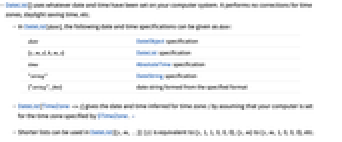
- DateList[] uses whatever date and time have been set on your computer system. It performs no corrections for time zones, daylight saving time, etc.
- In DateList[date], the following date and time specifications can be given as date:
-
date DateObject specification {y,m,d,h,m,s} DateList specification time AbsoluteTime specification "string" DateString specification {"string",fmt} date string formed from the specified format - DateList[TimeZone->z] gives the date and time inferred for time zone z by assuming that your computer is set for the time zone specified by $TimeZone. »
- Shorter lists can be used in DateList[{y,m,…}]: {y} is equivalent to {y,1,1,0,0,0}, {y,m} to {y,m,1,0,0,0}, etc.
- Values of m, d, h, m, s outside their normal ranges are appropriately reduced. Noninteger values of d, h, m, s can also be used. »
- You can compare two lists returned by DateList using NumericalOrder. »
- In the form DateList[{"string",{"e1","e2",…}}], the "ei" can be "Year", "YearShort", "Quarter", "Month", "MonthName", "Day", "DayName", "Hour", "Hour12", "AMPM", "Minute", "Second", or "Millisecond".
- DateList[{"string",{"e1","e2",…}}] uses the "ei" to fill in elements of {y,m,d,h,m,s}. Those not filled in are taken to have default values {yc,1,1,0,0,0}, where yc is the current year. »
- In DateList[{"string",{"e1","e2",…}}], the "ei" are extracted from "string" in the order given, and can be separated by any non-alphanumeric characters. »
- DateList[{"string",{"e1","sep12","e2","sep23",…}}] extracts elements using the explicit separators specified. »
Examples
open allclose allBasic Examples (6)
Scope (6)

Options (1)
Properties & Relations (4)
DateObject represents a date specification:
AbsoluteTime represents dates as seconds since the beginning of 1900:
DateList represents dates as lists of date elements:
DateString represents dates as strings:
Use DateListPlot to plot data with date list  coordinates:
Use DatePlus to add time units to a date list:
Use DateDifference to find the number of time units between dates:
Use NumericalOrder to determine the order of dates:
The canonicalization performed by DateList is significant:


Text
Wolfram Research (2007), DateList, Wolfram Language function, https://reference.wolfram.com/language/ref/DateList.html (updated 2014).
CMS
Wolfram Language. 2007. "DateList." Wolfram Language & System Documentation Center. Wolfram Research. Last Modified 2014. https://reference.wolfram.com/language/ref/DateList.html.
APA
Wolfram Language. (2007). DateList. Wolfram Language & System Documentation Center. Retrieved from https://reference.wolfram.com/language/ref/DateList.html