


FindMinValue
FindMinValue[f,x]
gives the value at a local minimum of f.
FindMinValue[f,{x,x0}]
gives the value at a local minimum of f, found by a search starting from the point x=x0.
FindMinValue[f,{{x,x0},{y,y0},…}]
gives the value at a local minimum of a function of several variables.
FindMinValue[{f,cons},{{x,x0},{y,y0},…}]
gives the value at a local minimum subject to the constraints cons.
FindMinValue[{f,cons},{x,y,…}]
starts from a point within the region defined by the constraints.
Details and Options
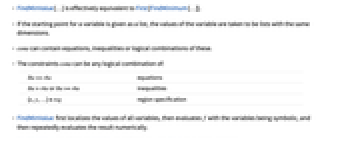
- FindMinValue[…] is effectively equivalent to First[FindMinimum[…]].
- If the starting point for a variable is given as a list, the values of the variable are taken to be lists with the same dimensions.
- cons can contain equations, inequalities or logical combinations of these.
- The constraints cons can be any logical combination of:
-
lhs==rhs equations lhs>rhs or lhs>=rhs inequalities {x,y,…}∈reg region specification - FindMinValue first localizes the values of all variables, then evaluates f with the variables being symbolic, and then repeatedly evaluates the result numerically.
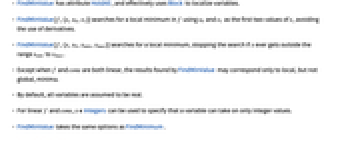
- FindMinValue has attribute HoldAll, and effectively uses Block to localize variables.
- FindMinValue[f,{x,x0,x1}] searches for a local minimum in f using x0 and x1 as the first two values of x, avoiding the use of derivatives.
- FindMinValue[f,{x,x0,xmin,xmax}] searches for a local minimum, stopping the search if x ever gets outside the range xmin to xmax.
- Except when f and cons are both linear, the results found by FindMinValue may correspond only to local, but not global, minima.
- By default, all variables are assumed to be real.
- For linear f and cons, x∈Integers can be used to specify that a variable can take on only integer values.
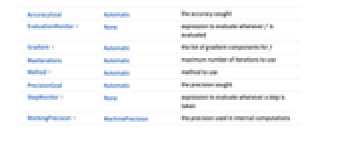
- FindMinValue takes the same options as FindMinimum.
List of all options
Examples
open allclose allBasic Examples (4)
Scope (12)
With different starting points, get the values of different local minima:
Value at a local minimum of a two-variable function starting from x=2, y=2:
Value at a local minimum constrained within a disk:
Starting point does not have to be provided:
For linear objective and constraints, integer constraints can be imposed:
Or constraints can be specified:
Find the minimum value of a function over a geometric region:
Find the minimum distance between two regions:
Find the minimum  such that the triangle and ellipse still intersect:
Find the minimum radius of a disk that contains the given three points:
Using Circumsphere gives the same result directly:
Use  to specify that
  is a vector in
  :
:
Options (8)
AccuracyGoal & PrecisionGoal (2)
This enforces convergence criteria  and
and  :
:
This enforces convergence criteria  and
and  :
:

Setting a high WorkingPrecision makes the process convergent:
Method (1)
In this case, the default derivative-based methods have difficulties:

Direct search methods that do not require derivatives can be helpful in these cases:
NMinimize also uses a range of direct search methods:
StepMonitor (1)
Steps taken by FindMinValue in finding the minimum of a function:
WorkingPrecision (1)
Set the working precision to  ; by default, AccuracyGoal and PrecisionGoal are set to
  :
:
Properties & Relations (1)
FindMinimum gives both the value of the minimum and the minimizing argument:
FindArgMin gives the location of the minimum as a list:
FindMinValue gives the value at the minimum:
Possible Issues (4)
If the constraint region is empty, the algorithm will not converge:

If the minimum value is not finite, the algorithm will not converge:


Integer linear programming algorithm is only available for machine-number problems:

Sometimes providing a suitable starting point can help the algorithm to converge:
Text
Wolfram Research (2008), FindMinValue, Wolfram Language function, https://reference.wolfram.com/language/ref/FindMinValue.html (updated 2014).
CMS
Wolfram Language. 2008. "FindMinValue." Wolfram Language & System Documentation Center. Wolfram Research. Last Modified 2014. https://reference.wolfram.com/language/ref/FindMinValue.html.
APA
Wolfram Language. (2008). FindMinValue. Wolfram Language & System Documentation Center. Retrieved from https://reference.wolfram.com/language/ref/FindMinValue.html