


PadLeft
PadLeft[list,n]
makes a list of length n by padding list with zeros on the left.
PadLeft[list,n,x]
pads by repeating the element x.
PadLeft[list,n,{x1,x2,…}]
pads by cyclically repeating the elements xi.
PadLeft[list,n,padding,m]
leaves a margin of m elements of padding on the right.
PadLeft[list,{n1,n2,…}]
makes a nested list with length ni at level i.
PadLeft[list]
pads a ragged array list with zeros to make it full.
Details
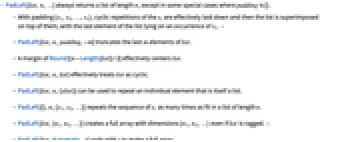
- PadLeft[list,n,…] always returns a list of length n, except in some special cases where padding is {}.
- With padding {x1,x2,…,xs}, cyclic repetitions of the xi are effectively laid down and then the list is superimposed on top of them, with the last element of the list lying on an occurrence of xs. »
- PadLeft[list,n,padding,-m] truncates the last m elements of list.
- A margin of Round[(n-Length[list])/2] effectively centers list.
- PadLeft[list,n,list] effectively treats list as cyclic.
- PadLeft[list,n,{xlist}] can be used to repeat an individual element that is itself a list.
- PadLeft[{},n,{x1,x2,…}] repeats the sequence of xi as many times as fit in a list of length n.
- PadLeft[list,{n1,n2,…}] creates a full array with dimensions {n1,n2,…} even if list is ragged. »
- PadLeft[list,Automatic,x] pads with x to make a full array.
- Negative ni specify to pad on the right.
- PadLeft[list,{n1,n2},{{x11,x12,…},{x21,…},…}] pads by repeating the block of xij.
- PadLeft[list,{n1,n2,…},list] effectively treats list as cyclic in every dimension.
- PadLeft[list,{n1,n2,…},padding,{m1,m2,…}] uses margin mi at level i.
- The object list need not have head List.
- PadLeft can be used on SparseArray objects.
Examples
open allclose allBasic Examples (6)
Scope (3)
Generalizations & Extensions (1)
Use a head other than List:
Applications (3)
Properties & Relations (1)
Text
Wolfram Research (1999), PadLeft, Wolfram Language function, https://reference.wolfram.com/language/ref/PadLeft.html (updated 2007).
CMS
Wolfram Language. 1999. "PadLeft." Wolfram Language & System Documentation Center. Wolfram Research. Last Modified 2007. https://reference.wolfram.com/language/ref/PadLeft.html.
APA
Wolfram Language. (1999). PadLeft. Wolfram Language & System Documentation Center. Retrieved from https://reference.wolfram.com/language/ref/PadLeft.html