
#n
represents the n  argument.
Slot
#
represents the first argument supplied to a pure function.
#n
represents the n  argument.
#name
represents the value associated with key "name" in an association in the first argument.
Details
- # is used to represent arguments or formal parameters in pure functions of the form body& or Function[body].
- # is equivalent to #1 or Slot[1].
- #n is equivalent to Slot[n]. n must be a non‐negative integer.
- #0 gives the head of the function, i.e. the pure function itself.
- When applied to an association, #name is equivalent to #["name"] and picks out elements in the association.
- In the form #name, the characters in name can be any combination of alphanumeric characters not beginning with digits.
- #"name" is equivalent to #name when name is a valid symbol name. #"name" can be additionally used for values of name that have whitespace, punctuation or other characters that would not work with #name.
Background & Context
- Slot[1] represents the first argument supplied to a pure function. The expression Slot[1] may be compactly denoted with the hash character
 , or more explicitly as
  . The
. The 
 argument to a pure function is represented by Slot[n], commonly denoted
  . The zeroth slot
  of a pure function is its head.
 - Slot is typically used inside Function. In pure functions of the form
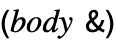 , # is used as part of the
  to represent arguments or formal parameters. An example application of Slot is given by
 ![f[#3,#2,#1]&[x,y,z]](Files/Slot.en/10.png "f[#3,#2,#1]&[x,y,z]") , which evaluates to
, which evaluates to ![f[z,y,x]](Files/Slot.en/11.png "f[z,y,x]") .
. - A sequence of arguments to be supplied to a pure function is represented using SlotSequence (written in shorthand as ##n).
- When pure functions are nested, the meaning of slots may become ambiguous, in which case parameters must be specified using an explicit Function construction with named parameters.
Examples
open all close allBasic Examples (3)
Scope (6)
# is short for #1, the first argument:
#&[1, 2, 3]#1&[1, 2, 3]#name is effectively a short form of #["name"]:
#x&[<|"x" -> a, "y" -> b|>]#["x"]&[<|"x" -> a, "y" -> b|>]#name is interpreted as Slot["name"]:
#z& // FullForm#name always refers to the association in the first argument:
#y&[<|"x" -> 1, "y" -> 2|>, <|"x" -> 3, "y" -> 4|>]Extract from an association slot other than the first:
#2["y"]&[<|"x" -> 1, "y" -> 2|>, <|"x" -> 3, "y" -> 4|>]Use #"name" to specify a name with whitespace characters:
#"key one"&[<|"key one" -> 1, "key two" -> 2|>]Generalizations & Extensions (1)
Applications (1)
Properties & Relations (4)
# allows function arguments to be referenced without giving them names:
Function[u, 1 + u][x](1 + #)&[x]Additional arguments are ignored:
f[#1, #2]&[a, b, c, d]## stands for the sequence of all arguments:
{#1, #2, #3}&[a, b, c]{##}&[a, b, c]Use Apply to fill Slot expressions from a list instead of sequence of arguments:
f[#1, #2, #1]&@@{x, y}For a function that will only be used with lists, an alternative is to use a combination of Slot and Part:
f[#[[1]], #[[2]], #[[1]]]&[{x, y}]Possible Issues (3)
Use explicit names to set up nested pure functions:
Function[u, Function[v, f[u, v]]][x]Function[u, Function[v, f[u, v]]][x][y]Function[u, f[u, #]&][x]Function[u, f[u, #]&][x][y]Function[v, f[#, v]]&[x]Function[v, f[#, v]]&[x][y]Using nested # notation behaves differently:
f[#, #]& &[x]f[#, #]& &[x][y]If too few arguments are provided, a message is generated:
f[#4]&[a, b, c]
f[#4]&[a, b, c, d]A space between # and the following token will be interpreted as multiplication:
# 2 //InputForm# name //InputForm
 Fast Introduction for Programmers: Pure Functions
 Fast Introduction for Programmers: Associations
 An Elementary Introduction to the Wolfram Language
 NKS|Online
Text
Wolfram Research (1988), Slot, Wolfram Language function, https://reference.wolfram.com/language/ref/Slot.html (updated 2025).
CMS
Wolfram Language. 1988. "Slot." Wolfram Language & System Documentation Center. Wolfram Research. Last Modified 2025. https://reference.wolfram.com/language/ref/Slot.html.
APA
Wolfram Language. (1988). Slot. Wolfram Language & System Documentation Center. Retrieved from https://reference.wolfram.com/language/ref/Slot.html