

PRODUCTS
Products Overview
Mathematica
Mathematica for Students
Mathematica Home Edition
Wolfram
CDF Player
(free download)
Computable Document Format (CDF)
web
Mathematica
grid
Mathematica
Wolfram
Workbench
Mathematica
Add-Ons
Wolfram|Alpha Products
SOLUTIONS
Solutions Overview
Engineering
Aerospace Engineering & Defense
Chemical Engineering
Control Systems
Electrical Engineering
Image Processing
Industrial Engineering
Materials Science
Mechanical Engineering
Operations Research
Optics
Petroleum Engineering
Biotechnology & Medicine
Bioinformatics
Medical Imaging
Finance, Statistics & Business Analysis
Actuarial Sciences
Data Analysis & Mining
Econometrics
Economics
Financial Engineering & Mathematics
Financial Risk Management
Statistics
Software Engineering & Content Delivery
Authoring & Publishing
Interface Development
Software Engineering
Web Development
Science
Astronomy
Biological Sciences
Chemistry
Environmental Sciences
Geosciences
Social & Behavioral Sciences
Design, Arts & Entertainment
Game Design, Special Effects & Generative Art
Education
STEM Education Initiative
Higher Education
Community & Technical College Education
Primary & Secondary Education
Students
Technology
Computable Document Format (CDF)
High-Performance & Parallel Computing (HPC)
See Also: Technology Guide
PURCHASE
Online Store
Other Ways to Buy
Volume & Site Licensing
Contact Sales
Software
Service
Upgrades
Training
Books
SUPPORT
Support Overview
Knowledge Base
Learning Center
Community & Forums
Training & Free Seminars
Does My Site Have a License?
Wolfram User Portal
COMPANY
About Wolfram Research
News & Events
Wolfram Blog
Partnerships
Employment Opportunities
History of
Mathematica
Stephen Wolfram's Home Page
Contact Us
OUR SITES
All Sites
Wolfram|Alpha
Demonstrations Project
MathWorld
Integrator
Wolfram Functions Site
Mathematica Journal
Wolfram Media
Wolfram
Tones
Wolfram Science
Stephen Wolfram
DOCUMENTATION CENTER SEARCH
New to
Mathematica
?
Find your learning path
»
Mathematica
>
Mathematics and Algorithms
>
Polynomial Algebra
>
Polynomial Systems
>
SolveAlways
>
BUILT-IN MATHEMATICA SYMBOL
Eliminating Variables
Tutorials »
|
Eliminate
Solve
Reduce
PolynomialReduce
ForAll
See Also »
|
Polynomial Systems
More About »
SolveAlways
SolveAlways
gives the values of parameters that make the equations
eqns
valid for all values of the variables
vars
.
MORE INFORMATION
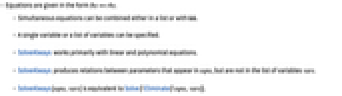
Equations are given in the form
.
Simultaneous equations can be combined either in a list or with
.
A single variable or a list of variables can be specified.
SolveAlways
works primarily with linear and polynomial equations.
SolveAlways
produces relations between parameters that appear in
eqns
, but are not in the list of variables
vars
.
SolveAlways
is equivalent to
Solve
[!
Eliminate
[!
eqns
,
vars
]]
.
EXAMPLES
CLOSE ALL
Basic Examples
(1)
Find a condition for the equation to hold for any value of
:
Find a condition for the equation to hold for any value of
:
In[1]:=
Out[1]=
Scope
(6)
A univariate polynomial equation:
A multivariate polynomial equation:
A list of polynomial equations:
An equation involving radicals:
An inequation:
Boolean combinations of equations and inequations:
Options
(1)
By default,
SolveAlways
finds exact solutions:
This computes the solutions using 20-digit numbers:
Applications
(2)
Find a condition for a cubic polynomial to have a triple root:
This solves the same problem using
Reduce
:
The same problem can also be solved using
Subresultants
and
Solve
:
Solve for undetermined coefficients in the series expansion:
Properties & Relations
(1)
Numeric solutions make the equations identically true:
An equivalent formulation using
Solve
and
Eliminate
:
An equivalent formulation using
Solve
and
Resolve
:
This solves the same problem using
Reduce
:
Possible Issues
(1)
SolveAlways
gives generic solutions:
The equations may not be identically true when parameters satisfy additional equations:
This finds conditions on parameters for which the solutions are not correct:
SEE ALSO
Eliminate
Solve
Reduce
PolynomialReduce
ForAll
TUTORIALS
Eliminating Variables
MORE ABOUT
Polynomial Systems
New in 1