


Unconstrained Optimization: Step Control
Introduction
Even with Newton's method where the local model is based on the actual Hessian, unless you are close to a root or minimum, the model step may not bring you any closer to the solution. A simple example is given by the following problem.
A good step-size control algorithm will prevent repetition or escape from areas near roots or minima from happening. At the same time, however, when steps based on the model function are appropriate, the step-size control algorithm should not restrict them, otherwise the convergence rate of the algorithm would be compromised. Two commonly used step-size control algorithms are line search and trust region methods. In a line search method, the model function gives a step direction, and a search is done along that direction to find an adequate point that will lead to convergence. In a trust region method, a distance in which the model function will be trusted is updated at each step. If the model step lies within that distance, it is used; otherwise, an approximate minimum for the model function on the boundary of the trust region is used. Generally the trust region methods are more robust, but they require more numerical linear algebra.
Both step control methods were developed originally with minimization in mind. However, they apply well to finding roots for nonlinear equations when used with a merit function. In the Wolfram Language, the 2-norm merit function  is used.
Line Search Methods
A method like Newton's method chooses a step, but the validity of that step only goes as far as the Newton quadratic model for the function really reflects the function. The idea of a line search is to use the direction of the chosen step, but to control the length, by solving a one-dimensional problem of minimizing

where  is the search direction chosen from the position
  . Note that

so if you can compute the gradient, you can effectively do a one-dimensional search with derivatives.
Typically, an effective line search only looks toward  since a reasonable method should guarantee that the search direction is a descent direction, which can be expressed as
  .
.
It is typically not worth the effort to find an exact minimum of  since the search direction is rarely exactly the right direction. Usually it is enough to move closer.
One condition that measures progress is called the Armijo or sufficient decrease condition for a candidate  .
.

Often with this condition, methods will converge, but for some methods, Armijo alone does not guarantee convergence for smooth functions. With the additional curvature condition

many methods can be proven to converge for smooth functions. Together these conditions are known as the strong Wolfe conditions. You can control the parameters  and
and  with the "DecreaseFactor"->μ and "CurvatureFactor"->η options of "LineSearch".
The default value for "CurvatureFactor"->η is  , except for Method->"ConjugateGradient" where
  is used since the algorithm typically works better with a closer-to-exact line search. The smaller
  is, the closer to exact the line search is.
If you look at graphs showing iterative searches in two dimensions, you can see the evaluations spread out along the directions of the line searches. Typically, it only takes a few iterations to find a point satisfying the conditions. However, the line search is not always able to find a point that satisfies the conditions. Usually this is because there is insufficient precision to compute the points closely enough to satisfy the conditions, but it can also be caused by functions that are not completely smooth or vary extremely slowly in the neighborhood of a minimum.

This runs into problems because the real differences in the function are negligible compared to evaluation differences around the point, as can be seen from the plot.
Sometimes it can help to subtract out the constants so that small changes in the function are more significant.

In this case, however, the approximation is only slightly closer because the function is quite noisy near 0, as can be seen from the plot.
Thus, to get closer to the correct value of zero, higher precision is required to compute the function more accurately.
For some problems, particularly where you may be starting far from a root or a local minimum, it may be desirable to restrict steps. With line searches, it is possible to do this by using the "MaxRelativeStepSize" method option. The default value picked for this is designed to keep searches from going wildly out of control, yet at the same time not prevent a search from using reasonably large steps if appropriate.
Note that you need to be careful not to set the "MaxRelativeStepSize" option too small, or it will affect convergence, especially for minima and roots near zero.
The following table shows a summary of the options, which can be used to control line searches.
option name | default value | |
| "Method" | Automatic | method to use for executing the line search; can be Automatic, "MoreThuente", "Backtracking", or "Brent" |
| "CurvatureFactor" | Automatic | factor  in the Wolfe conditions, between 0 and 1; smaller values of in the Wolfe conditions, between 0 and 1; smaller values of  result in a more exact line search result in a more exact line search |
| "DecreaseFactor" | 1/10000 | factor  in the Wolfe conditions, between 0 and in the Wolfe conditions, between 0 and  |
| "MaxRelativeStepSize" | 10 | largest step that will be taken relative to the norm of the current search point, can be any positive number or  for no restriction for no restriction |
Method options for "StepControl"->"LineSearch".
The following sections will describe the three line search algorithms implemented in the Wolfram Language. Comparisons will be made using the Rosenbrock function.
MoreThuente
The default line search used by FindMinimum, FindMaximum, and FindFit is one described by More and Thuente in [MT94]. It tries to find a point that satisfies both the decrease and curvature conditions by using bracketing and quadratic and cubic interpolation.
The points at which only the function and gradient were evaluated were the ones attempted in the line search phase that did not satisfy both conditions. Unless restricted by "MaxRelativeStepSize", the line search always starts with the full step length ( ), so that if the full (in this case Newton) step satisfies the line search criteria, it will be taken, ensuring a full convergence rate close to a minimum.
Decreasing the curvature factor, which means that the line search ends nearer to the exact minimum, decreases the number of steps taken by Newton's method but increases the total number of function and gradient evaluations.
This example demonstrates why a more exact line search is not necessarily better. When the line search takes the step to the right at the bottom of the narrow valley, the Newton step is based on moving along the valley without seeing its curvature (the curvature of the valley is beyond quadratic order), so the Newton steps end up being far too long, even though the direction is better. On the other hand, some methods, such as the conjugate gradient method, need a better line search to improve convergence.
Backtracking
This is a simple line search that starts from the given step size and backtracks toward a step size of 0, stopping when the sufficient decrease condition is met. In general with only backtracking, there is no guarantee that you can satisfy the curvature condition, even for nice functions, so the convergence properties of the methods are not assured. However, the backtracking line search also does not need to evaluate the gradient at each point, so if gradient evaluations are relatively expensive, this may be a good choice. It is used as the default line search in FindRoot because evaluating the gradient of the merit function involves computing the Jacobian, which is relatively expensive.
Each backtracking step is taken by doing a polynomial interpolation and finding the minimum point for the interpolant. This point  is used as long as it lies between
  and
and  where
where  is the previous value of the parameter α and
  . By default,
  and
and 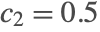 , but they can be controlled by the method option "BacktrackFactors"->{c1,c2}. If you give a single value for the factors, this sets
  , and no interpolation is used. The value 1/2 gives bisection.
option name | default value | |
| "BacktrackFactors" | {1/10, 1/2} | determine the minimum and maximum factor by which the attempted step length must shrink between backtracking steps |
Method option for line search Method->"Backtracking".
Brent
This uses the derivative-free univariate method of Brent [Br02] for the line search. It attempts to find the minimum of  to within tolerances, regardless of the decrease and curvature factors. In effect, it has two phases. First, it tries to bracket the root, then it uses Brent's combined interpolation/golden section method to find the minimum. The advantage of this line search is that it does not require, as the other two methods do, that the step be in a descent direction, since it will look in both directions in an attempt to bracket the minimum. As such it is very appropriate for the derivative-free principal axis method. The downside of this line search is that it typically uses many function evaluations, so it is usually less efficient than the other two methods.
 . Even though the number of Newton steps is relatively small in this example, the total number of function evaluations is much larger than for other line search methods:
Trust Region Methods
A trust region method has a region around the current search point, where the quadratic model

for local minimization is "trusted" to be correct and steps are chosen to stay within this region. The size of the region is modified during the search, based on how well the model agrees with actual function evaluations.
Very typically, the trust region is taken to be an ellipse such that  .
.  is a diagonal scaling (often taken from the diagonal of the approximate Hessian) and
  is the trust region radius, which is updated at each step.
When the step based on the quadratic model alone lies within the trust region, then, assuming the function value gets smaller, that step will be chosen. Thus, just as with line search methods, the step control does not interfere with the convergence of the algorithm near to a minimum where the quadratic model is good. When the step based on the quadratic model lies outside the trust region, a step just up to the boundary of the trust region is chosen, such that the step is an approximate minimizer of the quadratic model on the boundary of the trust region.
Once a step  is chosen, the function is evaluated at the new point, and the actual function value is checked against the value predicted by the quadratic model. What is actually computed is the ratio of actual to predicted reduction.

If  is close to 1, then the quadratic model is quite a good predictor and the region can be increased in size. On the other hand, if
  is too small, the region is decreased in size. When
  is below a threshold,
  , the step is rejected and recomputed. You can control this threshold with the method option "AcceptableStepRatio"->η. Typically the value of
  is quite small to avoid rejecting steps that would be progress toward a minimum. However, if obtaining the quadratic model at a point is quite expensive (e.g. evaluating the Hessian takes a relatively long time), a larger value of
  will reduce the number of Hessian evaluations, but it may increase the number of function evaluations.
To start the trust region algorithm, an initial radius  needs to be determined. By default the Wolfram Language uses the size of the step based on the model (1) restricted by a fairly loose relative step size limit. However, in some cases, this may take you out of the region you are primarily interested in, so you can specify a starting radius
  using the option "StartingScaledStepSize"->Δ0. The option contains Scaled in its name because the trust region radius works through the diagonal scaling
  , so this is not an absolute step size.
The plot looks quite bad because the search has extended over such a large region that the fine structure of the function cannot really be seen on that scale.
 . Here the search stays much closer to the initial condition and follows the narrow valley:
It is also possible to set an overall maximum bound for the trust region radius by using the option "MaxScaledStepSize"->Δmax so that for any step, Δk≤Δmax.
Trust region methods can also have difficulties with functions which are not smooth due to problems with numerical roundoff in the function computation. When the function is not sufficiently smooth, the radius of the trust region will keep getting reduced. Eventually, it will get to the point at which it is effectively zero.

The message means that the size of the trust region has become effectively zero relative to the size of the search point, so steps taken would have negligible effect. Note: On some platforms, due to subtle differences in machine arithmetic, the message may not show up. This is because the reasons leading to the message have to do with numerical uncertainty, which can vary between different platforms.

The plot along one direction makes it fairly clear why no more improvement is possible. Part of the reason the Levenberg–Marquardt method gets into trouble in this situation is that convergence is relatively slow because the residual is nonzero at the minimum. With Newton's method, the convergence is faster, and the full quadratic model allows for a better estimate of step size, so that FindMinimum can have more confidence that the default tolerances have been satisfied.
The following table summarizes the options for controlling trust region step control.
option name | default value | |
| "AcceptableStepRatio" | 1/10000 | the threshold  , such that when the actual to prediction reduction , such that when the actual to prediction reduction  , the search is moved to the computed step , the search is moved to the computed step |
| "MaxScaledStepSize" | ∞ | the value  , such that the trust region size , such that the trust region size  for all steps for all steps |
| "StartingScaledStepSize" | Automatic | the initial trust region size  |