
CanonicalWarpingCorrespondence
CanonicalWarpingCorrespondence[s1,s2]
gives the canonical time warping (CTW) correspondence between sequences s1 and s2.
CanonicalWarpingCorrespondence[s1,s2,warp]
uses warp as initial warping correspondence.
CanonicalWarpingCorrespondence[s1,s2,warp,win]
uses a window win for local search.
Details and Options
- Canonical time warping (CTW) iteratively performs spatial transformations and dynamic time warping on the reference sequence s1 and the query sequence s2 to find the alignment with minimal distance between sequences.
- The sequences si can be lists of numeric scalars or vectors. In contrast to dynamic time warping, elements of s1 and s2 can be of different dimensions.
- CanonicalWarpingCorrespondence returns {{n1,…,nk},{m1,…,mk}} of non-decreasing positions such that s1〚ni〛 correspond to s2〚mi〛.
- Corresponding positions attempt to minimize the distance
 over all possible such positions and with the constraint that all elements of s1 and s2 are represented as some s1〚ni〛 and s2〚mj〛, respectively.
 - Spatial transformation matrices α and β are computed in each iteration using canonical correlation analysis.
- Compute the effective distance using CanonicalWarpingDistance.
- Possible settings for the search window win are:
-
Automatic a full search 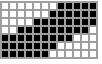
r a slanted band window of radius 
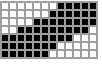
{"SlantedBand",r} a slanted band window of radius 
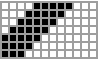
{"Band",r} band window of radius  (Sakoe–Chiba)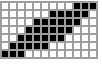
{"Parallelogram",a} parallelogram window placed at origin with slopes  and
and  (Itakura)
 - The following options are supported:
-
DistanceFunction Automatic distance function used in dynamic time warping MaxIterations Automatic maximal number of iterations Method Automatic additional parameters - The following options are available through Method->opts:
-
"DimensionsToKeep" Automatic dimensions after projection "EnergyThreshold" Automatic fraction of "energy" to be kept "Lambdas" Automatic regularization values "MatchingIntervals" Automatic whether to match the query to the full reference or part of the reference - Possible settings for the "MatchingIntervals" option include:
-
Automatic a full match "Flexible" flexible at both ends "FlexibleEnd" flexible only at the end of the interval
Examples
open all close allBasic Examples (2)
Find the canonical time warping correspondence between two scalar sequences:
CanonicalWarpingCorrespondence[{1, 2, 3, 1}, {8, 8, 7, 7}]Find the canonical time warping correspondence between a 3D path and a 2D line segment:
CanonicalWarpingCorrespondence[{{0, 0, 0}, {1, 1, 2}, {3, 5, 5}, {1, 3, 7}}, {{0, 0}, {4, 4}}]Scope (9)
Data (6)
Find the correspondence between two sequences of numerical scalars with different length:
CanonicalWarpingCorrespondence[{1, 1, 1, 2, 2, 3, 4}, {11, 13, 17, 19}]Find the correspondence between two sequences of vectors:
CanonicalWarpingCorrespondence[{{0, 0}, {-1, 0}, {-1, 1}}, {{-1, 2}, {1, -2}, {0, 7}}]Find the correspondence between a sequence of scalars and a sequence of 3D points:
CanonicalWarpingCorrespondence[{1, 1, 1, 2, 2, 3, 4}, {{-1, -2, -3}, {1, 2, 3}, {0, 0, 0}}]//TextGridFind the correspondence between two sequences of quantities with compatible units:
s1 = QuantityArray[{1, 2.5, 4}, "Decimeters"];
s2 = {Quantity[0.1, "Kilometers"], Quantity[200, "Inches"]};CanonicalWarpingCorrespondence[s1, s2]All units are converted to base SI units:
CanonicalWarpingCorrespondence[s1, s2] == CanonicalWarpingCorrespondence[UnitConvert[s1], UnitConvert[s2]]Find the correspondence between two sequences of quantity vectors with compatible units:
s1 = QuantityArray[{{1, 2.5}, {4, 5}, {5, 4}}, {"Seconds", "Minutes"}]s2 = Table[Quantity[(i + j) / 60, "Hours"], {i, 5}, {j, 2}]CanonicalWarpingCorrespondence[s1, s2]//TextGridFind the correspondence between a sequence of quantities and a sequence of scalars:
squant = QuantityArray[{1, 2.5, 4, 5}, "Kilometers"];
sscal = {500, 400, 300};CanonicalWarpingCorrespondence[squant, sscal]//TextGridThe scalars are interpreted as if they had a compatible unit from SI base units:
CanonicalWarpingCorrespondence[squant, QuantityArray[sscal, "meters"]]//TextGridInitial Warping (1)
By default, the shorter sequence is first warped uniformly to match the length of the longer sequence:
s1 = {1, 2, 3, 4, 5, 6, 7, 8, 9, 10, 11, 12, 13};
s2 = {1, 1, 1, 1, 1, 2, 3, 7, 8, 9, 10};CanonicalWarpingCorrespondence[s1, s2]Construct the initial uniform warping manually:
CanonicalWarpingCorrespondence[s1, s2, {Range[Length[s1]], ArrayResample[Range[Length[s2]], Length[s1], Resampling -> "NearestLeft"]}]Search Window (2)
By default, an unconstrained search is performed:
s1 = {1, 2, 3, 4, 5, 6, 7, 8, 9, 10, 11, 12, 13};
s2 = {1, 1, 1, 1, 1, 2, 3, 4, 5, 6, 7, 8, 9, 10};CanonicalWarpingCorrespondence[s1, s2]Use a "SlantedBand" search window:
s1 = {1, 2, 3, 4, 5, 6, 7, 8, 9, 10, 11, 12, 13};
s2 = {1, 1, 1, 1, 1, 2, 3, 4, 5, 6, 7, 8, 9, 10};CanonicalWarpingCorrespondence[s1, s2, Automatic, {"SlantedBand", 1}]Options (1)
MaxIterations (1)
By default, the maximal number of iterations is 50:
s1 = Table[{7t * Cos[1.8t], 3t * Sin[1.8t]}, {t, Range[0, 4Pi, 4Pi / 650]}];
s2 = Table[{5t * Cos[t], -3t * Sin[t]}, {t, Range[0, 6Pi, 6Pi / 500]}];
Graphics[{{Red, Point[s1]}, {Blue, Point[s2]}}]AbsoluteTiming[CanonicalWarpingCorrespondence[s1, s2];]Decreasing the maximal number of iterations may reduce the timing:
AbsoluteTiming[CanonicalWarpingCorrespondence[s1, s2, MaxIterations -> 20];]Properties & Relations (1)
Canonical time warping is robust to spatial transformations.
s1 = Table[{Cos[0.6t] * Cos[t], Cos[0.6t] * Sin[t]}, {t, 0, 6Pi, 2Pi / 100}];
s2 = TranslationTransform[{2, 2}] /@ s1;ListLinePlot[{s1, s2}]CanonicalWarpingCorrespondence[s1, s2]//ListLinePlots1 = Table[{2Cos[t], Sin[t]}, {t, 0, 2Pi, 2Pi / 20}];
s2 = 3s1;
ListLinePlot[{s1, s2}]CanonicalWarpingCorrespondence[s1, s2]//ListLinePlots1 = Table[{Cos[3t] * Cos[t], Cos[3t] * Sin[t]}, {t, 0, 2Pi, 2Pi / 100}];
s2 = RotationTransform[Pi] /@ s1;ListLinePlot[{s1, s2}]CanonicalWarpingCorrespondence[s1, s2]//ListLinePlotText
Wolfram Research (2016), CanonicalWarpingCorrespondence, Wolfram Language function, https://reference.wolfram.com/language/ref/CanonicalWarpingCorrespondence.html.
CMS
Wolfram Language. 2016. "CanonicalWarpingCorrespondence." Wolfram Language & System Documentation Center. Wolfram Research. https://reference.wolfram.com/language/ref/CanonicalWarpingCorrespondence.html.
APA
Wolfram Language. (2016). CanonicalWarpingCorrespondence. Wolfram Language & System Documentation Center. Retrieved from https://reference.wolfram.com/language/ref/CanonicalWarpingCorrespondence.html