

PRODUCTS
Products Overview
Mathematica
Mathematica for Students
Mathematica Home Edition
Wolfram
CDF Player
(free download)
Computable Document Format (CDF)
web
Mathematica
grid
Mathematica
Wolfram
Workbench
Mathematica
Add-Ons
Wolfram|Alpha Products
SOLUTIONS
Solutions Overview
Engineering
Aerospace Engineering & Defense
Chemical Engineering
Control Systems
Electrical Engineering
Image Processing
Industrial Engineering
Materials Science
Mechanical Engineering
Operations Research
Optics
Petroleum Engineering
Biotechnology & Medicine
Bioinformatics
Medical Imaging
Finance, Statistics & Business Analysis
Actuarial Sciences
Data Analysis & Mining
Econometrics
Economics
Financial Engineering & Mathematics
Financial Risk Management
Statistics
Software Engineering & Content Delivery
Authoring & Publishing
Interface Development
Software Engineering
Web Development
Science
Astronomy
Biological Sciences
Chemistry
Environmental Sciences
Geosciences
Social & Behavioral Sciences
Design, Arts & Entertainment
Game Design, Special Effects & Generative Art
Education
STEM Education Initiative
Higher Education
Community & Technical College Education
Primary & Secondary Education
Students
Technology
Computable Document Format (CDF)
High-Performance & Parallel Computing (HPC)
See Also: Technology Guide
PURCHASE
Online Store
Other Ways to Buy
Volume & Site Licensing
Contact Sales
Software
Service
Upgrades
Training
Books
SUPPORT
Support Overview
Knowledge Base
Learning Center
Community & Forums
Training & Free Seminars
Does My Site Have a License?
Wolfram User Portal
COMPANY
About Wolfram Research
News & Events
Wolfram Blog
Partnerships
Employment Opportunities
History of
Mathematica
Stephen Wolfram's Home Page
Contact Us
OUR SITES
All Sites
Wolfram|Alpha
Demonstrations Project
MathWorld
Integrator
Wolfram Functions Site
Mathematica Journal
Wolfram Media
Wolfram
Tones
Wolfram Science
Stephen Wolfram
DOCUMENTATION CENTER SEARCH
New to
Mathematica
?
Find your learning path
»
Mathematica
>
Data Manipulation
>
Importing and Exporting
>
Integer8
>
MATHEMATICA IMPORT/EXPORT FORMAT
"Binary"
"Bit"
"Byte"
"Character8"
"Character16"
"Integer16"
"Integer32"
"Integer64"
"Integer128"
"UnsignedInteger8"
"UnsignedInteger16"
"UnsignedInteger32"
"UnsignedInteger64"
"UnsignedInteger128"
"Real32"
"Real64"
"Real128"
"Complex64"
"Complex128"
"Complex256"
"String"
See Also »
|
Binary Data
Listing of All Formats
More About »
Integer8
Uniform sequence of signed 8-bit integers.
Binary data format.
Import
can read any file as a sequence of signed 8-bit integers.
Export
writes a list of integers in the range
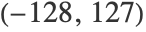
to a binary file.
IMPORT AND EXPORT
Import
imports an arbitrary file as a sequence of signed 8-bit integers, returning a packed array of integers in the range
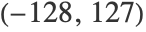
.
Export
exports a list of integers in the range
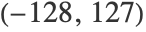
to a sequence of binary 8-bit integers.
Import
or
Import
imports the specified element from
file
.
Import
imports multiple elements.
See the reference pages for full general information on
Import
and
Export
.
ImportString
and
ExportString
support the Integer8 format.
ELEMENTS
General
Import
elements:
"Elements"
elements and options available in this file
"Rules"
full rules for each element and option
"Options"
rules for options, properties, and settings
Data representation element:
"Data"
list of integers in the range
By default,
Import
and
Export
use the
element.
Import
gives the
n
byte.
Trailing bytes are ignored if the size of the imported file is not a multiple of the data size.

OPTIONS
Import
option:
"HeaderBytes"
0
how many bytes to skip at the beginning of the file
SEE ALSO
"Binary"
"Bit"
"Byte"
"Character8"
"Character16"
"Integer16"
"Integer32"
"Integer64"
"Integer128"
"UnsignedInteger8"
"UnsignedInteger16"
"UnsignedInteger32"
"UnsignedInteger64"
"UnsignedInteger128"
"Real32"
"Real64"
"Real128"
"Complex64"
"Complex128"
"Complex256"
"String"
MORE ABOUT
Binary Data
Listing of All Formats
EXAMPLES
CLOSE ALL
Basic Examples
(1)
Convert a list of integers to a string representing binary 8-bit signed integers:
Convert the binary data back to an expression:
Import the same data, assuming it represents an array of unsigned 8-bit characters:
Convert a list of integers to a string representing binary 8-bit signed integers:
In[1]:=
Out[1]=
Convert the binary data back to an expression:
In[2]:=
Out[2]=
Import the same data, assuming it represents an array of unsigned 8-bit characters:
In[3]:=
Out[3]=