
DiscreteLQEstimatorGains[ssm,{w,v},τ]
给出过程与测量噪声协方差矩阵为 w 和 v 的连续时间的 StateSpaceModel ssm 的优化离散时间估计器增益矩阵,其中采样周期为 τ.
DiscreteLQEstimatorGains[{ssm,sensors},{w,v},τ]
指定 sensors 作为 ssm 的测量噪声.
DiscreteLQEstimatorGains[{ssm,sensors,dinputs},{w,v},τ]
指定 dinputs 作为 ssm 的确定性输入.
DiscreteLQEstimatorGains
DiscreteLQEstimatorGains[ssm,{w,v},τ]
给出过程与测量噪声协方差矩阵为 w 和 v 的连续时间的 StateSpaceModel ssm 的优化离散时间估计器增益矩阵,其中采样周期为 τ.
DiscreteLQEstimatorGains[{ssm,sensors},{w,v},τ]
指定 sensors 作为 ssm 的测量噪声.
DiscreteLQEstimatorGains[{ssm,sensors,dinputs},{w,v},τ]
指定 dinputs 作为 ssm 的确定性输入.
更多信息和选项
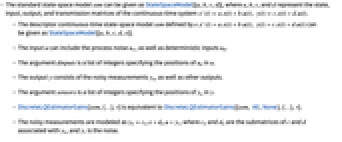
- 标准状态-空间模型 ssm 可以是 StateSpaceModel[{a,b,c,d}],其中 a、b、c 和 d 代表连续时间系统

的状态、输入、输出和传输矩阵. - 描述符连续时间状态空间模型 ssm 由
定义,可以以 StateSpaceModel[{a,b,c,d,e}] 形式给出. - 输入
可以包括过程噪声
和确定性输入
. - 参数 dinputs 是一个整数列表,指定
在
中的位置. - 输出
包括测量噪声
以及其它输出. - 参数 sensors 是一个整数列表,指定
在
中的位置. - DiscreteLQEstimatorGains[ssm,{…},τ] 等同于 DiscreteLQEstimatorGains[{ssm, All,None},{…},τ].
- 测量噪声为

,其中
和
是与
相关联的
和
的子矩阵,
是噪声. - 过程和测量噪声假设为白噪声和高斯噪声:
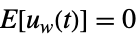
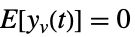
-
, 
过程噪声
, 
测量噪声 - 用具有优化增益的估计器最小化
,其中
是估计的状态向量. - DiscreteLQEstimatorGains 计算基于离散的等同的噪声矩阵上的估计器增益.
- 状态空间模型 ssm 使用零阶保持方法进行离散化处理.

范例
打开所有单元 关闭所有单元基本范例 (1)
范围 (3)
ssm = StateSpaceModel[{{{-1.7, 50, 160}, {0.22, -1.4, -32}, {0, 0, -12}},
{{-272, 0.02, 0.1}, {0, -0.0035, 0.004}, {14, 0, 0}}, {{1, 0, 0}, {0, 1, 0}},
{{0, 0, 0}, {0, 0, 0}}}, SamplingPeriod -> None, SystemsModelLabels -> None];DiscreteLQEstimatorGains[ssm, {(| | | |
| ----- | ----- | ----- |
| 0.001 | 0 | 0 |
| 0 | 0.001 | 0 |
| 0 | 0 | 0.001 |), (| | |
| - | - |
| 1 | 0 |
| 0 | 1 |)}, 0.5]//MatrixFormDiscreteLQEstimatorGains[{ssm, 2}, {(| | | |
| ----- | ----- | ----- |
| 0.001 | 0 | 0 |
| 0 | 0.001 | 0 |
| 0 | 0 | 0.001 |), (1)}, 0.5]//MatrixFormssm = StateSpaceModel[{{{0, 0, 1, 0}, {0, 0, 0, 1}, {-29.4, 19.6, 0, 0}, {14.7, -14.7, 0, 0}},
{{0, 1, 0, 0, 0}, {0, 0, 1, 0, 0}, {0, 0, 0, 1, 0}, {0.125, 0, 0, 0, 1}},
{{1, 0, 0, 0}, {0, 0, 1, 0}}, {{0, 0, 0, 0, 0}, {0, 0, 0, 0, 0}}}, SamplingPeriod -> None,
SystemsModelLabels -> None];DiscreteLQEstimatorGains[{ssm, All, {1}}, {10^6(| | | | |
| - | - | - | - |
| 1 | 0 | 0 | 0 |
| 0 | 1 | 0 | 0 |
| 0 | 0 | 1 | 0 |
| 0 | 0 | 0 | 1 |), (| | |
| - | - |
| 1 | 0 |
| 0 | 1 |)}, 0.2]DiscreteLQEstimatorGains[StateSpaceModel[{{{-0.3, 0.65, 0}, {0, -1, 1}, {0.25, -0.5, -0.6}},
{{-1, 0}, {0.5, 0}, {0.7, -0.6}}, {{1, 0, 0}, {0, -1, -1}}, {{0, 0}, {0, 0}},
{{3, 0, 0}, {0, 5, 0}, {0, 0, 0}}}, SamplingPeriod -> None, SystemsModelLabels -> None], {(| | |
| -- | -- |
| 1. | 0. |
| 0 | 2. |), (| | |
| -- | -- |
| 5. | .1 |
| .1 | 3. |)}, .1]属性和关系 (1)
使用 DiscreteLQEstimatorGains 求估值器增益:
ssm = StateSpaceModel[{{{0, 1, 0}, {-1, -1, 0}, {0, 0, -1}}, {{0, 0}, {1, 0}, {0, 1}}, {{2, 1, 1}},
{{0, 0}}}, SamplingPeriod -> None, SystemsModelLabels -> None];Subscript[l, 1] = DiscreteLQEstimatorGains[{ssm, All, 1}, {(16), (1)}, 0.5]//Chopkalman1 = StateOutputEstimator[{ToDiscreteTimeModel[ssm, 0.5, Method -> "ZeroOrderHold"], All, 1}, Subscript[l, 1]];kalman2 = ToDiscreteTimeModel[KalmanEstimator[{ssm, All, 1}, {(16), (1)}], 0.5, Method -> "ZeroOrderHold"];pnoise = Interpolation[Thread[{Range[0, 20], RandomReal[NormalDistribution[0, 4], {21}]}], t];mnoise = Interpolation[Thread[{Range[0, 20], RandomReal[NormalDistribution[0, 1], {21}]}], t];noisyout = OutputResponse[ssm, {UnitStep[t], pnoise}, {t, 20}] + mnoise;res1 = OutputResponse[kalman1, {UnitStep[t], noisyout[[1]]}, {t, 20}];res2 = OutputResponse[kalman2, {UnitStep[t], noisyout[[1]]}, {t, 20}];Show[{ListPlot[res1, Joined -> True], ListPlot[res2, PlotStyle -> Dashed, Joined -> True]}, PlotRange -> All]可能存在的问题 (1)
DiscreteLQEstimatorGains[StateSpaceModel[{{{-1, 0, 0}, {0, 2, 0}, {0, 0, 3}}, {{1, 1}, {-1, 0}, {0, 1}},
{{1, 0, 0}, {0, 0, 1}}, {{0, 0}, {0, 0}}}, SamplingPeriod -> None, SystemsModelLabels -> None], {(| | |
| - | - |
| 1 | 0 |
| 0 | 1 |), (| | |
| - | - |
| 1 | 0 |
| 0 | 1 |)}, 0.1]相关指南
文本
Wolfram Research (2010),DiscreteLQEstimatorGains,Wolfram 语言函数,https://reference.wolfram.com/language/ref/DiscreteLQEstimatorGains.html (更新于 2012 年).
CMS
Wolfram 语言. 2010. "DiscreteLQEstimatorGains." Wolfram 语言与系统参考资料中心. Wolfram Research. 最新版本 2012. https://reference.wolfram.com/language/ref/DiscreteLQEstimatorGains.html.
APA
Wolfram 语言. (2010). DiscreteLQEstimatorGains. Wolfram 语言与系统参考资料中心. 追溯自 https://reference.wolfram.com/language/ref/DiscreteLQEstimatorGains.html 年
BibTeX
@misc{reference.wolfram_2026_discretelqestimatorgains, author="Wolfram Research", title="{DiscreteLQEstimatorGains}", year="2012", howpublished="\url{https://reference.wolfram.com/language/ref/DiscreteLQEstimatorGains.html}", note=[Accessed: 18-August-2026]}
BibLaTeX
@online{reference.wolfram_2026_discretelqestimatorgains, organization={Wolfram Research}, title={DiscreteLQEstimatorGains}, year={2012}, url={https://reference.wolfram.com/language/ref/DiscreteLQEstimatorGains.html}, note=[Accessed: 18-August-2026]}