
EstimatedBackground[data]
data の背景を推定する.
EstimatedBackground[data,σ]
峰をスケール σ まで保存しようとする.
EstimatedBackground
EstimatedBackground[data]
data の背景を推定する.
EstimatedBackground[data,σ]
峰をスケール σ まで保存しようとする.
詳細とオプション
- EstimatedBackgroundは,入力リストの特徴を保存しようとしつつ,背景またはベースラインを推定する.
- 入力 data には次の形式が使える.
-
{y1,y2,…} 値のリスト TimeSeries[…] 時系列オブジェクト EventSeries[…] 事象系列オブジェクト - 使用可能なオプション
-
Method Automatic 使用するメソッド Padding "Reversed" 使用する充填方法 - EstimatedBackgroundはMethodオプションを取る.以下は可能な設定値である.
-
"MovingAverage" 移動平均背景推定 {"SNIP",r} 統計に敏感な非線形反復峰切取り
例題
すべて開く すべて閉じる例 (2)
data = {2, 1, 3, 5, 6, 6, 4, 3, 2, 4, 7, 3, 2, 4, 2, 2, 1};base = EstimatedBackground[data]ListLinePlot[{data, base}]もとのデータからベースラインを除き,リストを視覚的に比較する:
ListLinePlot[{data, data - base}]data = Table[Sin[i] + .1Sin[10 i], {i, 0, 2Pi, 0.01}];
ListLinePlot[{data, EstimatedBackground[data]}]スコープ (4)
背景はスケールに依存する.デフォルトで,自動計算されたスケールが使われる:
data = FinancialData["GE", {"Jun 2010", "Jan 2011"}, "Value"];ListLinePlot[{data, EstimatedBackground[data]}]ListLinePlot[{data, EstimatedBackground[data, 0]}]ListLinePlot[{data, EstimatedBackground[data, 10]}]list = Range[5, 20, 5];
ListLinePlot[Prepend[EstimatedBackground[data, #]& /@ list, data], PlotLegends -> Prepend["σ = " <> ToString[#]& /@ list, "Original"], Filling -> Table[i -> {i + 1}, {i, 1, Length[list]}]]Quantityオブジェクトのベースラインを推定する:
data = WeatherData["New York", "Temperature", {"2010", "2012", "Month"}, "Value"]EstimatedBackground[data]等間隔TimeSeriesオブジェクトのベースラインを推定する:
ts = TimeSeries[FinancialData["MSFT", "Jan. 1, 2008"], TemporalRegularity -> True]base = EstimatedBackground[ts]DateListPlot[{ts, EstimatedBackground[ts]}]不規則にサンプルされたTimeSeriesオブジェクトのベースラインを推定する:
v = {2, 1, 6, 5, 7, 4};
t = {1, 2, 5, 10, 12, 15};
ts = TimeSeries[v, {t}]RegularlySampledQ[ts]EstimatedBackground[ts]DateListPlot[{ts, %}]オプション (1)
アプリケーション (2)
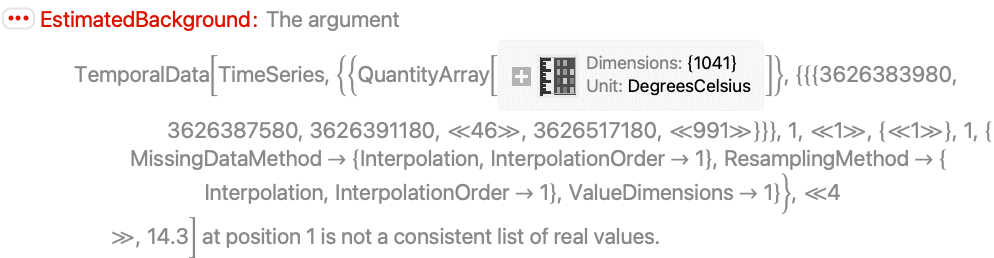
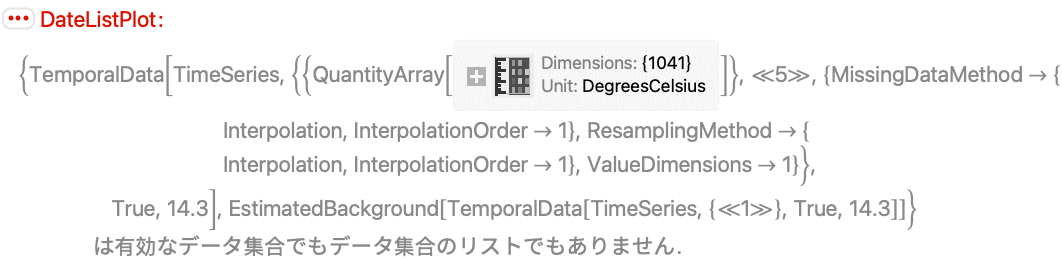
data = WolframAlpha["sunspot", {{"SunspotsPartialTimeSeries:SpaceWeatherData", 1}, "TimeSeriesData"}][[All, 2]];bg = EstimatedBackground[data];ListLinePlot[{data, bg}, AspectRatio -> 1 / 3]ListLinePlot[data - bg, AspectRatio -> 1 / 3]temp = WeatherData["Chicago", "Temperature", {{2014, 12, 1, 0, 0}, {2014, 12, 31, 23, 59}, All}]DateListPlot[temp]このプロットは,データに欠測値があることを示している.MissingDataMethodを指定し,背景を推定する:
res = EstimatedBackground[data = TimeSeries[temp, MissingDataMethod -> {"Interpolation", InterpolationOrder -> 1}]]DateListPlot[{data, res}]diff = TimeSeriesThread[Subtract[#[[1]], #[[2]]]&, {data, res}]DateListPlot[diff]model = TimeSeriesModelFit[TimeSeriesResample[diff]]model["Process"]特性と関係 (1)
"MovingAverage"は充填された入力のMovingAverageを計算する:
data = Table[Sin[i] + .1Sin[10 i], {i, 0, 2Pi, 0.01}];
r = 10;bg1 = EstimatedBackground[data, r, Method -> "MovingAverage"];
bg2 = MovingAverage[ArrayPad[data, r, "Reversed"], 2r + 1];bg1 == bg2関連するガイド
-
▪
- データの変換と平滑化 ▪
- 特徴検出 ▪
- 曲線のフィットと近似の関数
テキスト
Wolfram Research (2014), EstimatedBackground, Wolfram言語関数, https://reference.wolfram.com/language/ref/EstimatedBackground.html.
CMS
Wolfram Language. 2014. "EstimatedBackground." Wolfram Language & System Documentation Center. Wolfram Research. https://reference.wolfram.com/language/ref/EstimatedBackground.html.
APA
Wolfram Language. (2014). EstimatedBackground. Wolfram Language & System Documentation Center. Retrieved from https://reference.wolfram.com/language/ref/EstimatedBackground.html
BibTeX
@misc{reference.wolfram_2026_estimatedbackground, author="Wolfram Research", title="{EstimatedBackground}", year="2014", howpublished="\url{https://reference.wolfram.com/language/ref/EstimatedBackground.html}", note=[Accessed: 06-September-2026]}
BibLaTeX
@online{reference.wolfram_2026_estimatedbackground, organization={Wolfram Research}, title={EstimatedBackground}, year={2014}, url={https://reference.wolfram.com/language/ref/EstimatedBackground.html}, note=[Accessed: 06-September-2026]}