ExponentialModel


ExponentialModel
更多信息
- ExponentialModel 表示给定变量的指数函数,其格式适用于符号计算、数值计算和拟合.
- 指数模型描述的是变化与当前状态成比例的过程,如增长、衰减、弛豫以及趋近平衡.
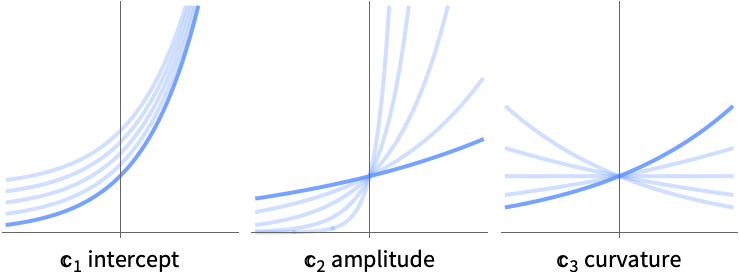
- ExponentialModel[] 的参数化形式为
 .
. - 多元指数函数参数化形式为
![TemplateBox[{1}, CTraditional] product_ie^(c_(i+1)x_i)](Files/ExponentialModel.zh/2.png "TemplateBox[{1}, CTraditional] product_ie^(c_(i+1)x_i)") .
. - 当未指定时,参数将自动使用 C[i] 枚举,变量使用 Slot 枚举.
范例
打开所有单元 关闭所有单元基本范例 (3)
ExponentialModel[]ExponentialModel[{a, b}, 1]Plot[{ExponentialModel[{0, 1, 1}, 1][{x}], ExponentialModel[{1, 1, -1}, 1][{x}], ExponentialModel[{-0.5, 1, .5}, 1][{x}]}, {x, -1, 1}]范围 (22)
变量 (6)
ExponentialModel[]ExponentialModel[][{x}]
ExponentialModel[][{x, y, z}]ModelFit 将假设变量的数量比数据点的维度少一个:
ModelFit[{{0, 0, 0}, {1, 9, 55}, {1, 1, 7}, {1, 4, 25}, {8, 9, 118}, {8, 10, 124}, {8, 5, 94}}, ExponentialModel[]]ExponentialModel[2]ExponentialModel[{var1, var2}]ExponentialModel[{var1, var2}][{a, b}]Plot3D[Evaluate@ExponentialModel[{0, 1, -0.5, .4}, 2][{x, y}], {x, -1, 1}, {y, -1, 1}, ColorFunction -> "Rainbow"]参数 (4)
ExponentialModel[2]model = ExponentialModel[ {c, A, k}, 1]model = ExponentialModel[{0, 2, k}, 1]model = ExponentialModel[{c, a -> 2, k}, 1]顺序与 C[n] 自动枚举的结果一致:
ExponentialModel[][x]求值 (5)
ExponentialModel[1][x]ExponentialModel[2][{x, y}]ExponentialModel[][x]ExponentialModel[][{x, y}]ExponentialModel[2][{{x, y}, {a, b}}]ExponentialModel[1][{{1}, {2}, {3}}]信息 (5)
Information[ExponentialModel[]]Information[ExponentialModel[{x, y}]]Information[ExponentialModel[{a, b, c}, x], "Variables"]Information[ExponentialModel[{a, b, c}, x], {"Variables", "Parameters"}]Information[ExponentialModel[1], {"Variables", "Parameters"}]应用 (1)
population = Tabular@CountryData["World", {{"Population"}, {1950, 2000}}]model = ModelFit[population, ExponentialModel[]]predictions = TransformColumns[population, {"Prediction" -> (model[#Timestamp]&)}]Show[ListLinePlot[predictions -> {"Timestamp", "Prediction"}, PlotRange -> {Automatic, {2 * 10 ^ 9, Automatic}}], ListPlot[predictions -> {"Timestamp", "Value"}, PlotStyle -> {StandardOrange, PointSize[Medium]}], AxesLabel -> {"Time (years)", "People"}, ImageSize -> Medium]model[DateObject[{2020}]]CountryData["World", {"Population", 2020}]millenniumPopulation = Tabular@CountryData["World", {{"Population"}, {2001, 2020}}]Show[ListLinePlot[TransformColumns[millenniumPopulation, {"Prediction" -> (model[#"Timestamp"]&)}] -> {"Timestamp", "Prediction"}, PlotRange -> {Automatic, {6 * 10 ^ 9, Automatic}}], ListPlot[millenniumPopulation -> {"Timestamp", "Value"}, PlotStyle -> {StandardOrange, PointSize[Medium]}], AxesLabel -> {"Time (years)", "People"}, ImageSize -> Medium]The loss starts increasing dramatically about 31 years ago, indicating that human population growth stopped being exponential in about 1995.
Wolfram Research (2026),ExponentialModel,Wolfram 语言函数,https://reference.wolfram.com/language/ref/ExponentialModel.html.
文本
Wolfram Research (2026),ExponentialModel,Wolfram 语言函数,https://reference.wolfram.com/language/ref/ExponentialModel.html.
CMS
Wolfram 语言. 2026. "ExponentialModel." Wolfram 语言与系统参考资料中心. Wolfram Research. https://reference.wolfram.com/language/ref/ExponentialModel.html.
APA
Wolfram 语言. (2026). ExponentialModel. Wolfram 语言与系统参考资料中心. 追溯自 https://reference.wolfram.com/language/ref/ExponentialModel.html 年