
FullInformationOutputRegulator
FullInformationOutputRegulator[sys,rspec]
指定 rspec を使って sys についての完全な状態情報出力調整器を与える.
FullInformationOutputRegulator[{sys,{out1,…},{in1,…}},…]
調整された出力 outi および制御された入力 inj を指定する.
詳細とオプション
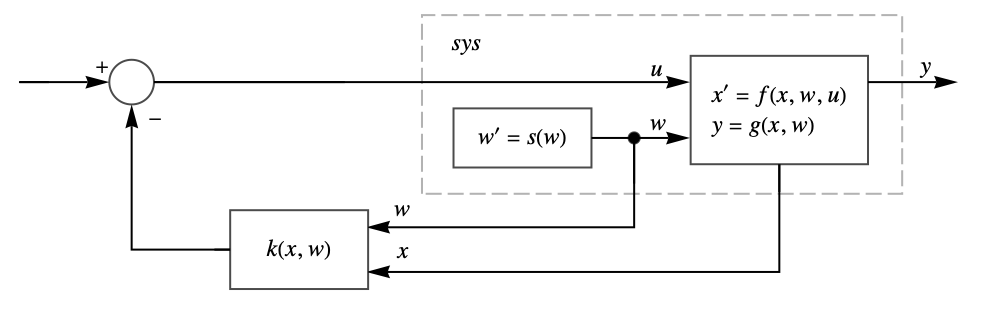
- FullInformationOutputRegulatorは,sys の出力をゼロに駆動し,一般に系に対する既知の入力を抑制したり追跡したりする調整器を返す.
- 系 sys 状態方程式
 および
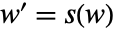 と出力
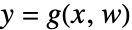 を持つとみなされる.
 は可制御入力である.状態
 は入力
 の影響を受けず,出力関数
 で示されるように,抑制または追跡のための信号のモデル化に使われる.
- 調整期がゼロに駆動する典型的な出力関数

-

状態  の影響
 を抑制する

 が
 を追跡するようにする
- 系 sys は,StateSpaceModel,AffineStateSpaceModelあるいはNonlinearStateSpaceModelでよい.
- 計算された状態フィードバック
 は,
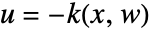 を使い,操作点付近で sys を調整する.
- 状態フィードバック
 は
 の形を取る.ただし,
 ,
 であり,
 は rspec に従って計算される.
- 使用可能な調整器指定 rspec
-
{"Poles",{p1,…}} StateFeedbackGainsで計算 {"Weights",{p,…}} LQRegulatorGainsで計算 {"Gains",κ} 明示的に与えられたゲイン - 指定 {"method",pars,opts}では,オプション opts がゲイン計算関数に渡される.
- 出力{out1,…}および入力{in1,…}は部分指定であり,デフォルトでAllであるとみなされる.
例題
すべて開く すべて閉じる例 (1)
sys = AffineStateSpaceModel[{{w + 2*Subscript[x, 1] +
Subscript[x, 2], Subscript[x, 1] - 2*Subscript[x, 2],
0}, {{1}, {0}, {0}}, {Subscript[x, 1] + Subscript[x, 2]}, {{0}}},
{{Subscript[x, 1], 0}, {Subscript[x, 2], 0}, {w, 0.5}},
{Subscript[, 1]}, {Automatic}, Automatic, SamplingPeriod -> None];

k = FullInformationOutputRegulator[sys, {"Poles", {-1, -2}}]csys = SystemsModelStateFeedbackConnect[sys, k]res1 = OutputResponse[{sys, {1, 1, 0.5}}, 0, {t, 0, 5}];
res2 = OutputResponse[{csys, {1, 1, 0.5}}, 0, {t, 0, 5}];Plot[{res1, res2}, {t, 0, 5}, PlotRange -> {0, 5}, PlotLegends -> {"unregulated", "regulated"}]スコープ (8)
FullInformationOutputRegulator[ssm = StateSpaceModel[{{{p, r}, {0, 0}}, {{b}, {0}},
{{c, 0}}, {{0}}}, SamplingPeriod -> None, SystemsModelLabels -> None], {"Poles", {Subscript[p, f]}}]SystemsModelStateFeedbackConnect[ssm, %]//Simplifyssm = StateSpaceModel[{{{p, Subscript[r, 1], Subscript[r, 2]},
{0, 0, ω}, {0, -ω, 0}}, {{b}, {0}, {0}},
{{c, 0, 0}}, {{0}}}, SamplingPeriod -> None, SystemsModelLabels -> None];Assuming[ω ∈ Reals, FullInformationOutputRegulator[ssm, {"Poles", {Subscript[p, f]}}]]SystemsModelStateFeedbackConnect[ssm, %]//Simplifyssm = StateSpaceModel[{{{p, Subscript[r, 1], Subscript[r, 2]},
{0, 0, ω}, {0, -ω, 0}}, {{b}, {0}, {0}},
{{c, Subscript[c, 1], Subscript[c, 2]}}, {{0}}},
SamplingPeriod -> None, SystemsModelLabels -> None];Assuming[ω ∈ Reals, FullInformationOutputRegulator[ssm, {"Poles", {Subscript[p, f]}}]]SystemsModelStateFeedbackConnect[ssm, %]OutputResponse[{%, {Subscript[x, 10], Subscript[w, 10], Subscript[w, 20]}}, 0, t]//FullSimplify% /. Subscript[p, f] -> -5 /. Thread[{c, Subscript[c, 1], Subscript[c, 2], Subscript[x, 10], Subscript[w, 10], Subscript[w, 20]} -> RandomReal[1, 6]]AffineStateSpaceModelを調整する:
Assuming[ω∈Reals, FullInformationOutputRegulator[AffineStateSpaceModel[{{p*x + x^2 +
Subscript[c, 1]*Subscript[w, 1] + Subscript[c, 2]*
Subscript[w, 2], ω*Subscript[w, 2],
(-ω)*Subscript[w, 1]}, {{b}, {0}, {0}},
{x}, {{0}}}, {x, Subscript[w, 1],
Subscript[w, 2]}, {Subscript[, 1]}, {Automatic}, Automatic,
SamplingPeriod -> None], {"Poles", {Subscript[p, f]}}]]NonlinearStateSpaceModelを調整する:
FullInformationOutputRegulator[NonlinearStateSpaceModel[
 {{p*x + w*Subscript[c, 1] +
    u*Subscript[c, 2] + u*w*x*
     Subscript[c, 3], 0}, {x}}, {x, w},
{u}, {Automatic}, Automatic, SamplingPeriod -> None], {"Poles", {Subscript[p, f]}}]FullInformationOutputRegulator[{StateSpaceModel[{{{0, 0}, {r, p}}, {{0, Subscript[b, 1]},
{Subscript[b, 2], 0}}, {{1, 0}, {0, 1}}, {{0, 0}, {0, 0}}}, SamplingPeriod -> None,
SystemsModelLabels -> None], {2}, {1}}, {"Poles", {Subscript[p, f]}}]LQRegulatorGainsを使い,重みを指定することで安定化ゲインを計算する:
FullInformationOutputRegulator[AffineStateSpaceModel[{{w + x, 0}, {{1}, {0}}, {x}, {{0}}},
{x, w}, {Subscript[, 1]}, {Automatic}, Automatic,
SamplingPeriod -> None], {"Weights", {{{1}}, {{1}}}}]FullInformationOutputRegulator[AffineStateSpaceModel[{{w + x, 0}, {{1}, {0}}, {x}, {{0}}},
{x, w}, {Subscript[, 1]}, {Automatic}, Automatic,
SamplingPeriod -> None], {"Gains", {{k}}}]アプリケーション (6)
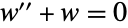
dModel = NonlinearStateSpaceModel[w''[t] + w[t] == 0, {{w[t], 0}, {w'[t], 1}}, {}, {}, t];nsys = NonlinearStateSpaceModel[{{x[t] + Subscript[, 1][t] + v[t]}, {x[t]}}, {{x[t], 0}}, {v[t]}, Automatic, t];sys = SystemsModelMerge[{dModel, nsys}]k = FullInformationOutputRegulator[sys, {"Poles", {-2}}]csys = SystemsModelStateFeedbackConnect[sys, k]OutputResponse[{csys, {0, 1, 1}}, 0, {t, 0, 3}];Plot[%, {t, 0, 3}, PlotRange -> All]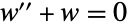
iModel = NonlinearStateSpaceModel[w''[t] + w[t] == 0, {{w[t], 0}, {w'[t], 1}}, {}, {}, t];nsys = NonlinearStateSpaceModel[{{x[t] + Subscript[, 1][t] + v[t]}, {x[t], x[t] - Subscript[, 1][t]}}, {{x[t], 0}}, {Subscript[, 1][t], v[t]}, Automatic, t];sys = SystemsModelMerge[{iModel, nsys}]k = FullInformationOutputRegulator[{sys, 2}, {"Poles", {-2}}]csys = SystemsModelExtract[SystemsModelStateFeedbackConnect[sys, k], All, 1]or = OutputResponse[{csys, {0, 1, 0.5}}, 0, {t, 0, 10}];
Plot[or, {t, 0, 10}, PlotRange -> All]iModel = NonlinearStateSpaceModel[{{0}, {x - r}}, {{r, 1}}, {}]dModel = NonlinearStateSpaceModel[{{Subscript[w, 2], -Subscript[w, 1]}, {}}, {{Subscript[w, 1], 0}, {Subscript[w, 2], 1}}, {}]nsys = NonlinearStateSpaceModel[{{x + r + Subscript[w, 1] + v}, {x}}, {{x, 0}}, {r, Subscript[w, 1], v}]sys = SystemsModelMerge[{nsys, iModel, dModel}]k = FullInformationOutputRegulator[{sys, 2}, {"Poles", {-8}}]csys = SystemsModelExtract[SystemsModelStateFeedbackConnect[sys, k], All, 1]このシミュレーションは,出力がステップ信号を追跡していることを示している:
OutputResponse[NonlinearStateSpaceModel[csys, {x -> -1, r -> 1, Subscript[w, 1] -> 0, Subscript[w, 2] -> 1}], 0, {t, 0, 5}];
Plot[%, {t, 0, 5}, PlotRange -> All]外乱がある場合の航空機の縦方向の力学を調整する:»
aircraft = StateSpaceModel[{{{0, 14.3877, 0, -31.5311}, {-0.0012, -0.4217, 1, -0.0284},
   {0.0002, -0.3816, -0.4658, 0}, {0, 0, 1, 0}}, {{0.7898, -0.6526, -0.335, 0.4637, 0.9185},
   {-0.00588, 0.0049, 0.0025, -0.0035, -0.0068}, {-0.2541, 0.21, 0.1078, -0.1492, -0.2959},
   {0, 0, 0, 0, 0}}, {{1, 0, 0, 0}}, {{0, 0, 0, 0, 0}}}, {Subscript[x, 1],
  Subscript[x, 2], Subscript[x, 3], Subscript[x, 4]},
 {u, Subscript[w, 1], Subscript[w, 2],
  Subscript[w, 3], Subscript[w, 4]}, SamplingPeriod -> None,
SystemsModelLabels -> None];dist = StateSpaceModel[{{{0, -0.1, 0, 0}, {0.1, 0, 0, 0}, {0, 0, 0, -0.2}, {0, 0, 0.2, 0}},
{{}, {}, {}, {}}, {}}, {Subscript[w, 1], Subscript[w, 2],
Subscript[w, 3], Subscript[w, 4]}, SamplingPeriod -> None,
SystemsModelLabels -> None];sys = SystemsModelMerge[{aircraft, dist}]fb = FullInformationOutputRegulator[sys, {"Poles", {-1, -2, -2.5 + I, -2.5 - I}}]csys = SystemsModelStateFeedbackConnect[sys, fb]OutputResponse[{csys, {0.1, 0.001, 0, 0, 1, 0, 1, 0}}, 0, {t, 0, 8}];
Plot[%, {t, 0, 8}, PlotRange -> All]fb.StateResponse[{csys, {0.1, 0.001, 0, 0, 1, 0, 1, 0}}, 0, {t, 0, 150}];
Plot[%, {t, 0, 150}, PlotRange -> All]Rösslerのプロトタイプ-4の系を調整する:»
asys = AffineStateSpaceModel[{{-Subscript[x, 2] - Subscript[x, 3],
   Subscript[x, 1],
   0.5*(Subscript[x, 2] - Subscript[x, 2]^2) -
    0.5*Subscript[x, 3]}, {{0}, {0}, {1}},
  {-w + Subscript[x, 2]}, {{0}}},
 {Subscript[x, 1], Subscript[x, 2], Subscript[x, 3]},
Automatic, {Automatic}, Automatic, SamplingPeriod -> None];StateResponse[{asys /. w -> 0, RandomReal[{-1, 1}, 3]}, 0, {t, 0, 300}];
ParametricPlot3D[%, {t, 0, 300}]
tmodel = NonlinearStateSpaceModel[{{0}, {}}, w, {}];
sys = SystemsModelMerge[{asys, tmodel}]fb = FullInformationOutputRegulator[sys, {"Poles", {-1, -1.5 + I, -1.5 - I}}]csys = SystemsModelStateFeedbackConnect[sys, fb]シミュレーションは, が調整され系にフィードバックがあるカオス的動作がないことを示している:
StateResponse[{csys, Join[RandomReal[{-1, 1}, 3], {1}]}, 0, {t, 0, 8}];
Plot[Evaluate[Most[%]], {t, 0, 8}, PlotLegends -> {Subscript[x, 1], Subscript[x, 2], Subscript[x, 3]}]
Chua回路中の電圧  を,他のChua回路の出力である外乱
 を拒絶しつつ正弦曲線に従うように調整する:»
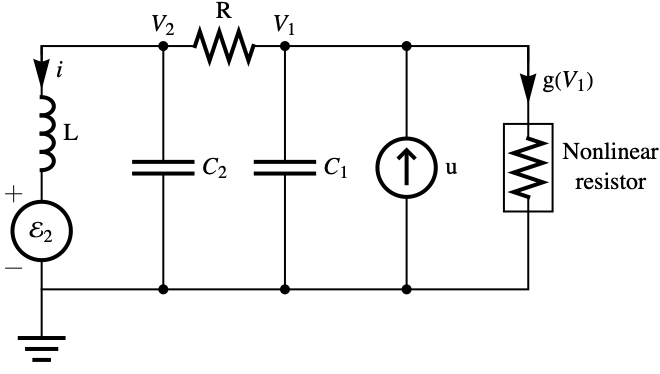
pars = {Subscript[𝒞, 1] -> 1, Subscript[𝒞, 2] -> 1, ℒ -> 1, ℛ -> 1};asys = AffineStateSpaceModel[{{(-2*Subscript[𝒱, 1] - Subscript[𝒱, 1]^3 +
(-Subscript[𝒱, 1] + Subscript[𝒱, 2])/ℛ)/
Subscript[𝒞, 1],
(-𝒾 + (Subscript[𝒱, 1] - Subscript[𝒱, 2])/
ℛ)/Subscript[𝒞, 2],
(-Subscript[ℰ, 2] + Subscript[𝒱, 2])/ℒ},
{{-Subscript[𝒞, 1]^(-1)}, {0}, {0}},
{-Subscript[ℰ, 4] + Subscript[𝒱, 2]}, {{0}}},
{Subscript[𝒱, 1], Subscript[𝒱, 2], 𝒾}, Automatic,
{Automatic}, Automatic, SamplingPeriod -> None] /. pars;pars1 = {Subscript[𝒞, 1] -> 1, Subscript[𝒞, 2] -> 1, ℒ -> 1, ℛ -> 1, ω -> 10};nsys = NonlinearStateSpaceModel[
{{(-Subscript[ℰ, 1] - 2*Subscript[ℰ, 1]^3 +
(-Subscript[ℰ, 1] + Subscript[ℰ, 2])/ℛ)/
Subscript[𝒞, 1],
((Subscript[ℰ, 1] - Subscript[ℰ, 2])/ℛ -
Subscript[ℰ, 3])/Subscript[𝒞, 2],
Subscript[ℰ, 2]/ℒ, ω*Subscript[ℰ, 5],
(-ω)*Subscript[ℰ, 4]}, {}},
{Subscript[ℰ, 1], Subscript[ℰ, 2], Subscript[ℰ, 3],
Subscript[ℰ, 4], Subscript[ℰ, 5]}, {}, Automatic, Automatic,
SamplingPeriod -> None, SystemsModelLabels -> {{}, None}] /. pars1;sys = SystemsModelMerge[{asys, nsys}]Subscript[poles, d] = Eigenvalues@First@Normal@StateSpaceModel[nsys]//Ndecays = Join[{-1, -2, -3}, DeleteCases[%, Complex[_ ? PossibleZeroQ, _]]]k = FullInformationOutputRegulator[{sys, All, All, {7, 8}}, {"Poles", decays}]csys = SystemsModelStateFeedbackConnect[sys, k]//SimplifyOutputResponse[{csys, {10, 0, 0.1, 0, 0, 0, 0, -1}}, 0, {t, 0, 10}];
Plot[%, {t, 0, 10}, PlotRange -> All]特性と関係 (4)
StateFeedbackGainsは特殊ケースである:
ssm = StateSpaceModel[{{{2, 0, -1}, {0, -2, 1}, {1, -1, 1}}, {{1, 1}, {0, 1}, {1, -1}},
  {{1, -1, 0}, {0, 1, -1}}, {{0, 0}, {0, 0}}}, SamplingPeriod -> None, SystemsModelLabels -> None];
poles = {-1, -2, -3};FullInformationOutputRegulator[ssm, {"Poles", poles}]StateFeedbackGains[ssm, poles]LQRegulatorGainsは特殊ケースである:
ssm = StateSpaceModel[{{{2, 0, -1}, {0, -2, 1}, {1, -1, 1}}, {{1, 1}, {0, 1}, {1, -1}},
  {{1, -1, 0}, {0, 1, -1}}, {{0, 0}, {0, 0}}}, SamplingPeriod -> None, SystemsModelLabels -> None];
weights = {IdentityMatrix[3], IdentityMatrix[2]};FullInformationOutputRegulator[N@ssm, {"Weights", weights}]LQRegulatorGains[N@ssm, weights]SystemsModelStateFeedbackConnectを使って閉ループ系を得る:
sys = NonlinearStateSpaceModel[{{u + w + p*x, 0},
  {x}}, {x, w}, {u}, {Automatic}, Automatic,
SamplingPeriod -> None];SystemsModelStateFeedbackConnect[sys, FullInformationOutputRegulator[sys, {"Poles", {Subscript[p, f]}}]]sys = StateSpaceModel[{{{2, 0, -1, 1}, {0, -2, 1, 0}, {1, -1, 1, 0}, {0, 0, 0, 0}},
{{1, 1}, {0, 1}, {1, -1}, {0, 0}}, {{1, -1, 0, 0}, {0, 1, -1, 0}}, {{0, 0}, {0, 0}}},
SamplingPeriod -> None, SystemsModelLabels -> None];k = FullInformationOutputRegulator[sys, {"Poles", N@{-1, -2, -3}}]csys = SystemsModelStateFeedbackConnect[sys, k]OutputResponse[{csys, RandomReal[2, 4]}, 0, {t, 0, 5}];
Plot[Evaluate[%], {t, 0, 5}, PlotRange -> All]テキスト
Wolfram Research (2014), FullInformationOutputRegulator, Wolfram言語関数, https://reference.wolfram.com/language/ref/FullInformationOutputRegulator.html.
CMS
Wolfram Language. 2014. "FullInformationOutputRegulator." Wolfram Language & System Documentation Center. Wolfram Research. https://reference.wolfram.com/language/ref/FullInformationOutputRegulator.html.
APA
Wolfram Language. (2014). FullInformationOutputRegulator. Wolfram Language & System Documentation Center. Retrieved from https://reference.wolfram.com/language/ref/FullInformationOutputRegulator.html