

Conjugate
Conjugate[z]
或 z,给出复数 z 的复共轭.
更多信息
- 数学函数,适宜于符号和数值运算.
- 可以通过输入
 co
 ,
 conj
 或 \[Conjugate]实现.
- Conjugate 自动逐项作用于列表的各个元素. »
- Conjugate 可与 Interval 和 CenteredInterval 对象一起使用. »
范例
打开所有单元 关闭所有单元基本范例 (4)

 表示共轭表达式:
范围 (24)
数值计算 (6)
Conjugate[.7]Conjugate[.5 + I]N[Conjugate[2 / 3 + I], 25]Conjugate[2.3000000000000000000000000 - 1 / I]Conjugate[I + 1 / 3`100]//TimingConjugate[5 I + 11 / 7`10000];//TimingConjugate[{{1 / 2, -1 - I}, {-5 / 3, 1 / 2 + I}}]或用 MatrixFunction 计算矩阵形式的 Conjugate 函数:
MatrixFunction[Conjugate, {{1 / 2, -1 - I}, {-5 / 3, 1 / 2 + I}}]//FullSimplifyConjugate 可与 Interval 和 CenteredInterval 对象一起使用:
Conjugate[Interval[{-5, 5}]]Conjugate[CenteredInterval[-5 - 3I, 1 + I]]或用 Around 计算一般情况下的统计区间:
Conjugate[ Around[-1.1 + I, 0.01]]特殊值 (3)
在固定点处的 Conjugate 的值:
Table[Conjugate[n ], {n, {2I , -1 / 3, 3 + 4I}}]Conjugate[0]Conjugate[I Infinity]Conjugate[ComplexInfinity]可视化 (4)


ReImPlot[{x + I, Conjugate[x + I]}, {x, -3, 3}, PlotLegends -> Automatic]
Plot[Abs[Conjugate[x + I]], {x, -3, 3}]

GraphicsRow[ComplexPlot3D[#, {z, -2 - 2I, 2 + 2I}, Mesh -> Automatic, RegionFunction -> Function[{z}, Abs[z] ≤ 2]]& /@ {z, Conjugate[z]}, ImageSize -> Medium]
ComplexContourPlot[Re[Conjugate[z ^ 2]], {z, -3 - 3 I, 3 + 3I}, Contours -> 20]
ComplexContourPlot[Im[Conjugate[z ^ 2]], {z, -3 - 3 I, 3 + 3I}, Contours -> 20]函数的属性 (11)
Conjugate 对所有实数和复数输入有定义:
FunctionDomain[Conjugate[x], x]FunctionDomain[Conjugate[x], x, Complexes]Conjugate 的值域是全体实数和复数:
FunctionRange[Conjugate[x], x, y]FunctionRange[Conjugate[x], x, y, Complexes]Conjugate 是奇函数:
Conjugate[-z]Conjugate 是对合的,即  :
Conjugate[Conjugate[z]]Conjugate 不是可微函数:
D[Conjugate[x], x]Underscript[, hUnderscript[ -> , ℂ]0](Conjugate[x + h] - Conjugate[x]/h)
Underscript[, hUnderscript[ -> , ℝ]0](Conjugate[1 + h] - Conjugate[1]/h)
Limit[(Conjugate[1 + h] - Conjugate[1]/h), h -> 0, Direction -> -I]Conjugate 不是解析函数:
FunctionAnalytic[Conjugate[x], x, Complexes]FunctionSingularities[Conjugate[x], x, Complexes]FunctionDiscontinuities[Conjugate[x], x, Complexes]Conjugate 在实轴上非递减:
FunctionMonotonicity[Conjugate[x], x]Conjugate 在实轴上是单射函数:
FunctionInjective[Conjugate[x], x]Plot[{Conjugate[x], 1}, {x, -4, 4}]Conjugate 在实轴上是满射函数:
FunctionSurjective[Conjugate[x], x]Plot[{Conjugate[x], -2.5}, {x, -4, 4}]Conjugate 既不是非负,也不是非正:
FunctionSign[Conjugate[x], x]TraditionalForm 格式:
Conjugate[z]//TraditionalForm应用 (6)
利用 BraKet 符号为复值列表定义标量积:
BraKet[{a_}, {b_}] := Conjugate[a].bBraKet[{{1, I}}, {{1I, 2}}]toRealDenominator[rat_] := With[{c = ComplexExpand[Conjugate[Denominator[rat]]]}, Expand[Numerator[rat] c] / Expand[Denominator[rat] c]]toRealDenominator[1 / (x ^ 2 + 3 I x - 2 + 4I)]Cancel[%]MöbiusTransformation[a_, z_] := (z - a) / (1 - Conjugate[a] z)a = 1 + 2I;
ParametricPlot[Evaluate[Table[{Re[MöbiusTransformation[a, ρ Exp[I ϕ]]], Im[MöbiusTransformation[a, ρ Exp[I ϕ]]]}, {ρ, 0, 1, 1 / 10}]], {ϕ, 0, 2Pi}]toCCForm[f_, {x_, y_}, z_] := f /. {x -> (z + Conjugate[z]) / 2, y -> (z - Conjugate[z]) / (2I)}toCCForm[x^3 - 3 x y^2, {x, y}, z] //SimplifytoCCForm[x^3 - 3 x y^2 + I (3 x^2 y - y^3), {x, y}, z]//Simplify用 Conjugate 描述几何区域:
Block[{z = x + I y}, RegionPlot[Abs[Conjugate[z] Re[z] + z Im[z]] < 1, {x, -2, 2}, {y, -2, 2}]]在量子力学中,具有有限多个状态的系统由单位向量表示,而物理量则由作用于它们的矩阵表示. 考虑处于以下状态的自旋为 1/2 的粒子,如电子:
s = {(1/Sqrt[5]), (2I/Sqrt[5])};
jz = (ℏ/2)PauliMatrix[3]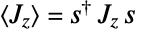
Conjugate[s].jz.s
σz = Simplify[Sqrt[Conjugate[s].jz.jz.s - (Conjugate[s].jz.s)^2], ℏ > 0]
jy = (ℏ/2)PauliMatrix[2]σy = Simplify[Sqrt[Conjugate[s].jy.jy.s - (Conjugate[s].jy.s)^2], ℏ > 0]
Simplify[σy σz > (ℏ/2)Abs[ Conjugate[s].(jy.jz - jz.jy).s] , ℏ > 0]属性和关系 (7)
Conjugate[1 / z]Conjugate[Re[z]]Conjugate 是它本身的逆:
Conjugate[Conjugate[z]]化简包含 Conjugate 的表达式:
z Conjugate[z]FullSimplify[%]Conjugate[z1 z2] - Conjugate[z1]Conjugate[z2]FullSimplify[%]Conjugate[x + I y]ComplexExpand[%]ComplexExpand[Conjugate[z], z]ComplexExpand[Conjugate[Sqrt[z]], z]Conjugate 作为 ComplexExpand 中的一个选项值:
ComplexExpand[Re[x], x, TargetFunctions -> {Conjugate}]Integrate[Conjugate[x ^ 2], {x, -2 + I, Pi + 2I}]N[%]NIntegrate[Conjugate[x ^ 2], {x, -2 + I, Pi + 2I}]m = RandomComplex[{-1 - I, 1 + I}, {2, 2}];Conjugate[Transpose[m]]//MatrixForm用 ConjugateTranspose 代替:
ConjugateTranspose[m]//MatrixForm可能存在的问题 (4)
Conjugate 并不总是传送参数:
Conjugate[Sin[z]]Conjugate[Exp[z]]对 Conjugate 求导是不可能的:
D[Conjugate[t], t]Limit[DifferenceQuotient[Conjugate[z], {z, h}], h -> 0, Direction -> 1]Limit[DifferenceQuotient[Conjugate[z], {z, h}], h -> 0, Direction -> I]使用 ComplexExpand 得到实值变量的微分表达式:
D[ComplexExpand[Conjugate[x + I y]], y]Conjugate 可以对数值参数保持不计算:
Conjugate[ArcSin[(-1 - 2 E - E ^ 2 + (1 + E) ^ 2)]]

Simplify[%]Conjugate 的机器精度的数值计算可能给出错误结果:
Conjugate[ArcSin[(-1 - 2 E - E ^ 2 + (1 + E) ^ 2) + 10 ^ -20]]N[%]N[%%, 20]
 MathWorld

 The Wolfram Functions Site
文本
Wolfram Research (1988),Conjugate,Wolfram 语言函数,https://reference.wolfram.com/language/ref/Conjugate.html (更新于 2021 年).
CMS
Wolfram 语言. 1988. "Conjugate." Wolfram 语言与系统参考资料中心. Wolfram Research. 最新版本 2021. https://reference.wolfram.com/language/ref/Conjugate.html.
APA
Wolfram 语言. (1988). Conjugate. Wolfram 语言与系统参考资料中心. 追溯自 https://reference.wolfram.com/language/ref/Conjugate.html 年