ConvectionPDETerm[vars,β]
対流係数
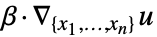
,モデル変数 vars の対流項
を表す.
ConvectionPDETerm[vars,β,pars]
モデルパラメータ pars を使う.
ConvectionPDETerm
ConvectionPDETerm[vars,β]
対流係数
,モデル変数 vars の対流項
を表す.
ConvectionPDETerm[vars,β,pars]
モデルパラメータ pars を使う.
詳細
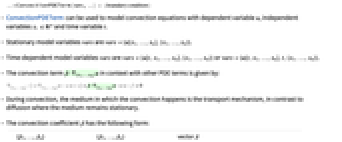
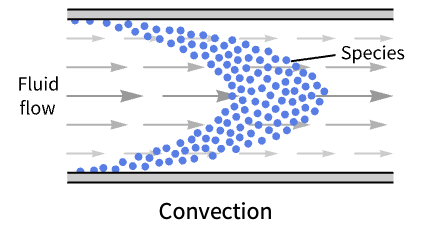
- 対流項は,熱力学,音響学,構造力学,流体力学等,数多くの分野で使われている.
- 対流は移流としても知られている.
- 対流係数
がある対流は,大規模移動による従属変数
の輸送過程である. - ConvectionPDETermは,偏微分方程式の一部として使われる微分演算子項を返す.
- ConvectionPDETermを使って,従属変数
,独立変数
,時間変数
の対流方程式がモデル化できる. - 定常モデル変数 vars は vars={u[x1,…,xn],{x1,…,xn}}である.
- 時間依存モデル変数 vars は vars={u[t,x1,…,xn],{x1,…,xn}}または vars={u[t,x1,…,xn],t,{x1,…,xn}}である.
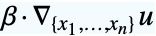
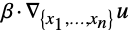
- 他のPDE項との関連での対流項
は以下で与えられる. - 対流の間,対流が起こっている媒介は輸送機構となるのに対し,拡散の場合の媒介は静止したままである.
- 対流係数
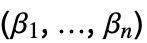
は次の形を持つことができる. -
{β1,…,βn} 
ベクトル 
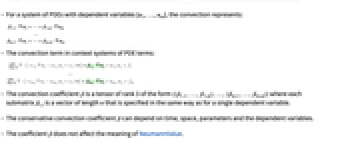
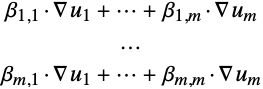
- 従属変数が{u1,…,um}の偏微分方程式系についての対流は以下を表す.
- 以下は,PDE項の系との関連での対流項である.
- 対流係数
は
の形の階数3のテンソルである.各部分行列
は単一の従属変数と同じ方法で指定できる長さ
のベクトルである. - 記号対流係数はVectorSymbolで指定できる. »
- 保存型の対流係数
は,時間,空間,パラメータ,従属変数に依存することがある. - 次は,使用可能なパラメータpars である.
-
パラメータ デフォルト シンボル "CoordinateChart" "Cartesian" 
- 係数
はNeumannValueの意味をもたらすことはない. - 与えられた独立変数に明示的に依存しないすべての数量の偏導関数は0であるとみなされる.
- ConservativeConvectionPDETermと緊密な関係がある.
例題
すべて開く すべて閉じる例 (4)
ConvectionPDETerm[{u[x], {x}}, {2}]ConvectionPDETerm[{u[t, x], t, {x}}, {2}]ConvectionPDETerm[{u[x, y], {x, y}}, {1, 0}]vars = {u[x, y], {x, y}};
NDSolveValue[{DiffusionPDETerm[vars, 1] + ConvectionPDETerm[vars, {2, 0}] == SourcePDETerm[vars, -1], DirichletCondition[u[x, y] == 0, x == 0 || y == 0]}, u[x, y], {x, y}∈Rectangle[]]ContourPlot[%, {x, y}∈Rectangle[]]スコープ (10)
ConvectionPDETerm[{u[t, x], t, {x}}, {a}]β = VectorSymbol["β", {1}];
ConvectionPDETerm[{u[x], {x}}, β]%//Activateβ = VectorSymbol["β", {1}];
ConvectionPDETerm[{u[x], {x}}, β, <|β -> {1}|>]β = VectorSymbol["β", {1}];
ConvectionPDETerm[{u[t, x], t, {x}}, β, <|β -> {1}|>]ConvectionPDETerm[{u[r], {r}}, {2}, <|"RegionSymmetry" -> "Axisymmetric"|>]Activateを項に適用する:
Activate[%]ConvectionPDETerm[{u[x, y], {x, y}}, {2, 1}]ConvectionPDETerm[{u[x, y], {x, y}}, {2, u[x, y] ^ 2}]ConvectionPDETerm[{u[t, x, y], t, {x, y}}, {2, u[x, y] ^ 2}]ConvectionPDETerm[{{u[x, y], v[x, y]}, {x, y}}, {{{1, 0}, {0, 2}}, {{0, 0}, {0, 1}}}]stokesModel[vars_, μ_] := DiffusionPDETerm[vars, {{μ, 0, 0}, {0, μ, 0}, {0, 0, 0}}] + ConvectionPDETerm[vars, {{0, 0, {1, 0}}, {0, 0, {0, 1}}, {{1, 0}, {0, 1}, 0}}]stokesModel[{{u[x, y], v[x, y], p[x, y]}, {x, y}}, μ] == {0, 0, 0}アプリケーション (3)
DiffusionPDETermを使ってダムの下の種の拡散をモデル化する.領域を設定する:
Subscript[Ω, dam] = Rectangle[{6, 3}, {12, 18}];
Subscript[Ω, sediment] = RegionDifference[Rectangle[{0, 0}, {18, 6}], Subscript[Ω, dam]];model = DiffusionPDETerm[{u[x, y], {x, y}}, 10 ^ -4]solution = NDSolveValue[{model == 0, DirichletCondition[u[x, y] == 16, x ≤ 6 && y == 6], DirichletCondition[u[x, y] == 8, x ≥ 12 && y == 6]}, u, {x, y}∈Subscript[Ω, sediment]]flux = model /. Inactive[Div][flux_, _] :> Activate[flux]Show[
...,
VectorPlot[Evaluate[flux /. u -> solution], {x, 0, 18}, {y, 0, 6}, Rule[...]]
]//Quietop = DiffusionPDETerm[{c[x, y], {x, y}}, 1] + ConvectionPDETerm[{c[x, y], {x, y}}, flux /. u -> solution] + 2 * 10 ^ -5c[x, y];concentration = NDSolveValue[{op == 0,
DirichletCondition[c[x, y] == 100, x ≤ 6 && y == 6], DirichletCondition[c[x, y] == 50, x ≥ 12 && y == 6]
}, c, {x, y}∈Subscript[Ω, sediment]]Show[
...,
ContourPlot[concentration[x, y], {x, y}∈concentration["ElementMesh"], ...],
VectorPlot[Evaluate[flux /. u -> solution], {x, 0, 18}, {y, 0, 6}, Rule[...]]
]//QuietstokesModel[vars_, μ_] := DiffusionPDETerm[vars, {{μ, 0, 0}, {0, μ, 0}, {0, 0, 0}}] + ConvectionPDETerm[vars, {{0, 0, {1, 0}}, {0, 0, {0, 1}}, {{1, 0}, {0, 1}, 0}}]eqn = stokesModel[{{u[x, y], v[x, y], p[x, y]}, {x, y}}, 1] == {0, 0, 0}Ω = RegionUnion[Rectangle[{0, 0}, {1, 1 / 2}], Rectangle[{1, 1 / 10}, {2, 2 / 5}]];bcs = {DirichletCondition[
{u[x, y] == 4 * 0.3 * y * (0.5 - y) / (0.41) ^ 2, v[x, y] == 0.}, x == 0.], DirichletCondition[{u[x, y] == 0., v[x, y] == 0.}, 0 < x < 2],
DirichletCondition[p[x, y] == 0., x == 2]};{xVel, yVel, pressure} = NDSolveValue[{eqn, bcs}, {u, v, p}, {x, y}∈Ω, Method -> {"FiniteElement", "InterpolationOrder" -> {u -> 2, v -> 2, p -> 1}, "MeshOptions" -> {"MaxCellMeasure" -> 0.0005}}];VectorPlot[{xVel[x, y], yVel[x, y]}, {x, y}∈Ω, AspectRatio -> Automatic, StreamPoints -> 6, StreamColorFunction -> "TemperatureMap", StreamColorFunctionScaling -> False]//Quietストークス流れのモデルを拡大してナビエ(Navier)・ストークス流れのモデルにする.ストークス流れのモデルを定義する:
stokesModel[vars_, μ_] := DiffusionPDETerm[vars, {{μ, 0, 0}, {0, μ, 0}, {0, 0, 0}}] + ConvectionPDETerm[vars, {{0, 0, {1, 0}}, {0, 0, {0, 1}}, {{1, 0}, {0, 1}, 0}}]navierStokesModel[vars_, μ_, ρ_] := stokesModel[vars, μ] + ConvectionPDETerm[vars, {{ρ vars[[1, {1, 2}]], 0, 0}, {0, ρ vars[[1, {1, 2}]], 0}, {0, 0, 0}}]eqn = navierStokesModel[{{u[x, y], v[x, y], p[x, y]}, {x, y}}, 1, 10 ^ -3] == {0, 0, 0}Ω = Rectangle[{0, 0}, {1, 1}];bcs = {DirichletCondition[
{u[x, y] == 1, v[x, y] == 0}, y == 1], DirichletCondition[{u[x, y] == 0, v[x, y] == 0}, y < 1],
DirichletCondition[p[x, y] == 0, x == 0 && y == 1]};{xVel, yVel, pressure} = NDSolveValue[{eqn, bcs}, {u, v, p}, {x, y}∈Ω, Method -> {"FiniteElement", "InterpolationOrder" -> {u -> 2, v -> 2, p -> 1}, "MeshOptions" -> {"MaxCellMeasure" -> 0.0005}}];VectorPlot[{xVel[x, y], yVel[x, y]}, {x, y}∈Ω, AspectRatio -> Automatic, StreamPoints -> 6, StreamColorFunction -> "TemperatureMap", StreamColorFunctionScaling -> False]考えられる問題 (2)
ConvectionPDETerm[{u[x], {x}}, 0]ConvectionPDETerm[{u[x], {x}}, {0}]ConvectionPDETerm[{u[x], {x}}, v]記号ベクトル対流係数の指定にはVectorSymbolを使用する:
vs = VectorSymbol["v", {1}];
ConvectionPDETerm[{u[x], {x}}, vs]ConvectionPDETerm[{u[x], {x}}, vs]//ActivateVectorSymbolに実際の値を代入する:
ConvectionPDETerm[{u[x], {x}}, vs, <|vs -> {1}|>]ConvectionPDETerm[{u[x], {x}}, {v}, <|v -> 1|>]関連するガイド
-
▪
- 偏微分方程式項
テキスト
Wolfram Research (2020), ConvectionPDETerm, Wolfram言語関数, https://reference.wolfram.com/language/ref/ConvectionPDETerm.html (2026年に更新).
CMS
Wolfram Language. 2020. "ConvectionPDETerm." Wolfram Language & System Documentation Center. Wolfram Research. Last Modified 2026. https://reference.wolfram.com/language/ref/ConvectionPDETerm.html.
APA
Wolfram Language. (2020). ConvectionPDETerm. Wolfram Language & System Documentation Center. Retrieved from https://reference.wolfram.com/language/ref/ConvectionPDETerm.html
BibTeX
@misc{reference.wolfram_2026_convectionpdeterm, author="Wolfram Research", title="{ConvectionPDETerm}", year="2026", howpublished="\url{https://reference.wolfram.com/language/ref/ConvectionPDETerm.html}", note=[Accessed: 07-September-2026]}
BibLaTeX
@online{reference.wolfram_2026_convectionpdeterm, organization={Wolfram Research}, title={ConvectionPDETerm}, year={2026}, url={https://reference.wolfram.com/language/ref/ConvectionPDETerm.html}, note=[Accessed: 07-September-2026]}