ConvectionPDETerm[vars,β]
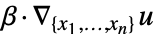
表示具有对流系数
和模型变量 vars 的对流项
.
ConvectionPDETerm[vars,β,pars]
使用模型参数 pars.
ConvectionPDETerm
ConvectionPDETerm[vars,β]
表示具有对流系数
和模型变量 vars 的对流项
.
ConvectionPDETerm[vars,β,pars]
使用模型参数 pars.
更多信息
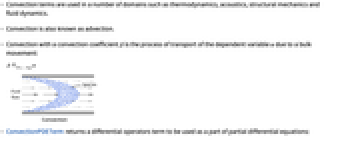
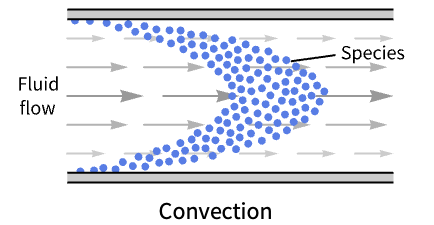
- 对流项用于许多领域,例如热力学、声学、结构力学和流体动力学等.
- 对流 (Convection) 也称作 Advection.
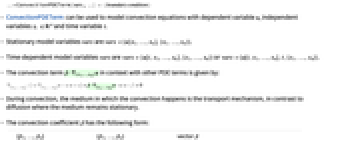
- 对流系数为
的对流是因变量
由于宏观运动而传输的过程: - ConvectionPDETerm 返回微分算子项,该项将用作偏微分方程的一部分:
- ConvectionPDETerm 可用来模拟对流方程,其中因变量为
,自变量为
,时间变量为
. - 平稳模拟变量 vars 为 vars={u[x1,…,xn],{x1,…,xn}}.
- 与时间相关的模型变量 vars 为 vars={u[t,x1,…,xn],{x1,…,xn}} 或 vars={u[t,x1,…,xn],t,{x1,…,xn}}.
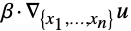
- 与其他偏微分方程项结合使用的对流项
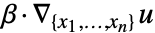
由下式给出: - 在对流过程中,发生对流的介质是传输机制,这与介质保持静止的扩散相反.
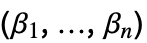
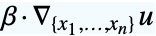
- 对流系数
具有以下形式: -
{β1,…,βn} 
vector 
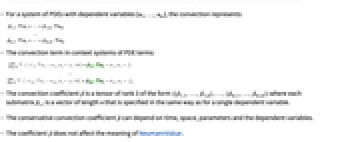
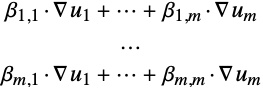
- 对于因变量为 {u1,…,um} 的偏微分方程组,对流表示:
- 对流项在相关的偏微分方程组中:
- 对流系数
是秩为 3 的张量,形如
,其中各子矩阵
为长度为
的向量,其指定方式与单个因变量的指定方式相同. - 符号式对流系数可以通过 VectorSymbol 指定. »
- 保守对流系数
可取决于时间、空间、参数和因变量. - 可以给出以下参数 pars:
-
参数 默认 符号 "CoordinateChart" "Cartesian" 
- 系数
不影响 NeumannValue 的意义. - 所有不明确依赖于给定自变量的量,其偏导数均被视为零.
- ConservativeConvectionPDETerm 密切相关.
范例
打开所有单元 关闭所有单元基本范例 (4)
ConvectionPDETerm[{u[x], {x}}, {2}]ConvectionPDETerm[{u[t, x], t, {x}}, {2}]ConvectionPDETerm[{u[x, y], {x, y}}, {1, 0}]vars = {u[x, y], {x, y}};
NDSolveValue[{DiffusionPDETerm[vars, 1] + ConvectionPDETerm[vars, {2, 0}] == SourcePDETerm[vars, -1], DirichletCondition[u[x, y] == 0, x == 0 || y == 0]}, u[x, y], {x, y}∈Rectangle[]]ContourPlot[%, {x, y}∈Rectangle[]]范围 (10)
ConvectionPDETerm[{u[t, x], t, {x}}, {a}]β = VectorSymbol["β", {1}];
ConvectionPDETerm[{u[x], {x}}, β]%//Activateβ = VectorSymbol["β", {1}];
ConvectionPDETerm[{u[x], {x}}, β, <|β -> {1}|>]β = VectorSymbol["β", {1}];
ConvectionPDETerm[{u[t, x], t, {x}}, β, <|β -> {1}|>]ConvectionPDETerm[{u[r], {r}}, {2}, <|"RegionSymmetry" -> "Axisymmetric"|>]对该项应用 Activate:
Activate[%]ConvectionPDETerm[{u[x, y], {x, y}}, {2, 1}]ConvectionPDETerm[{u[x, y], {x, y}}, {2, u[x, y] ^ 2}]ConvectionPDETerm[{u[t, x, y], t, {x, y}}, {2, u[x, y] ^ 2}]ConvectionPDETerm[{{u[x, y], v[x, y]}, {x, y}}, {{{1, 0}, {0, 2}}, {{0, 0}, {0, 1}}}]stokesModel[vars_, μ_] := DiffusionPDETerm[vars, {{μ, 0, 0}, {0, μ, 0}, {0, 0, 0}}] + ConvectionPDETerm[vars, {{0, 0, {1, 0}}, {0, 0, {0, 1}}, {{1, 0}, {0, 1}, 0}}]stokesModel[{{u[x, y], v[x, y], p[x, y]}, {x, y}}, μ] == {0, 0, 0}应用 (3)
使用 DiffusionPDETerm 模拟大坝下的物种扩散. 设置区域:
Subscript[Ω, dam] = Rectangle[{6, 3}, {12, 18}];
Subscript[Ω, sediment] = RegionDifference[Rectangle[{0, 0}, {18, 6}], Subscript[Ω, dam]];model = DiffusionPDETerm[{u[x, y], {x, y}}, 10 ^ -4]solution = NDSolveValue[{model == 0, DirichletCondition[u[x, y] == 16, x ≤ 6 && y == 6], DirichletCondition[u[x, y] == 8, x ≥ 12 && y == 6]}, u, {x, y}∈Subscript[Ω, sediment]]flux = model /. Inactive[Div][flux_, _] :> Activate[flux]Show[
...,
VectorPlot[Evaluate[flux /. u -> solution], {x, 0, 18}, {y, 0, 6}, Rule[...]]
]//Quietop = DiffusionPDETerm[{c[x, y], {x, y}}, 1] + ConvectionPDETerm[{c[x, y], {x, y}}, flux /. u -> solution] + 2 * 10 ^ -5c[x, y];concentration = NDSolveValue[{op == 0,
DirichletCondition[c[x, y] == 100, x ≤ 6 && y == 6], DirichletCondition[c[x, y] == 50, x ≥ 12 && y == 6]
}, c, {x, y}∈Subscript[Ω, sediment]]Show[
...,
ContourPlot[concentration[x, y], {x, y}∈concentration["ElementMesh"], ...],
VectorPlot[Evaluate[flux /. u -> solution], {x, 0, 18}, {y, 0, 6}, Rule[...]]
]//QuietstokesModel[vars_, μ_] := DiffusionPDETerm[vars, {{μ, 0, 0}, {0, μ, 0}, {0, 0, 0}}] + ConvectionPDETerm[vars, {{0, 0, {1, 0}}, {0, 0, {0, 1}}, {{1, 0}, {0, 1}, 0}}]eqn = stokesModel[{{u[x, y], v[x, y], p[x, y]}, {x, y}}, 1] == {0, 0, 0}Ω = RegionUnion[Rectangle[{0, 0}, {1, 1 / 2}], Rectangle[{1, 1 / 10}, {2, 2 / 5}]];bcs = {DirichletCondition[
{u[x, y] == 4 * 0.3 * y * (0.5 - y) / (0.41) ^ 2, v[x, y] == 0.}, x == 0.], DirichletCondition[{u[x, y] == 0., v[x, y] == 0.}, 0 < x < 2],
DirichletCondition[p[x, y] == 0., x == 2]};{xVel, yVel, pressure} = NDSolveValue[{eqn, bcs}, {u, v, p}, {x, y}∈Ω, Method -> {"FiniteElement", "InterpolationOrder" -> {u -> 2, v -> 2, p -> 1}, "MeshOptions" -> {"MaxCellMeasure" -> 0.0005}}];VectorPlot[{xVel[x, y], yVel[x, y]}, {x, y}∈Ω, AspectRatio -> Automatic, StreamPoints -> 6, StreamColorFunction -> "TemperatureMap", StreamColorFunctionScaling -> False]//Quiet将斯托克斯流模型扩展为纳维-斯托克斯流模型. 定义斯托克斯流模型:
stokesModel[vars_, μ_] := DiffusionPDETerm[vars, {{μ, 0, 0}, {0, μ, 0}, {0, 0, 0}}] + ConvectionPDETerm[vars, {{0, 0, {1, 0}}, {0, 0, {0, 1}}, {{1, 0}, {0, 1}, 0}}]navierStokesModel[vars_, μ_, ρ_] := stokesModel[vars, μ] + ConvectionPDETerm[vars, {{ρ vars[[1, {1, 2}]], 0, 0}, {0, ρ vars[[1, {1, 2}]], 0}, {0, 0, 0}}]eqn = navierStokesModel[{{u[x, y], v[x, y], p[x, y]}, {x, y}}, 1, 10 ^ -3] == {0, 0, 0}Ω = Rectangle[{0, 0}, {1, 1}];bcs = {DirichletCondition[
{u[x, y] == 1, v[x, y] == 0}, y == 1], DirichletCondition[{u[x, y] == 0, v[x, y] == 0}, y < 1],
DirichletCondition[p[x, y] == 0, x == 0 && y == 1]};{xVel, yVel, pressure} = NDSolveValue[{eqn, bcs}, {u, v, p}, {x, y}∈Ω, Method -> {"FiniteElement", "InterpolationOrder" -> {u -> 2, v -> 2, p -> 1}, "MeshOptions" -> {"MaxCellMeasure" -> 0.0005}}];VectorPlot[{xVel[x, y], yVel[x, y]}, {x, y}∈Ω, AspectRatio -> Automatic, StreamPoints -> 6, StreamColorFunction -> "TemperatureMap", StreamColorFunctionScaling -> False]可能存在的问题 (2)
ConvectionPDETerm[{u[x], {x}}, 0]ConvectionPDETerm[{u[x], {x}}, {0}]ConvectionPDETerm[{u[x], {x}}, v]指定符号式向量对流系数的方法是通过 VectorSymbol:
vs = VectorSymbol["v", {1}];
ConvectionPDETerm[{u[x], {x}}, vs]ConvectionPDETerm[{u[x], {x}}, vs]//Activate用实际值替换 VectorSymbol:
ConvectionPDETerm[{u[x], {x}}, vs, <|vs -> {1}|>]ConvectionPDETerm[{u[x], {x}}, {v}, <|v -> 1|>]相关指南
-
▪
- 偏微分方程术语
文本
Wolfram Research (2020),ConvectionPDETerm,Wolfram 语言函数,https://reference.wolfram.com/language/ref/ConvectionPDETerm.html (更新于 2026 年).
CMS
Wolfram 语言. 2020. "ConvectionPDETerm." Wolfram 语言与系统参考资料中心. Wolfram Research. 最新版本 2026. https://reference.wolfram.com/language/ref/ConvectionPDETerm.html.
APA
Wolfram 语言. (2020). ConvectionPDETerm. Wolfram 语言与系统参考资料中心. 追溯自 https://reference.wolfram.com/language/ref/ConvectionPDETerm.html 年
BibTeX
@misc{reference.wolfram_2026_convectionpdeterm, author="Wolfram Research", title="{ConvectionPDETerm}", year="2026", howpublished="\url{https://reference.wolfram.com/language/ref/ConvectionPDETerm.html}", note=[Accessed: 16-September-2026]}
BibLaTeX
@online{reference.wolfram_2026_convectionpdeterm, organization={Wolfram Research}, title={ConvectionPDETerm}, year={2026}, url={https://reference.wolfram.com/language/ref/ConvectionPDETerm.html}, note=[Accessed: 16-September-2026]}