

GraphPeriphery
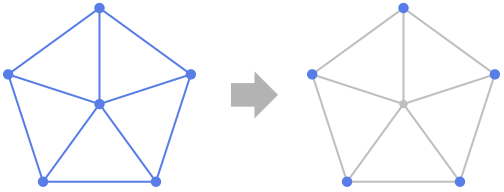
グラフ g 中の少なくとも1つの頂点との距離が最大である頂点を返す.
GraphPeriphery[{vw,…}]
規則 vw を使ってグラフ g を指定する.
詳細とオプション
- GraphPeripheryは末端頂点としても知られている.
- 使用可能なオプション
-
EdgeWeight Automatic 各辺の重み Method Automatic 使用するメソッド - デフォルト設定のEdgeWeight->Automaticのとき,辺の重みは,グラフ g のEdgeWeightが存在するときはそれ,なければ1であるとみなされる.
- Methodの可能な設定値には,"Dijkstra","FloydWarshall","Johnson"."PseudoDiameter"がある.
例題
すべて開く すべて閉じる例 (1)
スコープ (7)
GraphPeripheryは無向グラフに使うことができる:
GraphPeriphery[[image]]GraphPeriphery[[image]]GraphPeriphery[[image]]GraphPeriphery[[image]]GraphPeriphery[[image]]GraphPeriphery[{1 -> 2, 2 -> 3, 3 -> 1, 3 -> 4, 4 -> 5, 5 -> 3}]GraphPeripheryは大きいグラフに使うことができる:
g = GridGraph[{10, 10, 10, 10}];GraphPeriphery[g]//Length//Timingアプリケーション (1)
特性と関係 (8)
連結グラフについては,グラフの末端はVertexEccentricityで求めることができる:
g = GridGraph[{3, 4}]VertexEccentricity[g, #]& /@ VertexList[g]Flatten[Position[%, Max[%]]]GraphPeriphery[g]Select[RandomGraph[BernoulliGraphDistribution[7, 0.6], 9], ConnectedGraphQ]Length[GraphPeriphery[#]]& /@ %And@@Thread[% ≥ 2]CompleteGraphの場合,末端にはすべての頂点が含まれる:
HighlightGraph[#, GraphPeriphery[#]]& /@ Table[CompleteGraph[n, VertexSize -> Small], {n, 3, 6}]正の重みがあるPathGraphの場合,末端部は端点からなる:
HighlightGraph[#, GraphPeriphery[#]]& /@ Table[PathGraph[Range[n], VertexSize -> Large], {n, 5, 8}]非負の重みを持つグラフでは,末端部はそれぞれの端点で終る2つの経路を形成する:
HighlightGraph[#, GraphPeriphery[#]]&[PathGraph[Range[8], VertexSize -> Large, EdgeWeight -> {0, 1, 1, 0, 1, 0, 0}]]CycleGraphでは,すべての頂点が末端に含まれる:
HighlightGraph[#, GraphPeriphery[#]]& /@ Table[CycleGraph[n, VertexSize -> Small], {n, 3, 6}]サイズが5以上のWheelGraphでは,ハブを除くすべての頂点が末端に含まれる:
HighlightGraph[#, GraphPeriphery[#]]& /@ Table[WheelGraph[n, VertexSize -> Small], {n, 5, 8}]GridGraphでは,末端はコーナー位置の頂点からなる:
HighlightGraph[#, GraphPeriphery[#]]& /@ Table[GridGraph[dim, VertexSize -> Small, ImageSize -> {Tiny, Tiny}], {dim, {{3, 3}, {3, 4}, {4, 3}, {4, 4}}}]CompleteKaryTreeでは,末端は葉からなる:
HighlightGraph[#, GraphPeriphery[#]]& /@ Table[CompleteKaryTree[n, VertexSize -> Large], {n, 3, 5}]テキスト
Wolfram Research (2010), GraphPeriphery, Wolfram言語関数, https://reference.wolfram.com/language/ref/GraphPeriphery.html (2015年に更新).
CMS
Wolfram Language. 2010. "GraphPeriphery." Wolfram Language & System Documentation Center. Wolfram Research. Last Modified 2015. https://reference.wolfram.com/language/ref/GraphPeriphery.html.
APA
Wolfram Language. (2010). GraphPeriphery. Wolfram Language & System Documentation Center. Retrieved from https://reference.wolfram.com/language/ref/GraphPeriphery.html