

ThermodynamicData
ThermodynamicData["name","property"]
物質"name"についての特定の特性の値を与える.
ThermodynamicData["name","property",{parameter1quantity1,parameter2quantity}]
物質"name"についての,指定されたパラメータにおける特定の特性の値を与える.
詳細
- ThermodynamicData[]は使用可能な物質のリストを与える.
- ThermodynamicData["Properties"]は使用可能な全特性のリストを与える.
- 特定の場合に,該当しないあるいは未知の特性は,Missing[…]で示される.
- 適切な場合には,物質はQuantityを使って返される.
- 特に指定がない場合は,物質特性は標準温度(293.15K)および標準圧力(101,325パスカル)で与えられる.パラメータが1つ指定された場合は,その値が標準温度(パラメータが"Temperature"の場合は圧力)と組み合されて値が導出される.
- パラメータには,"Density","Enthalpy","Entropy","InternalEnergy","Pressure","Quality","Temperature"が含まれる.
- 次は,サポートされるパラメータの組合せである.
-
"Density" "Enthalpy" "Density" "Pressure" "Density" "Temperature" "Enthalpy" "Entropy" "Enthalpy" "Pressure" "Enthalpy" "Temperature" "Entropy" "InternalEnergy" "Entropy" "Pressure" "Entropy" "Temperature" "InternalEnergy" "Pressure" "InternalEnergy" "Temperature" "Pressure" "Quality" "Pressure" "Temperature" "Quality" "Temperature" - パラメータの値はAssociationとして与えることもできる.
- ThermodynamicData["name"]は,すべての特性を標準温度と標準圧力における値とともに返す.ThermodynamicData["name",{parameter1quantity1,parameter2quantity}]は,与えられたパラメータを使って値を計算してすべの特性を返す.
- サポートされている物質の一般的な英語名は"property" "Name"を使って求めることができる.
- パラメータに依存する特性
-
"AdiabaticBulkModulus" 断熱圧縮についての体積弾性率 "AdiabaticCompressibility" 定エントロピーでの体積変化率 "ChemicalPotentials" 量の変化によるギブズ自由エネルギーの変化 "CompressibilityFactor" 理想気体の挙動からの補正係数 "DerivativeOfPressureWithRespectToDensityAndTemperature" 密度と温度についての圧力微分 "DielectricConstant" 誘電率と真空の誘電率の比 "DynamicViscosity" 動的粘度 "Enthalpy" エンタルピー "Entropy" エントロピー "ExcessEnergy" 理想と現実の内部エネルギーの差 "ExcessEnthalpy" 理想と現実のエンタルピーの差 "ExcessEntropy" 理想と現実のエントロピーの差 "ExcessGibbsFreeEnergy" 理想と現実のギブズの自由エネルギーの差 "ExcessHelmholtzFreeEnergy" 理想と現実のヘルムホルツの自由エネルギーの差 "ExcessVolume" 理想と現実の体積の差 "FirstDerivativeOfDensityWithRespectToPressure" 圧力についての密度微分 "FirstDerivativeOfDensityWithRespectToTemperature" 温度についての密度微分 "FirstDerivativeOfPressureWithRespectToDensity" 密度についての圧力微分 "FirstDerivativeOfPressureWithRespectToTemperature" 温度についての圧力微分 "FourthVirialCoefficient" 第4ビリアル係数 "GibbsFreeEnergy" ギブズの自由エネルギー "HelmholtzFreeEnergy" ヘルムホルツの自由エネルギー "InternalEnergy" 内部エネルギー "IsenthalpicJouleThomsonCoefficient" 定エンタルピーにおける圧力による温度変化 "IsentropicExpansionCoefficient" 比熱比 "IsobaricHeatCapacity" 定圧における熱容量 "IsochoricHeatCapacity" 定容積における熱容量 "IsothermalBulkModulus" 定温における体積弾性率 "IsothermalCompressibility" 定温における体積変化 "IsothermalExpansionCoefficient" 定温における圧力による膨張 "IsothermalThrottlingCoefficient" 等温絞り係数 "MassDensity" 密度 "MolarDensity" 密度/モル容量 "MolarEnthalpy" エンタルピー/モル容量 "MolarEntropy" エントロピー/モル容量 "MolarInternalEnergy" 内部エネルギー/モル容量 "MolarIsobaricHeatCapacity" 定圧における熱容量/モル容量 "MolarIsochoricHeatCapacity" 定容積における熱容量/モル容量 "MolarSpecificVolume" モル容積 "Phase" 位相 "SecondAcousticVirialCoefficent" 断熱音速の第2ビリアル係数 "SecondDerivativeOfPressureWithRespectToDensity" 密度についての圧力の二次微分 "SecondDerivativeOfPressureWithRespectToTemperature" 温度についての圧力の二次微分 "SecondVirialCoefficient" 第2ビリアル係数 "SoundSpeed" 音速 "SpecificHeatInput" 比熱入力 "SpecificVolume" 比容積 "ThermalConductivity" 熱伝導率 "ThirdAcousticVirialCoefficent" 断熱音速の第3ビリアル係数 "ThirdVirialCoefficient" 第3ビリアル係数 "VolumeExpansivity" 温度による体積膨張 - "Enthalpy","Entropy",およびこれらのモル形式は物体の沸点におけるその値によって測られる.
- "Phase"は,"Temperature"および"Pressure"の以外のパラメータの組合せに使うことはできない.
- 三重点特性
-
"TriplePointGasDensity" 三重点における気体密度 "TriplePointLiquidDensity" 三重点における液体密度 "TriplePointPressure" 三重点における圧力 "TriplePointSolidDensity" 三重点における固体密度 "TriplePointTemperature" 三重点における温度 - 臨界点特性
-
"CriticalDensity" 臨界点における密度 "CriticalEnthalpy" 臨界点におけるエンタルピー "CriticalEntropy" 臨界点におけるエントロピー "CriticalInternalEnergy" 臨界点における内部エネルギー "CriticalPressure" 臨界点における圧力 "CriticalTemperature" 臨界点における温度 - 位相境界特性
-
"SolidLiquidPhaseBoundary" 温度あるいは圧力が与えられると,固体と液体の位相境界における対応する値を与える "SolidVaporPhaseBoundary" 温度あるいは圧力が与えられると,固体と蒸気の位相境界における対応する値を与える "LiquidVaporPhaseBoundary" 温度あるいは圧力が与えられると,蒸気と液体の位相境界における対応する値を与える
例題
すべて開く すべて閉じる例 (5)
ThermodynamicData["Water", "Entropy"]ThermodynamicData["Ammonia", "SoundSpeed"]ThermodynamicData["Air", "DynamicViscosity", {"Pressure" -> Quantity[0.2, "Megapascals"], "Temperature" -> Quantity[300, "Kelvins"]}]{ThermodynamicData["Water", "TriplePointGasDensity"], ThermodynamicData["Water", "TriplePointLiquidDensity"], ThermodynamicData["Water", "TriplePointSolidDensity"]}temps = Quantity[Table[t, {t, 1, 60}], "DegreesCelsius"];
densities = ThermodynamicData["Water", "MassDensity", {"Temperature" -> temps}];
ListLinePlot[Transpose[{temps, densities}], AxesLabel -> Automatic]ρH20[t_Real] := QuantityMagnitude[ThermodynamicData["Water", "MassDensity", {"Temperature" -> Quantity[t, "DegreesCelsius"]}]]
FindMaximum[ρH20[t], {t, 1, 10}]スコープ (8)
名前 (2)
特性 (3)
ThermodynamicData["Isobutene", "MassDensity"]ThermodynamicData["CarbonylSulfide", "Phase"]ThermodynamicData["Hexane", "InternalEnergy", {"Pressure" -> Quantity[0.1, "Megapascals"]}]ThermodynamicData["Properties"]ThermodynamicData["Methane", "SolidLiquidPhaseBoundary", {"Temperature" -> Quantity[300, "Kelvins"]}]ThermodynamicData["Methane", "SolidLiquidPhaseBoundary", {"Pressure" -> Quantity[1382, "Megapascals"]}]熱力学パラメータ (3)
パラメータの指定には数量のリストを入力として使うことができる:
ThermodynamicData["Water", "IsobaricHeatCapacity", {"Temperature" -> Quantity[Range[10, 20, 1], "DegreesCelsius"]}]ThermodynamicData["Water", "ThermalConductivity", {"Pressure" -> Quantity[0.1, "Megapascals"], "Quality" -> 0.25}]ThermodynamicData["CarbonMonoxide", "Enthalpy", {"Temperature" -> Quantity[293.15, "Kelvins"], "Entropy" -> Quantity[4005, "Joules" / ("Kilograms""Kelvins")]}]Associationを使って熱力学のパラメータを与えることができる:
ThermodynamicData["Oxygen", "ThermalConductivity", Association["Temperature" -> Quantity[12, "DegreesCelsius"],
	"Pressure" -> Quantity[1020, "Millibars"]]]
アプリケーション (9)
data = Quantity[Table[x, {x, -60, 120, 1}], "DegreesCelsius"];
data = Transpose[{data, ThermodynamicData["Ammonia", "Entropy", {"Temperature" -> Quantity[Table[x, {x, -60, 120, 1}], "DegreesCelsius"]}]}];ListLinePlot[data, Axes -> False, Frame -> True, FrameLabel -> Automatic, PlotRange -> All]temperature = Quantity[Table[x, {x, 0, 120, 1}], "DegreesCelsius"];
water = Transpose[{temperature, ThermodynamicData["Water", "MassDensity", {"Temperature" -> Quantity[Table[x, {x, 0, 120, 1}], "DegreesCelsius"]}]}];
methanol = Transpose[{temperature, ThermodynamicData["Methanol", "MassDensity", {"Temperature" -> Quantity[Table[x, {x, 0, 120, 1}], "DegreesCelsius"]}]}];
octane = Transpose[{temperature, ThermodynamicData["Octane", "MassDensity", {"Temperature" -> Quantity[Table[x, {x, 0, 120, 1}], "DegreesCelsius"]}]}];ListLinePlot[{water, methanol, octane}, Axes -> False, Frame -> True, FrameLabel -> Automatic, PlotLegends -> {"Water", "Methanol", "Octane"}]冷たい水を温めて蒸気を発生させるために必要なエネルギーを,キロジュールを単位として求める:
heatCapacity[x_Real] := QuantityMagnitude[ThermodynamicData["Water", "IsobaricHeatCapacity", {"Temperature" -> Quantity[x, "DegreesCelsius"]}]]heatingEnergyPerMole = NIntegrate[heatCapacity[x], {x, 10, 100, 120}, AccuracyGoal -> 3]vaporizationEnergyPerMole = QuantityMagnitude[ChemicalData["Water", "VaporizationHeat"]] * 1000heatingEnergyPerMole + vaporizationEnergyPerMolepressures = Quantity[Table[10 ^ x, {x, -3, 9, 0.3}], "Pascals"];
vaporliquidLine = ThermodynamicData["Water", "LiquidVaporPhaseBoundary", {"Pressure" -> pressures}];
solidliquidLine = ThermodynamicData["Water", "SolidLiquidPhaseBoundary", {"Pressure" -> pressures}];
solidvaporLine = ThermodynamicData["Water", "SolidVaporPhaseBoundary", {"Pressure" -> pressures}];ListLogPlot[Transpose[{#, pressures}]& /@ {vaporliquidLine, solidliquidLine, solidvaporLine}, PlotRange -> All, Joined -> True, Frame -> True, FrameLabel -> Automatic]pressureCurves = Table[Transpose[{ThermodynamicData["Water", "Entropy", {"Temperature" -> Quantity[Table[x, {x, 5, 800, 5}], "DegreesCelsius"], "Pressure" -> Quantity[i, "Bar"]}], ThermodynamicData["Water", "Enthalpy", {"Temperature" -> Quantity[Table[x, {x, 5, 800, 5}], "DegreesCelsius"], "Pressure" -> Quantity[i, "Bar"]}]}], {i, {500, 200, 100, 50, 20, 10, 5, 2, 1, 0.5, 0.2, 0.1, 0.05, 0.02, 0.01}}];temperatureCurves = Table[Transpose[{ThermodynamicData["Water", "Entropy", {"Temperature" -> Quantity[i, "DegreesCelsius"], "Pressure" -> Quantity[Table[10 ^ x, {x, -2, 3, 0.2}], "Bar"]}], ThermodynamicData["Water", "Enthalpy", {"Temperature" -> Quantity[i, "DegreesCelsius"], "Pressure" -> Quantity[Table[10 ^ x, {x, -2, 3, 0.2}], "Bar"]}]}], {i, 50, 800, 50}];Show[ListLinePlot[pressureCurves, PlotStyle -> Blue, Frame -> True, FrameLabel -> Automatic], ListLinePlot[temperatureCurves, PlotStyle -> Green], PlotRange -> {{5000, 10000}, {2 * 10 ^ 6, 4.2 * 10 ^ 6}}, AspectRatio -> 1]二酸化硫黄について,GibbsおよびHelmholtzの特定の自由エネルギーを求める:
temperatures = Quantity[Table[t, {t, 280, 800, 10}], "Kelvins"];
enthalpy = ThermodynamicData["SulfurDioxide", "Enthalpy", {"Temperature" -> temperatures, "Pressure" -> Quantity[1, "Bar"]}];
entropy = ThermodynamicData["SulfurDioxide", "Entropy", {"Temperature" -> temperatures, "Pressure" -> Quantity[1, "Bar"]}];
internalenergy = ThermodynamicData["SulfurDioxide", "InternalEnergy", {"Temperature" -> temperatures, "Pressure" -> Quantity[1, "Bar"]}];gibbs = enthalpy - entropy * temperatures;
helmholtz = internalenergy - entropy * temperatures;ListLinePlot[Transpose[{temperatures, #}]& /@ {gibbs, helmholtz}]constantT = Transpose[{Quantity[Table[10 ^ x, {x, 4, 6, 0.01}], "Pascals"], ThermodynamicData["CarbonDioxide", "SpecificVolume", {"Pressure" -> Quantity[Table[10 ^ x, {x, 4, 6, 0.01}], "Pascals"], "Temperature" -> Quantity[40, "DegreesCelcius"]}]}];
constantP = Transpose[{Quantity[Table[x, {x, 30, 50, 0.1}], "DegreesCelcius"], ThermodynamicData["CarbonDioxide", "SpecificVolume", {"Temperature" -> Quantity[Table[x, {x, 30, 50, 0.1}], "DegreesCelcius"], "Pressure" -> Quantity[10 ^ 5, "Pascals"]}]}];

dVdP[x_] = D[Interpolation[QuantityMagnitude[constantT]][x], x];
dVdT[x_] = D[Interpolation[QuantityMagnitude[constantP]][x], x];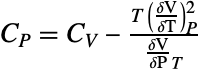
ThermodynamicData["CarbonDioxide", "IsochoricHeatCapacity", {"Temperature" -> Quantity[40, "DegreesCelcius"], "Pressure" -> Quantity[10 ^ 5, "Pascals"]}] - Quantity[313.15, "Kelvins"]dVdT[40] ^ 2 / dVdP[10 ^ 5] * Quantity[1, "Joules" / ("Kelvins" ^ 2"Kilograms")]ThermodynamicData["CarbonDioxide", "IsobaricHeatCapacity", {"Temperature" -> Quantity[40, "DegreesCelcius"], "Pressure" -> Quantity[10 ^ 5, "Pascals"]}]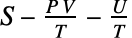
s = QuantityMagnitude@ThermodynamicData["Water", "Entropy", {"Temperature" -> Quantity[Table[x, {x, 20, 400, 20}], "DegreesCelsius"], "Pressure" -> Quantity[Table[10 ^ x, {x, 3, 6, 0.2}], "Pascals"]}];
u = QuantityMagnitude@ThermodynamicData["Water", "InternalEnergy", {"Temperature" -> Quantity[Table[x, {x, 20, 400, 20}], "DegreesCelsius"], "Pressure" -> Quantity[Table[10 ^ x, {x, 3, 6, 0.2}], "Pascals"]}];
v = QuantityMagnitude@ThermodynamicData["Water", "SpecificVolume", {"Temperature" -> Quantity[Table[x, {x, 20, 400, 20}], "DegreesCelsius"], "Pressure" -> Quantity[Table[10 ^ x, {x, 3, 6, 0.2}], "Pascals"]}];t = QuantityMagnitude[UnitConvert[Quantity[Table[x, {x, 20, 400, 20}], "DegreesCelsius"], "Kelvins"]];
p = Table[10 ^ x, {x, 3, 6, 0.2}];planck = Table[{Quantity[t[[j]], "Kelvins"], Quantity[p[[i]], "Pascals"], Quantity[s[[i, j]] - u[[i, j]] / t[[j]] - p[[i]]v[[i, j]] / t[[j]], "Joules" / ("Kelvins" * "Kilograms")]}, {i, Length[p]}, {j, Length[t]}];ListPlot3D[Flatten[planck, 1], AxesLabel -> Automatic]mAir = 10ChemicalData["Air", "MolarMass"]等温膨張曲線および等温圧縮曲線を,それぞれ摂氏200度および摂氏100度で計算する:
isothermalExpansion = Transpose[{
UnitSimplify[ThermodynamicData["Air", "SpecificVolume", {"Temperature" -> Quantity[200, "DegreesCelcius"], "Pressure" -> Quantity[Range[100, 200]1000, "Pascals"]}]mAir], Quantity[Range[100, 200]1000, "Pascals"]}];isothermalCompression = Transpose[{
UnitSimplify[ThermodynamicData["Air", "SpecificVolume", {"Temperature" -> Quantity[120, "DegreesCelcius"], "Pressure" -> Quantity[Range[100, 200]1000, "Pascals"]}]mAir], Quantity[Range[100, 200]1000, "Pascals"]}];
ListLinePlot[{isothermalExpansion, isothermalCompression}AxesLabel -> Automatic, PlotRange -> All, GridLines -> {{0.2, 0.3}, {}}]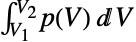
W = Quantity[
	NIntegrate[Evaluate[Interpolation[QuantityMagnitude[isothermalExpansion]][V]], {V, 0.2, 0.3}] -
NIntegrate[Evaluate[Interpolation[QuantityMagnitude[isothermalCompression]][V]], {V, 0.2, 0.3}], "Joules"]{pMax1, pMin1} = Quantity[Interpolation[QuantityMagnitude[isothermalExpansion]][{0.2, 0.3}], "Pascals"]{pMax2, pMin2} = Quantity[Interpolation[QuantityMagnitude[isothermalCompression]][{0.2, 0.3}], "Pascals"]U[T_, p_] := ThermodynamicData["Air", "InternalEnergy", {"Temperature" -> T, "Pressure" -> p}] * mAir;
ΔU = U[Quantity[200, "DegreesCelcius"], pMax1] - U[Quantity[120, "DegreesCelcius"], pMin2](W/ΔU)1. - (UnitConvert[Quantity[120, "DegreesCelcius"], "Kelvins"]/UnitConvert[Quantity[200, "DegreesCelcius"], "Kelvins"])考えられる問題 (6)
ThermodynamicData["heavy water", "Entropy"]
ThermodynamicData["Water", "speed of sound", {"Pressure" -> Quantity[180, "Hectopascals"], "Temperature" -> Quantity[100, "DegreesCelcius"]}]
ThermodynamicData["Air", "InternalEnergy", {"Temperature" -> Quantity[2 * 10 ^ 5, "Pascals"], "Pressure" -> Quantity[200, "DegreesCelsius"]}]

ThermodynamicData["Air", "InternalEnergy", {"Entropy" -> Quantity[4005.8, "Joules" / ("Kilograms""Kelvins")], "Quality" -> 0.5}]
ThermodynamicData["Water", "IsobaricHeatCapacity", {"Temperature" -> Quantity[-5, "DegreesCelsius"]}]ThermodynamicData["Water", "SolidLiquidPhaseBoundary", {"Temperature" -> Quantity[100, "DegreeCelsius"]}]ThermodynamicData["Water", "SolidLiquidPhaseBoundary", {"Pressure" -> Quantity[610, "Pascals"]}]Missingの項目については算術演算はできない:
data = Table[ThermodynamicData["Water", "LiquidVaporPhaseBoundary", {"Pressure" -> Quantity[10 ^ x, "Pascals"]}], {x, 2, 8}]演算の前にMissingの項目を削除する:
DeleteCases[data, _Missing]45 %おもしろい例題 (4)
蒸気圧公式 (1)
Tc = ThermodynamicData["Water", "CriticalTemperature"]pc = ThermodynamicData["Water", "CriticalPressure"]Ts = ThermodynamicData["Water", "LiquidVaporPhaseBoundary", {"Pressure" -> Quantity[Table[10 ^ x, {x, 2.9, 7.3, 0.01}], "Pascals"]}];ps = Quantity[Table[10 ^ x, {x, 2.9, 7.3, 0.01}], "Pascals"];logps = Log[ps / pc];waData = ListPlot[Transpose[{Ts, logps}]]ϑ = 1 - Quantity[t, "Kelvins"] / Tc;data = QuantityMagnitude /@ Transpose[{Ts, logps}];fit = Fit[data, QuantityMagnitude[Tc] / t{ϑ, ϑ ^ (3 / 2), ϑ ^ 3, ϑ ^ (7 / 2), ϑ ^ (4), ϑ ^ (15 / 2)}, t]Show[{Plot[Evaluate[fit], {t, 280, 650}], waData}]Total[((Function[t, Evaluate[fit]] /@ QuantityMagnitude[Ts]) - logps) ^ 2]圧力容積線図 (1)
h20G = ChemicalData["Water", "MolarMass"] Quantity[1, "Moles"]
Pc = ThermodynamicData["Water", "CriticalPressure"];
Tc = ThermodynamicData["Water", "CriticalTemperature"];pressures = Table[p, {p, 0.1, 2, 0.05}]Pc;TpVaporLiquid = Cases[Transpose[
{ThermodynamicData["Water", "LiquidVaporPhaseBoundary", {"Pressure" -> pressures}], pressures}], {_Quantity, _Quantity}];{TpSolidVaporLiquidVolume, TpSolidVaporVaporVolume} = (Function[δ, (ThermodynamicData["Water", "SpecificVolume", {"Temperature" -> #1, "Pressure" -> #2}]&@@@({(1 + δ)#1, #2}&@@@TpVaporLiquid))] /@ {-1 / 1000, 1 / 1000})h20G;pVCurves = ListLinePlot[Transpose[{#, pressures}]& /@
Table[ThermodynamicData["Water", "SpecificVolume", {"Pressure" -> pressures, "Temperature" -> t Tc}]h20G, {t, 0.5, 1.5, 0.05}], AxesLabel -> Automatic]
boilingRegion =
	ListLinePlot[Sort[Join[Transpose[{TpSolidVaporLiquidVolume, Last /@ TpVaporLiquid}],
	{{ThermodynamicData["Water", "SpecificVolume", {"Temperature" -> Tc, "Pressure" -> Pc}]h20G, Pc}},
	Transpose[{TpSolidVaporVaporVolume, Last /@ TpVaporLiquid}]]], Filling -> Axis,
AxesLabel -> Automatic, PlotRange -> {{0, 0.0015}, All}, PlotStyle -> Black, InterpolationOrder -> 2];Show[{boilingRegion, pVCurves}]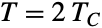 等温線を使ってファンデルワールス(van der Waals)方程式のパラメータ
 および
 を推定する:
dimensionlessPVanDerWaals = (R T/V - b) - (a/V^2) /.
{R -> QuantityMagnitude[UnitConvert[Quantity[1, "MolarGasConstant"]]], T -> QuantityMagnitude[2Tc]}abValues = FindFit[Transpose[
QuantityMagnitude[{ThermodynamicData["Water", "SpecificVolume", {"Pressure" -> pressures, "Temperature" -> 2Tc}]ChemicalData["Water", "MolarMass"]Quantity[1, "Moles"], pressures}]], dimensionlessPVanDerWaals, {{a, 0.5}, {b, 0.00003}}, V]気体液体共存領域では,van der Waals方程式の等温線は非単調であり,不安定性あるいは非物質的な動作を表しているので,Maxwellの規則を使って置換しなければならない:
Show[{boilingRegion,
Plot[Evaluate[Table[(R T) / (V - b) - a / V ^ 2 /. {R -> QuantityMagnitude[UnitConvert[Quantity[1, "MolarGasConstant"]]], T -> QuantityMagnitude[t Tc]} /. abValues, {t, 0.25, 1.5, 0.08}]], {V, 0, 0.0015}]}, PlotRange -> {{0, 0.001}, {0, 3*^7}}]
水の変動 (1)
室温・標準空気圧の大量の水があるとする.1 中の水の分子のどのくらいが時間とともに変動するだろうか.
大規模正準集団内で,粒子の変動の二乗平均平方根について,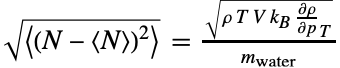 の関係を導出することができる.ただし,
 は水の密度である:
waterMoleculeMass = ChemicalData["Water", "MolecularMass"] を有限差分として計算する.変動は約450億個の水の分子に見られる:
Sqrt[Module[{ε = 0.25, T0 = Quantity[300, "Kelvins"], P0 = Quantity[1, "Atmospheres"]},
	(Subtract@@ThermodynamicData["Water", "MassDensity", {"Pressure" -> {1 + ε, 1 - ε}P0, "Temperature" -> T0}]) / Quantity[2ε, "Atmospheres"] * ThermodynamicData["Water", "Density", {"Pressure" -> P0, "Temperature" -> T0}] * T0 * Quantity[1, "BoltzmannConstant"] * Quantity[1, "Centimeters" ^ 3]] / waterMoleculeMass ^ 2]//UnitConvert
ジュール・トムソン係数 (1)
圧縮した気体についてのジュール・トムソン(Joule–Thomson)係数を計算する.陰関数微分法を使って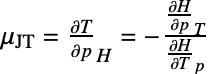 から得られる:
Solve[D[H[T[P, H], P], P] == 0, D[T[P, H], P]]μJT[substance_, {T_, P_}] :=
Module[{Δ = 0.2, Ps, Ts, HP, HT},
{Ps, Ts} = Table[(1 + δ)#, {δ, -Δ, Δ, 2Δ / 5}]& /@ {P, T};
{HP, HT} = Function[{p, t}, ThermodynamicData[substance, "Enthalpy",
{"Pressure" -> p, "Temperature" -> t}]]@@@{{Ps, T}, {P, Ts}};
SetPrecision[-Interpolation[Transpose[{Ps, HP}]]'[P] / Interpolation[Transpose[{Ts, HT}]]'[T], 1.8]]gases = {"Argon", "Nitrogen", "Hydrogen", "Helium"};水素とヘリウムのジュール・トムソン係数は負のことがあり,膨張すると暖かくなる:
μJTData = Table[{Quantity[t, "Kelvins"],
μJT[gas, {Quantity[t, "Kelvins"], Quantity[1, "Atmospheres"]}]}, {gas, gases}, {t, 175, 500, 50}];ListPlot[μJTData, AxesLabel -> Automatic, Joined -> True, Mesh -> All,
PlotLegends -> (ChemicalData[#, "Name"]& /@ gases)]関連リンク

 ThermodynamicDataの出典情報
テキスト
Wolfram Research (2014), ThermodynamicData, Wolfram言語関数, https://reference.wolfram.com/language/ref/ThermodynamicData.html.
CMS
Wolfram Language. 2014. "ThermodynamicData." Wolfram Language & System Documentation Center. Wolfram Research. https://reference.wolfram.com/language/ref/ThermodynamicData.html.
APA
Wolfram Language. (2014). ThermodynamicData. Wolfram Language & System Documentation Center. Retrieved from https://reference.wolfram.com/language/ref/ThermodynamicData.html