CoefficientRules[poly,{x1,x2,…}]
给出 poly 中关于 xi 的单项式的指数向量和系数的列表 {{e11,e12,…}c1,{e21,…}c2,…}.
CoefficientRules[poly,{x1,x2,…},order]
给出由 order 指定的单项式排序结果.
CoefficientRules
CoefficientRules[poly,{x1,x2,…}]
给出 poly 中关于 xi 的单项式的指数向量和系数的列表 {{e11,e12,…}c1,{e21,…}c2,…}.
CoefficientRules[poly,{x1,x2,…},order]
给出由 order 指定的单项式排序结果.
更多信息和选项
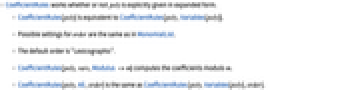
- 无论 poly 是否是显式的展开形式,CoefficientRules 都起作用.
- CoefficientRules[poly] 等价于 CoefficientRules[poly,Variables[poly]].
- order 的可能设置和 MonomialList 中相同.
- 缺省序是 "Lexicographic".
- CoefficientRules[poly,vars,Modulus ->m] 计算系数模除 m.
- CoefficientRules[poly,All,order] 与 CoefficientRules[poly,Variables[poly],order] 相同.
范例
打开所有单元 关闭所有单元范围 (1)
选项 (1)
属性和关系 (2)
FromCoefficientRules 重构原多项式:
CoefficientRules[a x ^ 2 + b x y + c y ^ 2, {x, y}]FromCoefficientRules[%, {x, y}]MonomialList 给出不同的表示:
MonomialList[a x ^ 2 + b x y + c y ^ 2, {x, y}]对于二个变量,"DegreeLexicographic" 和 "DegreeReverseLexicographic" 一致:
poly = Sum[RandomInteger[{-10, 10}]x ^ RandomInteger[10]y ^ RandomInteger[10], {20}]CoefficientRules[poly, {x, y}, "DegreeLexicographic"] === CoefficientRules[poly, {x, y}, "DegreeReverseLexicographic"]可能存在的问题 (1)
Variables[poly] 给出的列表不总是排序的:
Variables[y + x z]CoefficientRules[y + x z]FromCoefficientRules[%, {y, x, z}]巧妙范例 (2)
MonomialOrderPlot[poly_, {x1_, x2_}, ord_ : "Lexicographic", o : OptionsPattern[]] :=
Graphics[{Blue, Arrow /@ Partition[CoefficientRules[poly, {x1, x2}, ord][[All, 1]], 2, 1]}, Sequence@@FilterRules[{o}, Options[Graphics]]]orders = {"Lexicographic", "DegreeLexicographic", "DegreeReverseLexicographic", "NegativeLexicographic", "NegativeDegreeLexicographic", "NegativeDegreeReverseLexicographic"};Table[MonomialOrderPlot[Sum[x ^ i y ^ j, {i, 0, 5}, {j, 0, 5}], {x, y}, o, PlotLabel -> Style[o, Small]], {o, orders}]MonomialOrderPlot3D[poly_, {x1_, x2_, x3_}, ord_ : "Lexicographic", o : OptionsPattern[]] :=
Graphics3D[{Arrowheads[.06], Arrow[Tube[#, .02]]& /@ Partition[CoefficientRules[poly, {x1, x2, x3}, ord][[All, 1]], 2, 1]}, Sequence@@FilterRules[{o}, Options[Graphics3D]]]orders = {"Lexicographic", "DegreeLexicographic", "DegreeReverseLexicographic", "NegativeLexicographic", "NegativeDegreeLexicographic", "NegativeDegreeReverseLexicographic"};Table[MonomialOrderPlot3D[Sum[x ^ i y ^ j z ^ k, {i, 0, 2}, {j, 0, 2}, {k, 0, 2}], {x, y, z}, o, PlotLabel -> Style[o, Small]], {o, orders}]技术笔记
-
▪
- 多项式排序
相关指南
-
▪
- 多项式代数
文本
Wolfram Research (2008),CoefficientRules,Wolfram 语言函数,https://reference.wolfram.com/language/ref/CoefficientRules.html.
CMS
Wolfram 语言. 2008. "CoefficientRules." Wolfram 语言与系统参考资料中心. Wolfram Research. https://reference.wolfram.com/language/ref/CoefficientRules.html.
APA
Wolfram 语言. (2008). CoefficientRules. Wolfram 语言与系统参考资料中心. 追溯自 https://reference.wolfram.com/language/ref/CoefficientRules.html 年
BibTeX
@misc{reference.wolfram_2026_coefficientrules, author="Wolfram Research", title="{CoefficientRules}", year="2008", howpublished="\url{https://reference.wolfram.com/language/ref/CoefficientRules.html}", note=[Accessed: 15-September-2026]}
BibLaTeX
@online{reference.wolfram_2026_coefficientrules, organization={Wolfram Research}, title={CoefficientRules}, year={2008}, url={https://reference.wolfram.com/language/ref/CoefficientRules.html}, note=[Accessed: 15-September-2026]}