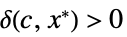
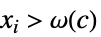
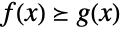
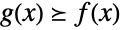
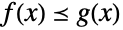
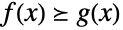
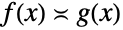
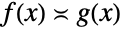
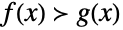
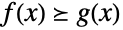
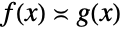
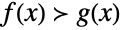
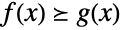
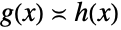
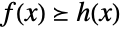
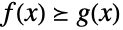
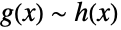
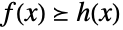
AsymptoticGreaterEqual[f,g,xx*]
给出当 xx* 时
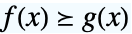
或
的条件.
AsymptoticGreaterEqual[f,g,{x1,…,xn}{
,…,
}]
给出当 {x1,…,xn}{
,…,
} 时
或
的条件.
AsymptoticGreaterEqual
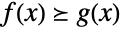
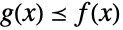
AsymptoticGreaterEqual[f,g,xx*]
给出当 xx* 时
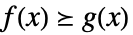
或
的条件.
AsymptoticGreaterEqual[f,g,{x1,…,xn}{
,…,
}]
给出当 {x1,…,xn}{
,…,
} 时
或
的条件.
更多信息和选项
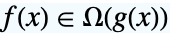
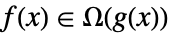
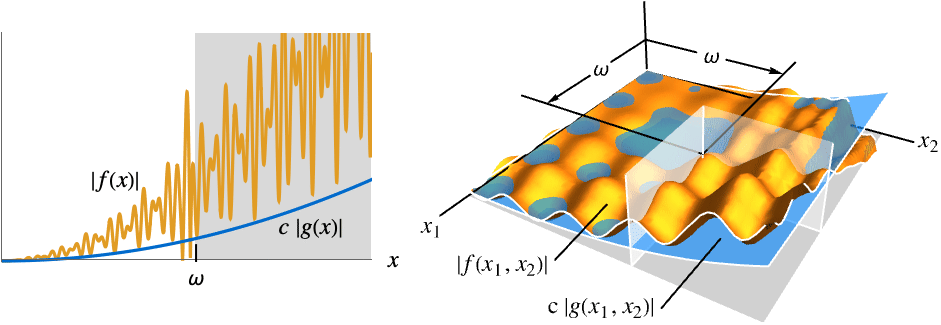
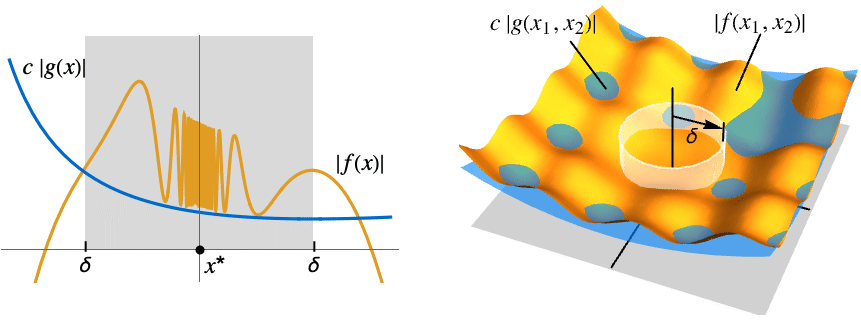
- 渐近大于或等于也被表示为 f 是 g 的大写的 omega,f 以 g 为下界,f 的大小至少为 g,f 至少与 g 增长得一样快. 经常从上下文中估计点 x*.
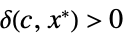
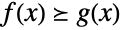
- 渐近大于或等于是一种排序关系, 意味着对于某些常数
,当 x 靠近 x* 时,
. - 典型的用途包括表示函数和序列在一些点附近的简单下界. 它经常用于方程的解,并给出计算复杂度的简单下界.
- 对于有限极限点 x* 和 {
,…,
}: -
AsymptoticGreaterEqual[f[x],g[x],xx*] 存在
和
,使得
意味着
成立AsymptoticGreaterEqual[f[x1,…,xn],g[x1,…,xn],{x1,…,xn}{
,…,
}]存在
和
,使得
意味着
成立 - 对于无限极限点:
-
AsymptoticGreaterEqual[f[x],g[x],x∞] 存在
和
,使得
意味着
成立AsymptoticGreaterEqual[f[x1,…,xn],g[x1,…,xn],{x1,…,xn}{∞,…,∞}] 存在
和
,使得
意味着
成立 - 在 x* 附近 g[x] 的值不为无限个零时,当且仅当 MinLimit[Abs[f[x]/g[x]],xx*]>0 成立时, AsymptoticGreaterEqual[f[x],g[x],xx*] 才存在.
- 可以给出下列选项:
-
Assumptions $Assumptions 对参数的设定 Direction Reals 趋近极限点的方向 GenerateConditions Automatic 对参数生成条件 Method Automatic 所使用的方法 PerformanceGoal "Quality" 优化目标 - Direction 的可能设置包括:
-
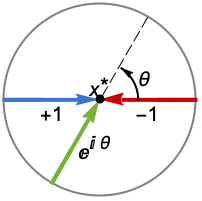
Reals or "TwoSided" 从两个实方向 "FromAbove" or -1 从上面或较大的值 "FromBelow" or +1 从下面或较小的值 Complexes 从所有复方向 Exp[ θ] 从方向 
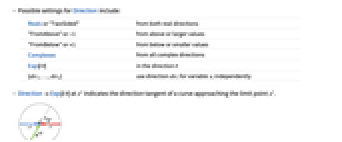
{dir1,…,dirn} 对变量 xi 分别使用方向 diri - 在 x* 处的 DirectionExp[ θ] 表示接近极限点 x* 的曲线的方向切线.
- GenerateConditions 的可能设置包括:
-
Automatic 只给出非通用条件 True 所有条件 False 不给出条件 None 如果需要条件则不经计算直接返回 - PerformanceGoal 的可能设置包括 $PerformanceGoal、"Quality" 和 "Speed". 当设置为 "Quality" 时,AsymptoticGreaterEqual 通常可以解出更多的问题或者产生更简单的结果,但是可能会耗费更多的时间和内存.
范例
打开所有单元 关闭所有单元基本范例 (2)
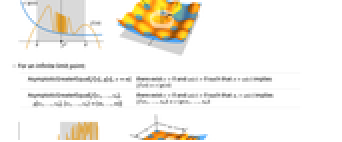
AsymptoticGreaterEqual[x ^ 2 , x, x -> ∞]Plot[{x ^ 2, x}, {x, 0, 10}, PlotLegends -> "Expressions"]AsymptoticGreaterEqual[x ^ 2 + y ^ 2, x + y, {x, y} -> ∞]Plot3D[{x ^ 2 + y ^ 2, x + y}, {x, 0, 10}, {y, 0, 10}, PlotLegends -> "Expressions"]范围 (9)
AsymptoticGreaterEqual[x, -x ^ 2, x -> ∞]AsymptoticGreaterEqual[(1/x^2), (1/x Sin[x]), x -> 0]答案可能是布尔表达式,而不是明确的 True 或 False:
AsymptoticGreaterEqual[Sinh[p(x - 2)], Sin[x - 2], x -> 2]AsymptoticGreaterEqual[(1/(x - 1)^p), (10/x - 1), x -> 1]AsymptoticGreaterEqual[x^4, x^2 UnitStep[x], x -> 0]AsymptoticGreaterEqual[x^4, x^2 UnitStep[x], x -> 0, Direction -> "FromBelow"]AsymptoticGreaterEqual[x^4, x^2 UnitStep[x], x -> 0, Direction -> "FromAbove"]Plot[{x^4, x^2UnitStep[x]}, {x, -1, 1}, PlotTheme -> {"DashedLines", "Detailed"}]像 Sqrt 这样的函数可能在负实数的两个实数方向上具有相同的关系:
AsymptoticGreaterEqual[(Sqrt[z] - I)^3, (z + 1), z -> -1]AsymptoticGreaterEqual[(Sqrt[z] - I)^3, (z + 1), z -> -1, Direction -> -I]AsymptoticGreaterEqual[(Sqrt[z] - I)^3, (z + 1), z -> -1, Direction -> I]这是由于在与坐标轴相交时 Sqrt 的虚部的符号发生了反转:
TableForm[Table[{-1 + Δ, Sqrt[-1 + Δ], Abs[Sqrt[-1 + Δ] - I]}, {Δ, {0.01, -0.01, 0.01I, -0.01I}}], TableHeadings -> {None, {z, Sqrt[z], HoldForm@Abs[Sqrt[z] - I]}}]AsymptoticGreaterEqual[(Sqrt[z] - I)^3, (z + 1), z -> -1, Direction -> Complexes]Plot[{Abs[ (-1 + Δz/(Sqrt[-1 + Δz] - I)^3)], Abs[ (-1 + I Δz/(Sqrt[-1 + I Δz] - I)^3)]}, {Δz, -1, 1}, IconizedObject[«plot options»]]AsymptoticGreaterEqual[(x - 1)^2(y - 2), Sin[ x]Cos[3y / 4], {x, y} -> {1, 2}]Show[Plot3D[{Abs[(x - 1) ^ 2 (y - 2)], Abs[Sin[x] Cos[3 y / 4]]}, {x, y}∈Disk[{1, 2}, .25], PlotTheme -> "Detailed"], Graphics3D[{AbsolutePointSize[7], Point[{1, 2, 0}]}], ViewPoint -> {1.36, -2.75, 1.42}]AsymptoticGreaterEqual[Exp[x]Log[y], x y, {x, y} -> {-∞, ∞}]AsymptoticGreaterEqual[Sinh[x]y, Sinh[a x]Sqrt[y], {x, y} -> {∞, 1}]选项 (10)
Assumptions (1)
用 Assumptions 为参数指定条件:
AsymptoticGreaterEqual[1, x ^ a, x -> 0, Assumptions -> a ≥ 0]AsymptoticGreaterEqual[1, x ^ a, x -> 0, Assumptions -> a < 0]Direction (5)
AsymptoticGreaterEqual[x UnitStep[x], Sin[x], x -> 0, Direction -> "FromBelow"]AsymptoticGreaterEqual[x UnitStep[x], Sin[x], x -> 0, Direction -> 1]AsymptoticGreaterEqual[x UnitStep[x], Sin[x], x -> 0, Direction -> "FromAbove"]AsymptoticGreaterEqual[x UnitStep[x], Sin[x], x -> 0, Direction -> -1]AsymptoticGreaterEqual[FractionalPart[x ^ 2]Sin[x], Cos[x / 2], x -> 2, Direction -> "FromBelow"]AsymptoticGreaterEqual[FractionalPart[x ^ 2]Sin[x], Cos[x / 2], x -> 2, Direction -> "FromAbove"]AsymptoticGreaterEqual[FractionalPart[x ^ 2]Sin[x], Cos[x / 2], x -> 2, Direction -> "TwoSided"]Plot[{FractionalPart[x ^ 2]Sin[x], Cos[x / 2], Abs[(FractionalPart[x ^ 2]Sin[x]/Cos[x / 2])]}, {x, 1.5, 2.5}, PlotLegends -> "Expressions"]AsymptoticGreaterEqual[Tan[x], (2/2x - π), x -> π / 2, Direction -> "FromBelow"]AsymptoticGreaterEqual[Tan[x], (2/2x - π), x -> π / 2, Direction -> "FromAbove"]AsymptoticGreaterEqual[Tan[x], (2/2x - π), x -> π / 2, Direction -> ℝ]AsymptoticGreaterEqual[Tan[x], (2/2x - π), x -> π / 2, Direction -> ℂ]AsymptoticGreaterEqual[Tanh[x], Sqrt[x - 1] - I, x -> 0, Direction -> +I]AsymptoticGreaterEqual[Tanh[x], Sqrt[x - 1] - I, x -> 0, Direction -> -I]AsymptoticGreaterEqual[Tanh[x], Sqrt[x - 1] - I, x -> 0, Direction -> Reals]AsymptoticGreaterEqual[Tanh[x], Sqrt[x - 1] - I, x -> 0, Direction -> Complexes]f[x_, y_] := x + Abs[y]g[x_, y_] := Sin[x y]AsymptoticGreaterEqual[f[x, y], g[x, y], {x, y} -> {0, 0}, Direction -> "FromAbove"]AsymptoticGreaterEqual[f[x, y], g[x, y], {x, y} -> {0, 0}, Direction -> {"FromAbove", "FromAbove"}]AsymptoticGreaterEqual[f[x, y], g[x, y], {x, y} -> {0, 0}, Direction -> {"FromAbove", "FromBelow"}]//QuietAsymptoticGreaterEqual[f[x, y], g[x, y], {x, y} -> {0, 0}, Direction -> {"FromAbove", Reals}]AsymptoticGreaterEqual[f[x, y], g[x, y], {x, y} -> {0, 0}, Direction -> {Reals, "FromBelow"}]ContourPlot[Abs[f[x, y] / g[x, y]], {x, -1, 1}, {y, -1, 1}, PlotLegends -> Automatic, ClippingStyle -> Automatic]GenerateConditions (3)
AsymptoticGreaterEqual[1, x ^ n, x -> 0, GenerateConditions -> False]AsymptoticGreaterEqual[1, x ^ n, x -> 0]AsymptoticGreaterEqual[Exp[a x], 1, x -> ∞, GenerateConditions -> None]AsymptoticGreaterEqual[Exp[a x], 1, x -> ∞]AsymptoticGreaterEqual[(x - a)^2 + y^2, x y, {x, y} -> {0, 0}]当 GenerateConditions->True 时,非通用条件也要报告:
AsymptoticGreaterEqual[(x - a)^2 + y^2, x y, {x, y} -> {0, 0}, GenerateConditions -> True]PerformanceGoal (1)
用 PerformanceGoal 来避免潜在的巨量计算:
f = y^2 - 2 y z + z^2 - y (x - 2 y + 3 z) + z (x - 2 y + 3 z) + (x - 2 y + 3 z)^2;
g = 2 y z^2 - z^3 + y (x - 2 y + 3 z)^2 - z (x - 2 y + 3 z)^2;AsymptoticGreaterEqual[f, g, {x, y, z} -> {0, 0, 0}, PerformanceGoal -> "Speed"]//AbsoluteTimingAsymptoticGreaterEqual[f, g, {x, y, z} -> {0, 0, 0}]//AbsoluteTiming应用 (10)
基本应用 (4)
{AsymptoticGreaterEqual[1, x, x -> 0], AsymptoticGreaterEqual[x, x^2, x -> 0], AsymptoticGreaterEqual[x^2, x^3, x -> 0]}AsymptoticGreaterEqual[x^k, x^l, x -> 0, Assumptions -> {k, l}∈ℤ && l ≥ k ≥ 0]Plot[{1, Abs[x], Abs[x^2], Abs[x^3]}, {x, -1, 1}, PlotLegends -> "Expressions"]AsymptoticGreaterEqual[x^k, x^l, x -> 0, Assumptions -> l ≥ k]Plot[{Abs[1 / x], Abs[1 / Sqrt[x]], 1, Abs[Sqrt[x]], Abs[x]}, {x, -1, 1}, PlotLegends -> "Expressions"]{AsymptoticGreaterEqual[x^3, x^2, x -> ∞], AsymptoticGreaterEqual[x^2, x, x -> ∞], AsymptoticGreaterEqual[x^1, x^0, x -> ∞]}AsymptoticGreaterEqual[x^k, x^l, x -> ∞, Assumptions -> {k, l}∈ℤ && 0 ≤ l ≤ k]LogPlot[{1, Abs[x], Abs[x^2], Abs[x^3]}, {x, 10, 100}, PlotLegends -> "Expressions"]AsymptoticGreaterEqual[x^k, x^l, x -> ∞, Assumptions -> l ≤ k]LogPlot[{Abs[1 / x], Abs[1 / Sqrt[x]], 1, Abs[Sqrt[x]], Abs[x]}, {x, 10, 100}, PlotLegends -> "Expressions"]AsymptoticGreaterEqual[x, x^2(Sin[1 / x] + 2), x -> 0]AsymptoticGreaterEqual[x^2(Sin[1 / x] + 2), x^2, x -> 0]Plot[{x^2, x^2(Sin[1 / x] + 2), Abs[x]}, {x, -1 / 3, 1 / 3}, PlotLegends -> "Expressions"]AsymptoticGreaterEqual[x^2, x^2(Sin[x] + 2), x -> ∞]AsymptoticGreaterEqual[x^2(Sin[x] + 2), x, x -> ∞]LogPlot[{x^2, x^2(Sin[x] + 2), x}, {x, 1, 100}, PlotLegends -> "Expressions"]计算复杂度 (4)
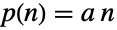
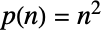
简单的排序算法(冒泡排序,插入排序)需要大约 a n2 个步骤对 n 个对象进行排序,而最优通用算法(堆排序,合并排序)大约需要 b n Log[n] 个步骤来进行排序. 证明

,对足够大的对象集合进行排序时,最优算法永远不会更慢:
AsymptoticGreaterEqual[a n^2, b n Log[n], n -> ∞, Assumptions -> a b > 0]某些特殊的算法(计数排序,基数排序),在有关可能的输入的信息提前存在的情况下,可在 c n 时间内完成. 证明

:
AsymptoticGreaterEqual[b n Log[n], c n, n -> ∞, Assumptions -> b c > 0]LogPlot[{n^2, n Log[n], n}, {n, 10, 1000}, PlotLegends -> "Expressions", PlotLabel -> Row[{n^2∈Ω[n Log[n]], n Log[n]∈Ω[n]}, Spacer[10]]]在冒泡排序中,对相邻的项进行比较,如果顺序不对即进行交换. 经过 n-1 次比较后,最大的元素在最后. 然后在剩余的 n-1 个元素上重复该过程,直到开头处只剩下两个元素. 如果比较和交换需要 c 个步骤,则排序需要的总步骤如下所示:
Sum[c(i - 1), {i, n, 2, -1}]AsymptoticGreaterEqual[(1/2) (-c n + c n^2), n^2, n -> ∞, Assumptions -> c > 0]AsymptoticLessEqual[(1/2) (-c n + c n^2), n^2, n -> ∞, Assumptions -> c > 0]AsymptoticEqual[(1/2) (-c n + c n^2), n^2, n -> ∞, Assumptions -> c > 0]在合并排序中,元素列表被分成两部分,分别对每部分进行排序,然后合并两个部分. 因此,进行排序的总时间 T[n] 将是用于计算中值的某个固定时间 b 加上对每一半元素进行排序的时间 2T[n/2],再加上用于将两部分元素合并在一起的时间,即元素个数的倍数 a n:

reqn = T[n] == 2T[n / 2] + a n + bt = RSolveValue[reqn, T[n], n]//ExpandAsymptoticGreaterEqual[t, n Log[n], n -> ∞, Assumptions -> a > 0]AsymptoticLessEqual[t, n Log[n], n -> ∞, Assumptions -> a > 0]AsymptoticEqual[t, n Log[n], n -> ∞, Assumptions -> a > 0]旅行推销员问题 (TSP) 需要找到连接
个城市的最短路线. 一个朴素的算法是尝试所有
个路线. Held–Karp 算法将其减少到大约
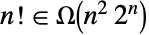
个步骤. 证明
:
AsymptoticGreaterEqual[n!, n ^ 2 2^n, n -> ∞]这两种算法都表明,TSP 的计算复杂度类不比 EXPTIME 难,EXPTIME 问题是可以在时间
内解决的问题. 对于 Held–Karp 算法,使用
就可以了,其中
:
AsymptoticGreaterEqual[2^2n, n^2 2^n, n -> ∞]AsymptoticGreaterEqual[2^n^2, n!, n -> ∞]可以在
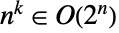
时间内找到近似解,所以近似 TSP 属于复杂度类 P 问题,是在多项式时间内可以解决的问题. 任何多项式算法都比指数型算法快,或
:
AsymptoticGreaterEqual[2^n, n^k, n -> ∞]收敛性测试 (2)
如果
,序列
被认为是绝对可以求和的. 如果第二个序列
,且
不是绝对可以求和的,比较测试指出,则
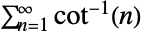
也不是绝对可以求和的. 通过与
的和进行比较,用测试证明
发散:
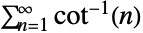
AsymptoticGreaterEqual[(1/n), ArcCot[n], n -> ∞]DiscreteLimit[Sum[(1/n), {n, 1, k}], k -> ∞]与 SumConvergence 给出的答案比较:
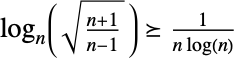
SumConvergence[ArcCot[n], n]AsymptoticGreaterEqual[(1/PrimePi[n]), (1/n), n -> ∞]AsymptoticGreaterEqual[Log[n, Sqrt[(n + 1/n - 1)]], (1/n Log[n]), n -> ∞]与 SumConvergence 给出的答案比较:
SumConvergence[Abs[(1/n Log[n])], n]如果
,函数
被认为在
上是绝对可积的. 如果
和
在开区间
上是连续的,且在
和
处有
,比较测试指出,如果
不是绝对可积的,那么
也不是绝对可积的. 用测试证明
在
上不是绝对可积的:
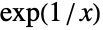
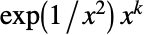
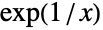
AsymptoticGreaterEqual[ArcCot[x], (1/ x), x -> ∞]AsymptoticGreaterEqual[ArcCot[x], (1/ x), x -> 1]Integrate[Abs[(1/x)], {x, 1, ∞}]Integrate[Abs[Exp[(1/x)]], {x, 0, 1}]AsymptoticGreaterEqual[Exp[1 / x^2]x^k, Exp[1 / x], x -> 0]AsymptoticGreaterEqual[Exp[1 / x^2]x^k, Exp[1 / x], x -> 1]AsymptoticGreaterEqual[Exp[(1/x^2)] x^k, Exp[(1/x)], x -> ∞, Assumptions -> k ≥ 0]Integrate[Abs[Exp[(1/x)]], {x, 1, ∞}]AsymptoticGreaterEqual[Exp[(1/x^2)] x^k, Exp[(1/x)], x -> ∞, Assumptions -> k < 0]属性和关系 (8)
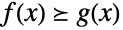
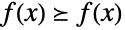
AsymptoticGreaterEqual 是一种自反关系,即
:
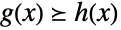
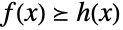
AsymptoticGreaterEqual[f[x], f[x], x -> x0]{f, g, h} = {x^3, x^2, x};{AsymptoticGreaterEqual[f, g, x -> ∞], AsymptoticGreaterEqual[g, h, x -> ∞], AsymptoticGreaterEqual[f, h, x -> ∞]}{AsymptoticGreaterEqual[f, g, x -> ∞], AsymptoticGreaterEqual[g, f, x -> ∞]}当且仅当 MinLimit[Abs[f[x]/g[x]],xx0]>0 时,AsymptoticGreaterEqual[f[x],g[x],xx0] 的结果为:
{f, g} = {x, x Sin[x]};{AsymptoticGreaterEqual[f, g, x -> ∞], MinLimit[Abs[f / g], x -> ∞]}{f, g} = {x Sin[x], Sqrt[x]};{AsymptoticGreaterEqual[f, g, x -> ∞], MinLimit[Abs[f / g], x -> ∞]}如果 Limit[Abs[f[x]/g[x]],xx0]>0,则 AsymptoticGreaterEqual[f[x],g[x],xx0] 的结果为:
{f, g} = {x^2, x^3 / (1 + x)};{AsymptoticGreaterEqual[f, g, x -> ∞], Limit[Abs[f / g], x -> ∞]}然而,当极限为 Indeterminate 时,结果是不确定的:
{f, g} = {x, x Sin[x]};{AsymptoticGreaterEqual[f, g, x -> ∞], Limit[Abs[f / g], x -> ∞]}{f, g} = {x Sin[x], Sqrt[x]};{AsymptoticGreaterEqual[f, g, x -> ∞], Limit[Abs[f / g], x -> ∞]}{f, g} = {x, x^2 / (1 + x)};{AsymptoticGreaterEqual[f, g, x -> ∞], AsymptoticLessEqual[g, f, x -> ∞]}{f, g} = {x, x^2 / (1 + x)};{AsymptoticLessEqual[f, g, x -> ∞], AsymptoticGreaterEqual[f, g, x -> ∞], AsymptoticEqual[f, g, x -> ∞]}{f, g} = {x^2 / (1 + x), x};{AsymptoticEqual[f, g, x -> ∞], AsymptoticGreaterEqual[f, g, x -> ∞]}{f, g} = {x^3 / (1 + x), x};{AsymptoticGreater[f, g, x -> ∞], AsymptoticGreaterEqual[f, g, x -> ∞]}{f, g} = {1 / x, Sin[x] / x};{AsymptoticGreaterEqual[f, g, x -> ∞], AsymptoticGreater[f, g, x -> ∞], AsymptoticEqual[g, h, x -> ∞]}{f, g, h} = {x^2, x, x^3 / (1 + x^2)};{AsymptoticGreaterEqual[f, g, x -> ∞], AsymptoticEqual[g, h, x -> ∞], AsymptoticGreaterEqual[f, h, x -> ∞]}{f, g, h} = {x^2, x, x^3 / (1 + x^2)};{AsymptoticGreaterEqual[f, g, x -> ∞], AsymptoticEquivalent[g, h, x -> ∞], AsymptoticGreaterEqual[f, h, x -> ∞]}相关指南
-
▪
- 渐近
文本
Wolfram Research (2018),AsymptoticGreaterEqual,Wolfram 语言函数,https://reference.wolfram.com/language/ref/AsymptoticGreaterEqual.html.
CMS
Wolfram 语言. 2018. "AsymptoticGreaterEqual." Wolfram 语言与系统参考资料中心. Wolfram Research. https://reference.wolfram.com/language/ref/AsymptoticGreaterEqual.html.
APA
Wolfram 语言. (2018). AsymptoticGreaterEqual. Wolfram 语言与系统参考资料中心. 追溯自 https://reference.wolfram.com/language/ref/AsymptoticGreaterEqual.html 年
BibTeX
@misc{reference.wolfram_2026_asymptoticgreaterequal, author="Wolfram Research", title="{AsymptoticGreaterEqual}", year="2018", howpublished="\url{https://reference.wolfram.com/language/ref/AsymptoticGreaterEqual.html}", note=[Accessed: 13-August-2026]}
BibLaTeX
@online{reference.wolfram_2026_asymptoticgreaterequal, organization={Wolfram Research}, title={AsymptoticGreaterEqual}, year={2018}, url={https://reference.wolfram.com/language/ref/AsymptoticGreaterEqual.html}, note=[Accessed: 13-August-2026]}