


ConjugateTranspose
或  ,给出
,给出  的共轭转置.
更多信息和选项
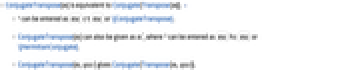
- ConjugateTranspose[m] 等价于 Conjugate[Transpose[m]]. »
 可以通过输入
  ct
ct 或 \[ConjugateTranspose] 得到.
 - ConjugateTranspose[m] 也可以作为
 给出,其中
给出,其中  通过输入
通过输入  hc
hc 或\[HermitianConjugate] 得到.
 - ConjugateTranspose[m] 的 StandardForm 和 TraditionalForm 格式为

- ConjugateTranspose[m,spec] 给出 Conjugate[Transpose[m,spec]]. »
范例
打开所有单元 关闭所有单元
 输入:
输入:范围 (11)
矩阵 (6)
ConjugateTranspose[vec] 对项进行共轭,但不会改变 vec 的形状:
ConjugateTranspose 适用于符号矩阵:
使用 ComplexExpand 假设所有变量都是实数:
ConjugateTranspose 保持单位矩阵不变:
转置一个 SymmetrizedArray 对象:
数组 (5)
对秩为 3 的数组的前两层进行共轭转置,有效地将其视为向量矩阵:
使用 TwoWayRule 表示法进行转置:
应用 (10)
矩阵分解 (4)


![TemplateBox[{q}, ConjugateTranspose]](Files/ConjugateTranspose.zh/34.png "TemplateBox[{q}, ConjugateTranspose]")


![TemplateBox[{a}, ConjugateTranspose].a](Files/ConjugateTranspose.zh/42.png "TemplateBox[{a}, ConjugateTranspose].a")


特数矩阵 (6)
埃尔米特矩阵服从 ![s=TemplateBox[{s}, ConjugateTranspose]](Files/ConjugateTranspose.zh/50.png "s=TemplateBox[{s}, ConjugateTranspose]") ,反埃尔米矩阵服从
,反埃尔米矩阵服从 ![a=-TemplateBox[{a}, ConjugateTranspose]](Files/ConjugateTranspose.zh/51.png "a=-TemplateBox[{a}, ConjugateTranspose]") . 该矩阵为埃尔米特矩阵:
. 该矩阵为埃尔米特矩阵:
使用 HermitianMatrixQ 进行验证:
使用 AntihermitianMatrixQ 进行验证:
![TemplateBox[{u}, Inverse]=TemplateBox[{u}, ConjugateTranspose]](Files/ConjugateTranspose.zh/52.png "TemplateBox[{u}, Inverse]=TemplateBox[{u}, ConjugateTranspose]")

使用 UnitaryMatrixQ 验证酉矩阵:
埃尔米特矩阵可酉对角化为 ![h=u.d.TemplateBox[{u}, ConjugateTranspose]](Files/ConjugateTranspose.zh/54.png "h=u.d.TemplateBox[{u}, ConjugateTranspose]") ,其中
,其中  为是对角实数矩阵,
 为酉矩阵. 验证以下矩阵是埃尔米特矩阵,然后对其进行对角化:



![u=TemplateBox[{v}, Transpose]](Files/ConjugateTranspose.zh/60.png "u=TemplateBox[{v}, Transpose]")
反埃尔米特阵可酉对角化为 ![a=u.d.TemplateBox[{u}, ConjugateTranspose]](Files/ConjugateTranspose.zh/61.png "a=u.d.TemplateBox[{u}, ConjugateTranspose]") ,其中
,其中  为对角矩阵且值为虚数,
 为酉矩阵. 验证以下矩阵是反埃尔米矩阵,然后对其进行对角化:



![u=TemplateBox[{v}, Transpose]](Files/ConjugateTranspose.zh/67.png "u=TemplateBox[{v}, Transpose]")
酉矩阵本身可酉对角化为 ![u=v.d.TemplateBox[{v}, ConjugateTranspose]](Files/ConjugateTranspose.zh/68.png "u=v.d.TemplateBox[{v}, ConjugateTranspose]") ,其中
,其中  为酉矩阵且
为酉矩阵且  为对角矩阵,其项位于单位圆上. 验证以下矩阵是酉矩阵,然后对其进行对角化:

![u=v.d.TemplateBox[{v}, ConjugateTranspose]](Files/ConjugateTranspose.zh/72.png "u=v.d.TemplateBox[{v}, ConjugateTranspose]")
如果 ![n.TemplateBox[{n}, ConjugateTranspose]=TemplateBox[{n}, ConjugateTranspose].n](Files/ConjugateTranspose.zh/73.png "n.TemplateBox[{n}, ConjugateTranspose]=TemplateBox[{n}, ConjugateTranspose].n") ,则矩阵
,则矩阵  被称为正规矩阵. 正规矩阵是最通用的一种矩阵,它可以被酉对角化为
  ,其中
,其中  为对角矩阵,且
  为酉矩阵. 所有埃尔米特矩阵
  都是正规的,因为等式的两边都只是
  :
:

酉矩阵是正规矩阵,因为在定义中代入 ![TemplateBox[{u}, ConjugateTranspose]=TemplateBox[{u}, Inverse]](Files/ConjugateTranspose.zh/81.png "TemplateBox[{u}, ConjugateTranspose]=TemplateBox[{u}, Inverse]") 会在等式两边给出单位矩阵:
会在等式两边给出单位矩阵:
使用 NormalMatrixQ 进行验证:
像  这样的正规矩阵可使用 Eigensystem 进行酉对角化:
![n=u.d.TemplateBox[{u}, ConjugateTranspose]](Files/ConjugateTranspose.zh/83.png "n=u.d.TemplateBox[{u}, ConjugateTranspose]")
属性和关系 (10)
ConjugateTranspose[m] 等价于 Conjugate[Transpose[m]]:
ConjugateTranspose 服从 ![TemplateBox[{{(, TemplateBox[{A}, ConjugateTranspose, SyntaxForm -> SuperscriptBox], )}}, ConjugateTranspose]=A](Files/ConjugateTranspose.zh/84.png "TemplateBox[{{(, TemplateBox[{A}, ConjugateTranspose, SyntaxForm -> SuperscriptBox], )}}, ConjugateTranspose]=A") :
:
对于兼容矩阵  和
和  ,ConjugateTranspose 服从
 ![TemplateBox[{{(, {a, ., b}, )}}, ConjugateTranspose]=TemplateBox[{b}, ConjugateTranspose].TemplateBox[{a}, ConjugateTranspose]](Files/ConjugateTranspose.zh/87.png "TemplateBox[{{(, {a, ., b}, )}}, ConjugateTranspose]=TemplateBox[{b}, ConjugateTranspose].TemplateBox[{a}, ConjugateTranspose]") :
:
矩阵求逆与 ConjugateTranspose 互换,即 ![TemplateBox[{{(, TemplateBox[{a}, ConjugateTranspose], )}}, Inverse]=TemplateBox[{{(, TemplateBox[{a}, Inverse], )}}, ConjugateTranspose]](Files/ConjugateTranspose.zh/88.png "TemplateBox[{{(, TemplateBox[{a}, ConjugateTranspose], )}}, Inverse]=TemplateBox[{{(, TemplateBox[{a}, Inverse], )}}, ConjugateTranspose]") :
:
许多特殊矩阵根据其在 ConjugateTranspose 下的属性进行定义. 埃尔米特矩阵有 ![TemplateBox[{h}, ConjugateTranspose]=h](Files/ConjugateTranspose.zh/89.png "TemplateBox[{h}, ConjugateTranspose]=h") :
:
![TemplateBox[{o}, ConjugateTranspose]=TemplateBox[{o}, Inverse]](Files/ConjugateTranspose.zh/90.png "TemplateBox[{o}, ConjugateTranspose]=TemplateBox[{o}, Inverse]")








结果不能再次为 {{}} ,因为维度 {1,0} 的排列是 {0,1} 且没有表达式有维度 {0,1}:
ConjugateTranspose[a] 转置数组的前两层:
ConjugateTranspose[a,perm] 返回维数为 Permute[Dimensions[a],perm] 的数组:
文本
Wolfram Research (2004),ConjugateTranspose,Wolfram 语言函数,https://reference.wolfram.com/language/ref/ConjugateTranspose.html (更新于 2025 年).
CMS
Wolfram 语言. 2004. "ConjugateTranspose." Wolfram 语言与系统参考资料中心. Wolfram Research. 最新版本 2025. https://reference.wolfram.com/language/ref/ConjugateTranspose.html.
APA
Wolfram 语言. (2004). ConjugateTranspose. Wolfram 语言与系统参考资料中心. 追溯自 https://reference.wolfram.com/language/ref/ConjugateTranspose.html 年