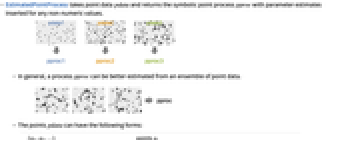
EstimatedPointProcess[pdata,pproc]
根据点数据 pdata 估计参数化点过程 pproc.
EstimatedPointProcess[pdata,pproc,{{p,p0},{q,q0},…}]
从起始值 p0、q0、… 开始估计参数 p、q、….
EstimatedPointProcess
EstimatedPointProcess[pdata,pproc]
根据点数据 pdata 估计参数化点过程 pproc.
EstimatedPointProcess[pdata,pproc,{{p,p0},{q,q0},…}]
从起始值 p0、q0、… 开始估计参数 p、q、….
更多信息和选项
- EstimatedPointProcess 接受点数据 pdata,返回符号点过程 pproc,并用估计的参数值替换非数字的值.

-
- 通常,根据一组点数据能更好地估计过程 pproc.
-
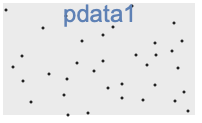
- 点 pdata 可采用以下形式:
-
{p1,p2,…} 点 pi GeoPosition[…],GeoPositionXYZ[…],… 地理点 SpatialPointData[…] 空间点集 {pts,reg} 点集 pts 和观察区域 reg - 点被转换为 SpatialPointData 对象,如果 pdata 中没有提供,则使用 Ripley–Rasson 估计器生成观察区域.
- 可以给出下列选项:
-
AccuracyGoal Automatic 追求的准确度 PointProcessEstimator Automatic 使用哪个过程参数估计器 PrecisionGoal Automatic 追求的精度 WorkingPrecision Automatic 内部计算中使用的精度 - 在各个点过程的参考页面可看到 PointProcessEstimator 的设置.
范例
打开所有单元 关闭所有单元基本范例 (1)
估计 PoissonPointProcess 的参数:
data = RandomPointConfiguration[PoissonPointProcess[20, 2], Disk[]];eproc = EstimatedPointProcess[data, PoissonPointProcess[mu, 2]]gdata = NearestNeighborG[data];
gproc = NearestNeighborG[eproc];Plot[{gdata[r], gproc[r]}, {r, 0, 0.3}]范围 (3)
聚类点过程 (1)
proc = MaternPointProcess[20, 30, 1, 2];
points = RandomPointConfiguration[proc, Rectangle[]];ListPlot[points]est = EstimatedPointProcess[points, MaternPointProcess[a, b, c, d], PointProcessEstimator -> "FindClusters"]DiscretePlot[{RipleyK[est, r], RipleyK[proc, r]}, {r, 0.1, .5, .005}, PlotLegends -> {"original process", "estimated model"}]Gibbs 点过程 (2)
proc = HardcorePointProcess[30, .1, 2];
points = RandomPointConfiguration[proc, Disk[]];ListPlot[points]EstimatedPointProcess[points, HardcorePointProcess[a, b, c]]a0 = points["MeanPointCount"];
b0 = Min[DeleteCases[Flatten[DistanceMatrix[points["Points"]]], 0. | 0]];EstimatedPointProcess[points, HardcorePointProcess[a, b, 2], {{a, a0}, {b, b0}}, Method -> "MaximumPseudoLikelihood"]proc = StraussPointProcess[100, 0.5, 0.1, 2];
reg = Rectangle[];pts = RandomPointConfiguration[proc, reg, 3]ListPlot[pts]EstimatedPointProcess[pts, StraussPointProcess[μ, γ, R, 2]]选项 (3)
PointProcessEstimator (2)
proc = ThomasPointProcess[20, 30, 1, 2];
points = RandomPointConfiguration[proc, Rectangle[]];EstimatedPointProcess[points, ThomasPointProcess[a, b, c, d], PointProcessEstimator -> "FindClusters"]EstimatedPointProcess[points, ThomasPointProcess[a, b, c, d], PointProcessEstimator -> "MethodOfMoments"]proc = HardcorePointProcess[40, .1, 2];
points = RandomPointConfiguration[proc, Rectangle[]];使用 "MaximumPseudoLikelihood" 方法:
EstimatedPointProcess[points, HardcorePointProcess[a, b, c], PointProcessEstimator -> "MaximumPseudoLikelihood"]EstimatedPointProcess[points, HardcorePointProcess[a, b, c], PointProcessEstimator -> "MaximumLikelihood"]WorkingPrecision (1)
proc = PoissonPointProcess[30, 2];
points = RandomPointConfiguration[proc, Disk[], WorkingPrecision -> 20];指定 WorkingPrecision:
EstimatedPointProcess[points, PoissonPointProcess[μ, d], WorkingPrecision -> 20]默认情况下,EstimatedPointProcess 使用 MachinePrecision:
EstimatedPointProcess[points, PoissonPointProcess[μ, d]]文本
Wolfram Research (2020),EstimatedPointProcess,Wolfram 语言函数,https://reference.wolfram.com/language/ref/EstimatedPointProcess.html.
CMS
Wolfram 语言. 2020. "EstimatedPointProcess." Wolfram 语言与系统参考资料中心. Wolfram Research. https://reference.wolfram.com/language/ref/EstimatedPointProcess.html.
APA
Wolfram 语言. (2020). EstimatedPointProcess. Wolfram 语言与系统参考资料中心. 追溯自 https://reference.wolfram.com/language/ref/EstimatedPointProcess.html 年
BibTeX
@misc{reference.wolfram_2026_estimatedpointprocess, author="Wolfram Research", title="{EstimatedPointProcess}", year="2020", howpublished="\url{https://reference.wolfram.com/language/ref/EstimatedPointProcess.html}", note=[Accessed: 07-September-2026]}
BibLaTeX
@online{reference.wolfram_2026_estimatedpointprocess, organization={Wolfram Research}, title={EstimatedPointProcess}, year={2020}, url={https://reference.wolfram.com/language/ref/EstimatedPointProcess.html}, note=[Accessed: 07-September-2026]}