

FindAstroEvent
FindAstroEvent[etype]
タイプ etype の次の天文現象の日付を与える.
FindAstroEvent[etype,date]
与えられた日付の次の天文現象を与える.
FindAstroEvent[etype,date,loc]
場所 loc で観測される次の天文現象の日付を与える.
詳細とオプション
- 月相,合,衝,その他さまざまなタイプの並び方の,天文現象の正確な日付を求める.
- 次は,地球から見た太陽の至と分点に関連した,FindAstroEvent[etype,…]の可能な現象タイプ etype である.
-
"MarchEquinox" 太陽の黄経が0°になる分点 "JuneSolstice" 太陽の黄経が90°になる至 "SeptemberEquinox" 太陽の黄経が180°になる分点 "DecemberSolstice" 太陽の黄経が270°になる至 - 次は,月相に関連した現象タイプである.
-
"NewMoon" 地球の月の新月 "FullMoon" 地球の月の満月 {"MoonPhase",phase} 地球の月の phase の瞬間 {"NewMoon",moon} その中心体から観測された moon の新月 {"FullMoon",moon} その中心体から観測された moon の満月 {"MoonPhase",moon,phase} その中心体から観測された moon の phase - 次は,出/入り/正中の観測に関連した現象タイプである.
-
"Sunrise" 日の出 "Sunset" 日の入り "FirstEquilux" 1年の前半で昼と夜の長さが等しくなる日 "SecondEquilux" 1年の後半で昼と夜の長さが等しくなる日 "Moonrise" 地球の月の出 "Moonset" 地球の月の入り {"Rise",body} 指定された天体の出 {"Set",body} 指定された天体の入り {"UpperCulmination",body} 天体の極上正中 {"LowerCulmination",body} 天体の極下正中 - 次は,近接アラインメントに関連した現象タイプである.
-
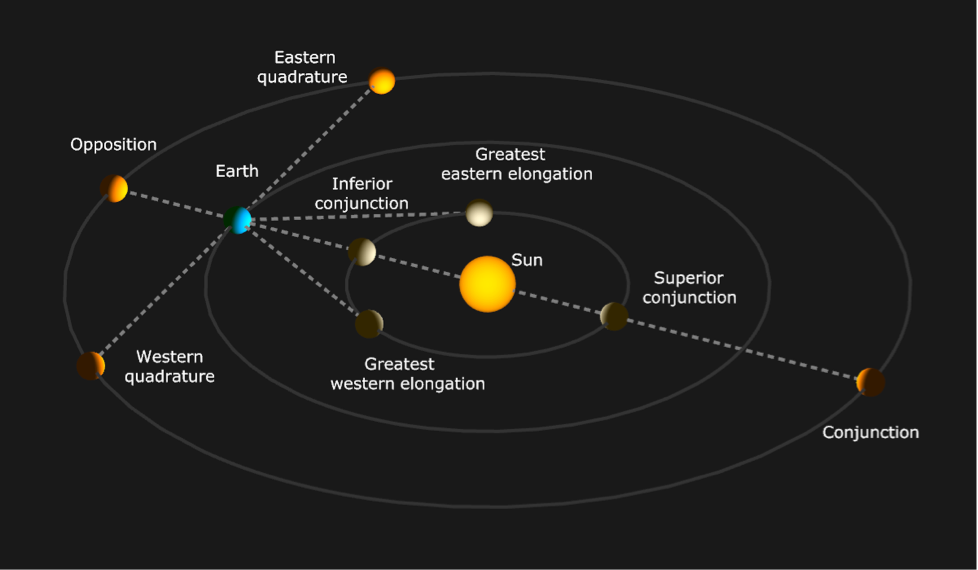
{"Conjunction",body1,body2} 経度座標における2つの天体の合 {"InferiorConjunction",body} 太陽と観測者の間を通過する天体 {"SuperiorConjunction",body} 太陽の後ろを通過する天体 {"Conjunction",body} 太陽と天体の内合または外合 {"Opposition",body} 太陽と天体の衝 - 次は,矩と最大離角に関連した現象タイプである.
-
{"EasternQuadrature",body} 太陽系外天体の東矩 {"WesternQuadrature",body} 太陽系外天体の西矩 {"GreatestEasternElongation",body} 太陽系内天体の東方最大離角 {"GreatestWesternElongation",body} 太陽系内天体の西方最大離角 - 次は,物理距離に関連した現象タイプである.
-
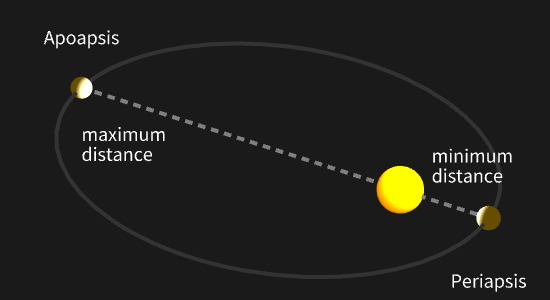
{"Distance",body1,body2,cond} body1と body2の間の距離は条件 cond に従う {"Distance",body1,body2,cond,adjst} adjst によって拡張された大域的距離条件 {"Periapsis",body} 中心を周回する body の距離の極小値 {"Apoapsis",body} 中心を周回する body の距離の極大値 - 次は,角度分離に関連した現象タイプである.
-
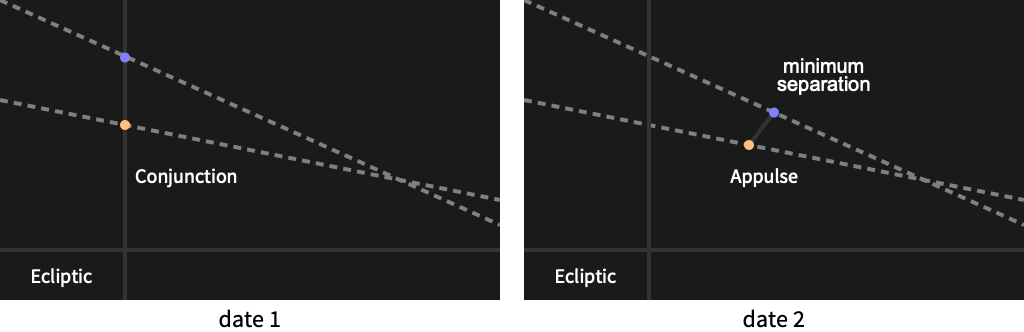
{"Separation",body1,body2,cond} body1と body2の間の角度は条件 cond に従う {"Separation",body1,body2,cond,adjst} adjst によって拡張された角度条件 {"Appulse",body1,body2} 2つの天体間の角度分離の極小値 {"Appulse",body} body と太陽の間の角度分離の極小値 - 次は,使用可能な条件 cond である.
-
Quantity[…] 適切な単位による数量の厳密な値 GreaterThan[val] 数量は値 val よりも大きい "GlobalMaximum" 数量の最大値 "LocalMaximum" 数量の極大値のリスト - 極小値と極大値の条件を調整して,値と極値の差が指定された調整値未満になる日付間隔を返すことができる.
例題
すべて開く すべて閉じる例 (2)
FindAstroEvent["MarchEquinox"]この日,太陽の黄経は厳密に0°であるが,これは360°に相当する:
AstroPosition["Sun", {"Ecliptic", %}]FindAstroEvent[{"Conjunction", Entity["Planet", "Mars"]}]AstroGraphics[Entity["Star", "Sun"], AstroReferenceFrame -> {"Ecliptic", %}, AstroRange -> Quantity[2, "AngularDegrees"], AstroGridLines -> Quantity[1, "AngularDegrees"]]スコープ (24)
分点と至の現象 (2)
FindAstroEvent["MarchEquinox", TimeZone -> 0]FindAstroEvent["MarchEquinox", DateInterval@DateObject[{2001}, "CenturyBeginning01"], TimeZone -> "GMT"]//Short[#, 4]&CountsBy[%, #["Day"]&]出,入り,正中,昼夜の長さが等しい日の現象 (3)
FindAstroEvent["Moonrise"]上記の書き方は以下のより一般的な形式を簡略化したものである:
FindAstroEvent[{"Rise", "Moon"}]FindAstroEvent[{"Set", Entity["Planet", "Jupiter"]}]FindAstroEvent[{"UpperCulmination", "Moon"}]FindAstroEvent[{"LowerCulmination", "Sun"}]date = FindAstroEvent[{"UpperCulmination", Entity["PlanetaryMoon", "Phobos"]}, Now, Entity["SolarSystemFeature", "OlympusMonsMars"]]AstroPosition[Entity["PlanetaryMoon", "Phobos"], {"Horizon", date, Entity["SolarSystemFeature", "OlympusMonsMars"]}]2025年の上半期にサンホセで昼と夜がほぼ12時間ずつになる日を求める:
FindAstroEvent["FirstEquilux", DateObject[{2025}], Entity["City", {"SanJose", "SanJose", "CostaRica"}]]Sunset[Entity["City", {"SanJose", "SanJose", "CostaRica"}], %] - Sunrise[Entity["City", {"SanJose", "SanJose", "CostaRica"}], %]Sunrise[Entity["City", {"SanJose", "SanJose", "CostaRica"}], %% + Quantity[1, "Days"]] - Sunset[Entity["City", {"SanJose", "SanJose", "CostaRica"}], %%]FindAstroEvent["SecondEquilux", DateObject[{2025}], Entity["City", {"SanJose", "SanJose", "CostaRica"}]]Sunset[Entity["City", {"SanJose", "SanJose", "CostaRica"}], %] - Sunrise[Entity["City", {"SanJose", "SanJose", "CostaRica"}], %]Sunrise[Entity["City", {"SanJose", "SanJose", "CostaRica"}], %% + Quantity[1, "Days"]] - Sunset[Entity["City", {"SanJose", "SanJose", "CostaRica"}], %%]合,衝,矩,離角の現象 (4)
FindAstroEvent[{"Conjunction", Entity["Planet", "Jupiter"]}]FindAstroEvent[{"Opposition", Entity["Planet", "Jupiter"]}]FindAstroEvent[{"WesternQuadrature", Entity["Planet", "Jupiter"]}]FindAstroEvent[{"EasternQuadrature", Entity["Planet", "Jupiter"]}]FindAstroEvent[{"InferiorConjunction", Entity["Planet", "Venus"]}]FindAstroEvent[{"GreatestWesternElongation", Entity["Planet", "Venus"]}]FindAstroEvent[{"SuperiorConjunction", Entity["Planet", "Venus"]}]FindAstroEvent[{"GreatestEasternElongation", Entity["Planet", "Venus"]}]FindAstroEvent[{"Conjunction", Entity["Planet", "Venus"], Entity["Planet", "Jupiter"]}]AstroPosition[Entity["Planet", "Venus"], {"Ecliptic", %}]AstroPosition[Entity["Planet", "Jupiter"], {"Ecliptic", %%}]date = FindAstroEvent[{"InferiorConjunction", Entity["Planet", "Earth"]}, DateObject[{2031}], Entity["Planet", "Mars"]]AstroGraphics[Entity["Star", "Sun"], AstroReferenceFrame -> {"Ecliptic", date, Entity["Planet", "Mars"]}, AstroRange -> Quantity[30, "Arcminutes"], AstroGridLines -> Quantity[5, "Arcminutes"]]距離の現象 (6)
FindAstroEvent[{"Distance", "Moon", "Earth", "LocalMaximum"}]FindAstroEvent[{"Apogee", "Moon"}]軌道を回る物体とその軌道の中心との最小距離は近点と呼ばれる:
FindAstroEvent[{"Periapsis", Entity["Planet", "Mercury"]}]FindAstroEvent[{"Perihelion", Entity["Planet", "Mercury"]}]FindAstroEvent[{"Perigee", Entity["PlanetaryMoon", "Moon"]}]太陽系のその他の主な天体の周りを回る天体の近点にも特別な名前がある:
FindAstroEvent[{"Periareion", Entity["PlanetaryMoon", "Phobos"]}]FindAstroEvent[{"Perijove", Entity["PlanetaryMoon", "Callisto"]}]FindAstroEvent[{"Perikrone", Entity["PlanetaryMoon", "Titan"]}]FindAstroEvent[{"Periuranion", Entity["PlanetaryMoon", "Oberon"]}]FindAstroEvent[{"Periposeideum", Entity["PlanetaryMoon", "Triton"]}]軌道を回る天体と軌道の中心との最大距離は,軌道遠点と呼ばれる:
FindAstroEvent[{"Apoapsis", Entity["Planet", "Mercury"]}]太陽の周りを回る天体の軌道遠点は遠日点としても知られている:
FindAstroEvent[{"Aphelion", Entity["Planet", "Mercury"]}]地球の周りを回る天体の軌道遠点は遠地点としても知られている:
FindAstroEvent[{"Apogee", Entity["PlanetaryMoon", "Moon"]}]太陽系のその他の主な天体の周りを回る天体の軌道遠点にも特別な名前がある:
FindAstroEvent[{"Apoareion", Entity["PlanetaryMoon", "Phobos"]}]FindAstroEvent[{"Apojove", Entity["PlanetaryMoon", "Callisto"]}]FindAstroEvent[{"Apokrone", Entity["PlanetaryMoon", "Titan"]}]FindAstroEvent[{"Apouranion", Entity["PlanetaryMoon", "Oberon"]}]FindAstroEvent[{"Apoposeideum", Entity["PlanetaryMoon", "Triton"]}]FindAstroEvent[{"Distance", "Moon", "Earth", "LocalMaximum"}, DateInterval[{{2024, 1}, {2024, 12}}]]AssociationMap[AstroDistance["Moon", {"Earth", #}]&, %]DateListPlot[Table[{date, AstroDistance["Moon", Dated["Earth", date]]}, {date, DateRange[DateObject[{2024, 1, 1}, "Day"], DateObject[{2025, 1, 1}, "Day"]]}], TargetUnits -> "Kilometers", ImageSize -> Medium]2020年から2050年までの,土星と地球の間の最短距離を求める:
FindAstroEvent[{"Distance", "Saturn", "Earth", "GlobalMinimum"}, DateInterval[{{2020}, {2050}}]]2024年7月に地球と月の距離が40万キロを超える期間を求める:
dint = FindAstroEvent[{"Distance", "Moon", "Earth", GreaterThan[Quantity[400000, "Kilometers"]]}, DateInterval[{{2024, 7, 1}, {2024, 7, 31}}]]DateRange@@DateBounds[%]DateListPlot[Table[{date, AstroDistance["Moon", Dated["Earth", date]]}, {date, DateRange[MinDate[dint], MaxDate[dint], "Hour"]}], TargetUnits -> "Kilometers"]角度分離の現象 (5)
date = FindAstroEvent[{"Separation", "Jupiter", "Saturn", "GlobalMinimum"}, DateInterval[{{2020, 1}, {2020, 12}}]]Plot[AstroAngularSeparation["Jupiter", "Saturn", Dated["Earth", date + Quantity[h, "Hours"]]], {h, -48, 48}, TargetUnits -> "Arcminutes"]AstroGraphics[{Entity["Planet", "Jupiter"], Entity["Planet", "Saturn"]}, AstroReferenceFrame -> {"Equatorial", date}, AstroRange -> Quantity[4, "Arcminutes"], AstroGridLines -> Quantity[1, "Arcminutes"]]2010年から2035年までの木星と土星の角度分離の極小値を求める:
mins = FindAstroEvent[{"Separation", "Jupiter", "Saturn", "LocalMinimum"}, DateInterval[{{2010}, {2035}}]]2つの惑星の角度分離を,極小値に格子線を置いてプロットする:
Plot[AstroAngularSeparation["Jupiter", "Saturn", Dated["Earth", year]], {year, 2010, 2035}, GridLines -> {DateValue[mins, "YearExact"]}, ImageSize -> Medium]FindAstroEvent[{"Separation", "Moon", "Sun", "GlobalMinimum"}, DateInterval[{{2024, 4, 1}, {2024, 4, 30}}]]SolarEclipse[DateObject[{2024, 4}]]FindAstroEvent[{"Separation", "Moon", "Sun", "GlobalMaximum"}, DateInterval[{{2024, 9, 1}, {2024, 9, 30}}]]LunarEclipse[DateObject[{2024, 9}]]2010年から2015年までに地球から観測された金星と月の最小分離を求める:
date = FindAstroEvent[{"Separation", Entity["Planet", "Venus"], Entity["Star", "Sun"], "GlobalMinimum"}, DateInterval[{{2010}, {2015}}]]Manipulate[AstroGraphics[Entity["Star", "Sun"], AstroReferenceFrame -> {"Ecliptic", date + Quantity[h, "Hours"]}, AstroRange -> Quantity[0.4, "AngularDegrees"], AstroGridLines -> Automatic], {{h, 0}, -3, 3}, SaveDefinitions -> True, SynchronousUpdating -> False]
| |

| |

| |

| |

| |

| |

| |

| |

| |

| |

| |

| |

| |

| |

| |

| |
日付指定 (4)
FindAstroEvent["MarchEquinox", DateObject[{2000, 1, 1}]]FindAstroEvent["JuneSolstice", DateInterval[{{2020}, {2030}}]]FindAstroEvent["SeptemberEquinox", DateRange[DateObject[{2020, 1, 1}], DateObject[{2030, 1, 1}], "Year"]]Normal[%]現象タイプが連続した期間を定義するなら,結果は日付区間である:
FindAstroEvent[{"Distance", "Moon", "Earth", GreaterThan[Quantity[400000, "Kilometers"]]}, DateInterval[{{2024, 10, 1}, {2024, 10, 31}}]]TimelinePlot[%, PlotRangePadding -> None]FindAstroEvent[{"Distance", "Moon", "Earth", EqualTo[Quantity[400000, "Kilometers"]]}, DateInterval[{{2024, 10, 1}, {2024, 10, 31}}]]オプション (7)
CalendarType (2)
FindAstroEventは,デフォルトで,日付をグレゴリオ暦で返す:
FindAstroEvent["SeptemberEquinox"]FindAstroEvent["SeptemberEquinox", CalendarType -> "ArithmeticFrench"]西暦紀元の始まりの頃,春分点はユリウス暦の3月22日付近だった:
FindAstroEvent["MarchEquinox", DateObject[{1}], CalendarType -> "Julian"]1582年の初めまでには,春分点がユリウス暦の3月10日付近まで移動した:
FindAstroEvent["MarchEquinox", DateObject[{1582}], CalendarType -> "Julian"]FindAstroEvent["MarchEquinox", DateObject[{1583}], CalendarType -> "Gregorian"]DateFormat (1)
FindAstroEventは,デフォルトで,日付を長い形式で返す:
FindAstroEvent["MarchEquinox"]FindAstroEvent["MarchEquinox", DateFormat -> {"Day", "/", "Month", "/", "Year"}]DateGranularity (1)
FindAstroEventは,デフォルトで,日付を粒度"Instant"で返す:
FindAstroEvent["JuneSolstice"]FindAstroEvent["JuneSolstice", DateGranularity -> "Day"]TimeDirection (1)
FindAstroEventは,デフォルトで,指定されたタイプの次の現象を求める:
FindAstroEvent["DecemberSolstice"]FindAstroEvent["DecemberSolstice", TimeDirection -> -1]TimeSystem (1)
FindAstroEventは,デフォルトで,日付を万国標準時で返す:
FindAstroEvent["MarchEquinox"]FindAstroEvent["MarchEquinox", TimeSystem -> "TT"]TimeZone (1)
FindAstroEventは,デフォルトで,日付をユーザのローカルな時刻帯で返す:
FindAstroEvent["MarchEquinox"]FindAstroEvent["MarchEquinox", TimeZone -> "GMT"]アプリケーション (3)
GMT時刻帯で報告された2020年のすべての至点と分点を求める:
data = FindAstroEvent[{"MarchEquinox", "JuneSolstice", "SeptemberEquinox", "DecemberSolstice"}, DateInterval[{{2020}, {2030}}], TimeZone -> 0];ToTabular[GroupBy[data, Last -> First], "Columns"]etypes = Thread[{{"Conjunction", "Opposition", "WesternQuadrature", "EasternQuadrature"}, Entity["Planet", "Jupiter"]}];events = FindAstroEvent[etypes, DateInterval[{{2024}, {2026}}]]結果をTabularオブジェクトで表示する:
ToTabular[data = KeyMap[First, GroupBy[events, Last -> First]], "Columns"]TimelinePlot[data]ボイジャー宇宙船の日付を計算し,その事象の前後数時間の距離を1000km単位でプロットし,中心の天体を茶色で表す関数を構築する:
flybyPlot[probe_, body_, hmax_] := With[{date = FindAstroEvent[{"Distance", probe, body, "GlobalMinimum"}, DateInterval[{{1979}, {1990}}], TimeZone -> 0, TimeSystem -> "TT"], R = body["Radius"], Mm = "Megameters"}, Echo[date -> UnitConvert[AstroDistance[probe, Dated[body, date]], Mm]];Plot[AstroDistance[probe, Dated[body, date + Quantity[h, "Hours"]]], {h, -hmax, hmax}, TargetUnits -> Mm, PlotRange -> {0, All}, Epilog -> {Brown, Rectangle[{-hmax, 0}, {hmax, R / Quantity[Mm]}]}]
	]
ボイジャー1は1977年9月5日に打ち上げられ,最まず,1979年3月5日に木星の系を訪れた:
Entity["DeepSpaceProbe", "Voyager1"]["LaunchDate"]flybyPlot[Entity["DeepSpaceProbe", "Voyager1"], Entity["Planet", "Jupiter"], 10]flybyPlot[Entity["DeepSpaceProbe", "Voyager1"], Entity["PlanetaryMoon", "Io"], 0.5]次に1980年11月12〜13日に土星の系を訪れ,タイタンに非常に接近した:
flybyPlot[Entity["DeepSpaceProbe", "Voyager1"], Entity["PlanetaryMoon", "Titan"], 0.2]flybyPlot[Entity["DeepSpaceProbe", "Voyager1"], Entity["Planet", "Saturn"], 5]ボイジャー2はボイジャー1の2週間前に打ち上げられたが,木星に達したのはボイジャー1よりも遅く,1979年7月9日であった:
Entity["DeepSpaceProbe", "Voyager2"]["LaunchDate"]flybyPlot[Entity["DeepSpaceProbe", "Voyager2"], Entity["PlanetaryMoon", "Ganymede"], 2]flybyPlot[Entity["DeepSpaceProbe", "Voyager2"], Entity["Planet", "Jupiter"], 10]flybyPlot[Entity["DeepSpaceProbe", "Voyager2"], Entity["Planet", "Saturn"], 5]flybyPlot[Entity["DeepSpaceProbe", "Voyager2"], Entity["Planet", "Uranus"], 5]次に,1989年8月25日に海王星を訪れ,惑星の表面近くを通過した:
flybyPlot[Entity["DeepSpaceProbe", "Voyager2"], Entity["Planet", "Neptune"], 1]特性と関係 (11)
NewMoon[date]はFindAstroEvent["NewMoon",date]に等しい:
NewMoon[]FindAstroEvent["NewMoon"]FullMoon[date]はFindAstroEvent["FullMoon",date]に等しい:
FullMoon[]FindAstroEvent["FullMoon"]MoonPhaseDate[date,"phase"]はFindAstroEvent[{"MoonPhase","phase"},date]に等しい:
MoonPhaseDate["FirstQuarter"]FindAstroEvent[{"MoonPhase", "FirstQuarter"}]新月から新月までの月齢周期が0から1になる月相の数値指定を使う:
MoonPhaseDate[0.25]FindAstroEvent[{"MoonPhase", 0.25}]MoonPhaseDateは,以下が次の第1四半期になるように月齢カウンタを外挿する:
MoonPhaseDate[1.25]FindAstroEventは,以下が同じ四半期になるように,1を法として月齢を解釈する:
FindAstroEvent[{"MoonPhase", 1.25}]NewMoon,FullMoon,MoonPhaseDateは,地球の中心から観測した月相を定義する:
FullMoon[]これは,FindAstroEventのデフォルトでもある:
FindAstroEvent["FullMoon"]FindAstroEventは,観察者の位置が指定されている場合は視差効果を考慮する:
FindAstroEvent["FullMoon", Now, Entity["City", {"London", "GreaterLondon", "UnitedKingdom"}]]Sunrise[loc,date]はFindAstroEvent["Sunrise",date,loc]に等しい:
Sunrise[Entity["City", {"Chicago", "Illinois", "UnitedStates"}], DateObject[{2024, 10, 1}, "Day"]]FindAstroEvent["Sunrise", DateObject[{2024, 10, 1}, "Day"], Entity["City", {"Chicago", "Illinois", "UnitedStates"}]]Sunset[loc,date]はFindAstroEvent["Sunset",date,loc]に等しい:
Sunset[Entity["City", {"Chicago", "Illinois", "UnitedStates"}], DateObject[{2024, 10, 1}, "Day"]]FindAstroEvent["Sunset", DateObject[{2024, 10, 1}, "Day"], Entity["City", {"Chicago", "Illinois", "UnitedStates"}]]出/入りの現象タイプについては,AstroRiseSet[body,type,loc,date]はFindAstroEvent[{type,body},date,loc]に等しい:
AstroRiseSet["Mars", "Rise"]FindAstroEvent[{"Rise", "Mars"}]MoonPhaseDate["FirstQuarter"]FindAstroEvent[{"EasternQuadrature", "Moon"}]MoonPhaseDate["LastQuarter"]FindAstroEvent[{"WesternQuadrature", "Moon"}]NewMoon[]FindAstroEvent[{"Conjunction", "Moon"}]FullMoon[]FindAstroEvent[{"Opposition", "Moon"}]FindAstroEvent["MarchEquinox"]AstroPosition["Sun", {"Ecliptic", %}]その黄緯は0に非常に近くなり,太陽直下点もまた赤道に非常に近くなる:
AstroSubpoint["Sun", %%]DMSString[%]equinox = FindAstroEvent["MarchEquinox", DateGranularity -> "Day"]しかしこのことは,たとえ赤道近くの場所でも,昼夜の長さが等しくなることを意味する訳ではない:
Sunset[Entity["City", {"Bogota", "DistritoCapital", "Colombia"}], equinox] - Sunrise[Entity["City", {"Bogota", "DistritoCapital", "Colombia"}], equinox]Sunrise[Entity["City", {"Bogota", "DistritoCapital", "Colombia"}], equinox] - Sunset[Entity["City", {"Bogota", "DistritoCapital", "Colombia"}], equinox - Quantity[1, "Days"]]UnitConvert[%% - %, "Minutes"]指定の場所で昼夜の長さがほぼ等しくなる日は「equilux」と呼ばれる:
equilux = FindAstroEvent["FirstEquilux", Now, Entity["City", {"Bogota", "DistritoCapital", "Colombia"}]]Sunset[Entity["City", {"Bogota", "DistritoCapital", "Colombia"}], equilux] - Sunrise[Entity["City", {"Bogota", "DistritoCapital", "Colombia"}], equilux]Sunrise[Entity["City", {"Bogota", "DistritoCapital", "Colombia"}], equilux] - Sunset[Entity["City", {"Bogota", "DistritoCapital", "Colombia"}], equilux - Quantity[1, "Days"]]UnitConvert[%% - %, "Seconds"]conjunction = FindAstroEvent[{"Conjunction", "Mars", "Jupiter"}]近接は,角度の分離の局所的最小値によって定義される.近傍に一つ存在する:
appulse = First@FindAstroEvent[{"Appulse", "Mars", "Jupiter"}, DateInterval[conjunction + Quantity[{-1, 1}, "Days"]]]AstroPosition[{"Mars", "Jupiter"}, {"Ecliptic", conjunction}]["Longitude"]AstroPosition[{"Mars", "Jupiter"}, {"Ecliptic", appulse}]["Longitude"]{AstroAngularSeparation["Mars", "Jupiter", {"Earth", appulse}], AstroAngularSeparation["Mars", "Jupiter", {"Earth", conjunction}]}テキスト
Wolfram Research (2025), FindAstroEvent, Wolfram言語関数, https://reference.wolfram.com/language/ref/FindAstroEvent.html.
CMS
Wolfram Language. 2025. "FindAstroEvent." Wolfram Language & System Documentation Center. Wolfram Research. https://reference.wolfram.com/language/ref/FindAstroEvent.html.
APA
Wolfram Language. (2025). FindAstroEvent. Wolfram Language & System Documentation Center. Retrieved from https://reference.wolfram.com/language/ref/FindAstroEvent.html