

PairedBarChart
PairedBarChart[{y1,y2,…},{z1,z2,…}]
makes a paired bar chart with bar lengths y1, y2, … and z1, z2, …, respectively.
PairedBarChart[{…,wi[yi,…],…},{…,wj[zj,…],…}]
makes a paired bar chart with bar features defined by the symbolic wrappers wk.
PairedBarChart[{data11,…},{data21,…}]
makes a paired bar chart from multiple datasets data1i and data2j.
Details and Options
- Data elements for PairedBarChart can be given in the following forms:
-
yi a pure bar value Quantity[yi,unit] bar value with a unit wi[yi,…] a bar with value yi and wrapper wi formi->mi a bar form with metadata mi - Data not given in these forms is taken to be missing, and typically yields a gap in the bar chart.
- Datasets for PairedBarChart can be given in the following forms:
-
{e1,e2,…} list of elements with or without wrappers <k1y1,k2y2,…> association of keys and lengths TimeSeries[…],EventSeries[…],TemporalData[…] time series, event series, and temporal data WeightedData[…],EventData[…] augmented datasets w[{e1,e2,…},…] wrapper applied to a whole dataset w[{data1,data1,…},…] wrapper applied to all datasets - The following wrappers can be used for chart elements:
-
Annotation[e,label] provide an annotation Button[e,action] define an action to execute when the element is clicked EventHandler[e,…] define a general event handler for the element Hyperlink[e,uri] make the element act as a hyperlink Labeled[e,…] display the element with labeling Legended[e,…] include features of the element in a chart legend Mouseover[e,over] make the element show a mouseover form PopupWindow[e,cont] attach a popup window to the element StatusArea[e,label] display in the status area when the element is moused over Style[e,opts] show the element using the specified styles Tooltip[e,label] attach an arbitrary tooltip to the element - PairedBarChart[Tabular[…]cspec, …] extracts and plots values from the tabular object using the column specification cspec.
- The following forms of column specifications cspec are allowed for plotting tabular data:
-
col plot values from column col {col1,col2,…,coln} plot columns {col1, …, coln} as a group of values - PairedBarChart has the same options as Graphics with the following additions and changes: [List of all options]
-
AspectRatio 1/GoldenRatio overall ratio of height to width Axes True whether to draw axes BarOrigin "YAxis" origin placement for bars BarSpacing Automatic fractional spacing between bars ChartBaseStyle Automatic overall style for bars ChartElementFunction Automatic how to generate raw graphics for bars ChartElements Automatic graphics to use in each of the bars ChartLabels None labels for data elements and datasets ChartLayout Automatic overall layout to use ChartLegends None legends for data elements and datasets ChartStyle Automatic style for bars ColorFunction Automatic how to color bars ColorFunctionScaling True whether to normalize arguments to ColorFunction Joined False whether to join bars LabelingFunction Automatic how to label bars LabelingSize Automatic maximum size of callouts and labels LegendAppearance Automatic overall appearance of legends PerformanceGoal $PerformanceGoal aspects of performance to try to optimize PlotTheme $PlotTheme overall theme for the chart ScalingFunctions None how to scale individual coordinates TargetUnits Automatic units to display in the chart - Possible settings for BarOrigin include "XAxis" and "YAxis".
- With the setting BarSpacing->{sp,sg,sb}, sp can be used to control the space between the pair of bar charts. The unit for sp is in fractions of the width of the resulting graphic.
- The following settings for ChartLayout can be used to display multiple sets of data:
-

"Grouped" separate the data for each dataset 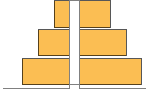
"Stacked" accumulate the data for each dataset 
"Percentile" accumulate and normalize the data for each dataset - The arguments supplied to ChartElementFunction are the bar region {{xmin,xmax},{ymin,ymax}}, the data value yi, and metadata {m1,m2,…} from each level in a nested list of datasets.
- A list of built-in settings for ChartElementFunction can be obtained from ChartElementData["PairedBarChart"].
- The argument supplied to ColorFunction and ScalingFunctions is yi.
- Style and other specifications from options and other constructs in PairedBarChart are effectively applied in the order ChartStyle, ColorFunction, Style and other wrappers, ChartElements, and ChartElementFunction, with later specifications overriding earlier ones.
List of all options
Examples
open all close allBasic Examples (3)
Generate a paired bar chart from two lists of heights:
PairedBarChart[{1, 3, 5}, {2, 4, 6}]PairedBarChart[{1, 3, 5}, {2, 4, 6}, PlotLabels -> <|"Elements" -> {"a", "b", "c"}|>]PairedBarChart[{1, 3, 5}, {2, 4, 6}, PlotStyle -> <|"Elements" -> {RGBColor[0.5882352941176471, 0.3058823529411765, 0.20784313725490197], RGBColor[0.7411764705882353, 0.5294117647058824, 0.3843137254901961], RGBColor[0.8509803921568627, 0.7333333333333333, 0.592156862745098]}|>, PlotLabels -> <|"Elements" -> {"a", "b", "c"}|>]PairedBarChart[{{1, 3, 5}, {2, 4, 6}}, {{2, 3, 6}, {4, 5, 3}}]Scope (34)
Data and Layouts (13)
Items in a dataset are grouped together:
PairedBarChart[{{1, 1, 1}, {2, 2, 2}, {3, 3, 3}}, {{1, 1, 1}, {2, 2, 2}, {3, 3, 3}}]Datasets do not need to have the same number of items:
PairedBarChart[{{1, 2}, {1, 2, 3}, {1, 2, 3, 4}}, {{1, 2}, {1, 2, 3}, {1, 2, 3, 4}}]Nonreal data is taken to be missing and typically yields a gap in the bar chart:
PairedBarChart[{{1, Missing[], 3}, {4, 2, 1 + I, 2}, {foo, 2, 4}}, {{1, Missing[], 3}, {4, 2, 1 + I, 2}, {foo, 2, 4}}]PairedBarChart[{Quantity[1, "Meters"], Quantity[1, "Meters"], Quantity[2, "Meters"], Quantity[3, "Meters"], Quantity[5, "Meters"], Quantity[8, "Meters"]}, {Quantity[3, "Feet"], Quantity[6, "Feet"], Quantity[6, "Feet"], Quantity[5, "Feet"], Quantity[7, "Feet"], Quantity[10, "Feet"]}, AxesLabel -> Automatic]PairedBarChart[{Quantity[1, "Meters"], Quantity[1, "Meters"], Quantity[2, "Meters"], Quantity[3, "Meters"], Quantity[5, "Meters"], Quantity[8, "Meters"]}, {Quantity[3, "Feet"], Quantity[6, "Feet"], Quantity[6, "Feet"], Quantity[5, "Feet"], Quantity[7, "Feet"], Quantity[10, "Feet"]}, AxesLabel -> Automatic, TargetUnits -> "Feet"]The time stamps in TimeSeries, EventSeries, and TemporalData are ignored:
PairedBarChart[TimeSeries[{19, 16, 9, 3, 7, 2, 17}, {"May 24, 1982"}], TimeSeries[{18, 9, 3, 17, 9, 13, 2}, {"Apr 21, 1981"}]]The values in associations are taken as the heights of the bars:
PairedBarChart[<|"a" -> 1, "b" -> 2, "c" -> 5, "d" -> 3|>, <|"a" -> 3, "b" -> 1, "c" -> 4, "d" -> 2|>]PairedBarChart[<|"a" -> 1, "b" -> 2, "c" -> 5, "d" -> 3|>, <|"a" -> 3, "b" -> 1, "c" -> 4, "d" -> 2|>, PlotLabels -> Automatic]PairedBarChart[<|"a" -> 1, "b" -> 2, "c" -> 5, "d" -> 3|>, <|"a" -> 3, "b" -> 1, "c" -> 4, "d" -> 2|>, PlotStyle -> <|"Elements" -> {Hue[0.61, 0.7, 1], Hue[0.17, 0.4, 0.65], Hue[0.64, 0.5, 0.75], Hue[0.45, 0.4, 0.7]}|>, PlotLegends -> Automatic]PairedBarChart[<|"group a" -> <|"a" -> 1, "b" -> 2, "c" -> 5, "d" -> 3|>, "group b" -> <|"a" -> 4, "b" -> 1, "c" -> 3, "d" -> 2|>|>, <|"group a" -> <|"a" -> 2, "b" -> 1, "c" -> 3, "d" -> 4|>, "group b" -> <|"a" -> 5, "b" -> 3, "c" -> 1, "d" -> 5|>|>, PlotLegends -> Automatic]The weights in WeightedData are ignored:
PairedBarChart[WeightedData[{1, 2, 3, 4, 5}, {0.5, 0.2, 0.1, 0.2, 0.3}], WeightedData[{1, 2, 3, 4, 5}, {0.3, 0.1, 0.3, 0.5, 0.3}]]The censoring and truncation information in EventData is ignored:
PairedBarChart[EventData[{8, 3, 5, 4, 9}, {0, 1, 1, 0, 0}], EventData[{5, 3, 8, 4, 9}, {0, 0, 1, 0, 1}]]Use different layouts to display multiple datasets:
Table[PairedBarChart[{{1, 2, 3}, {1, 3, 2}}, {{1, 2, 3}, {1, 3, 2}}, ChartLayout -> l], {l, {"Grouped", "Stepped"}}]Stacked layouts are more compact in the horizontal direction:
Table[PairedBarChart[RandomReal[1, {5, 5}], RandomReal[1, {5, 5}], ChartLayout -> l], {l, {"Stacked", "Percentile"}}]Use Joined to indicate connections between data points:
PairedBarChart[RandomReal[1, {6, 4}], RandomReal[1, {6, 4}], ChartLayout -> "Stacked", Joined -> True, BarSpacing -> {1, None}]Table[PairedBarChart[Range[5], Range[5], BarOrigin -> o, PlotLabel -> o], {o, {"XAxis", "YAxis"}}]Adjust the spacing between bars and groups of bars:
Table[PairedBarChart[{Range[4], Range[4]}, {Range[4], Range[4]}, BarSpacing -> s, PlotLabel -> s, PlotStyle -> <|"Base" -> Opacity[0.2]|>], {s, {Automatic, {0, 1}, {-0.3, 1}}}]Tabular Data (2)
tabular = ToTabular[IconizedObject[«WolframAlpha US population pyramid»]]Compare number of males and females per age range:
PairedBarChart[tabular -> "male", tabular -> "female", PlotLabels -> <|"Elements" -> Normal[tabular[All, "age"]]|>, BarSpacing -> {5 * 10 ^ 6, 0, 0}]Wrappers (5)
Use wrappers on individual data, datasets, or collections of datasets:
{PairedBarChart[{{1, Style[2, RGBColor[0.93, 0.27, 0.27]], 3}, {4, 5, 6}}, {{1, Style[2, RGBColor[0.93, 0.27, 0.27]], 3}, {4, 5, 6}}], PairedBarChart[{Style[{1, 2, 3}, RGBColor[0.14, 0.8, 0.14]], {4, 5, 6}}, {Style[{1, 2, 3}, RGBColor[0.14, 0.8, 0.14]], {4, 5, 6}}], PairedBarChart[Style[{{1, 2, 3}, {4, 5, 6}}, RGBColor[0.4, 0.6, 1]], Style[{{1, 2, 3}, {4, 5, 6}}, RGBColor[0.4, 0.6, 1]]]}{PairedBarChart[{{1, Style[2, RGBColor[0.93, 0.27, 0.27]], 3}, {4, 5, 6}}, {{1, Style[2, RGBColor[0.93, 0.27, 0.27]], 3}, {4, 5, 6}}], PairedBarChart[{Style[{1, Style[2, RGBColor[0.93, 0.27, 0.27]], 3}, RGBColor[0.14, 0.8, 0.14]], {4, 5, 6}}, {Style[{1, Style[2, RGBColor[0.93, 0.27, 0.27]], 3}, RGBColor[0.14, 0.8, 0.14]], {4, 5, 6}}], PairedBarChart[Style[{Style[{1, Style[2, RGBColor[0.93, 0.27, 0.27]], 3}, RGBColor[0.14, 0.8, 0.14]], {4, 5, 6}}, RGBColor[0.4, 0.6, 1]], Style[{Style[{1, Style[2, RGBColor[0.93, 0.27, 0.27]], 3}, RGBColor[0.14, 0.8, 0.14]], {4, 5, 6}}, RGBColor[0.4, 0.6, 1]]]}Override the default tooltips:
PairedBarChart[{1, Tooltip[2, "median"], 3}, {1, Tooltip[2, "median"], 3}]Use any object in the tooltip:
PairedBarChart[Table[Tooltip[CountryData[c, "Population"], CountryData[c, "Flag"]], {c, CountryData["G8"]}], Table[Tooltip[CountryData[c, "Population"], CountryData[c, "Flag"]], {c, CountryData["G8"]}]]Use PopupWindow to provide additional drilldown information:
PairedBarChart[{1, PopupWindow[2, DateListPlot[FinancialData["IBM", "Jan. 1, 2004"]]], 3}, {1, PopupWindow[2, DateListPlot[FinancialData["IBM", "Jan. 1, 2004"]]], 3}]Button can be used to trigger any action:
PairedBarChart[{1, Button[2, Speak[2]], 3}, {1, Button[2, Speak[2]], 3}]Styling and Appearance (6)
Use an explicit list of styles for the bars:
PairedBarChart[{1, 2, 3, 4}, {1, 2, 3, 4}, PlotStyle -> <|"Elements" -> {RGBColor[0.93, 0.27, 0.27], RGBColor[0.14, 0.8, 0.14], RGBColor[0.4, 0.6, 1], RGBColor[1, 0.75, 0]}|>]PlotStyle can be used to set an initial style for all chart elements:
PairedBarChart[Range[5], Range[5], PlotStyle -> <|"Base" -> EdgeForm[Dashed], "Elements" -> ColorData[45] /@ Range@5|>]Style can be used to override styles:
PairedBarChart[{1, 2, Style[3, RGBColor[0.93, 0.27, 0.27]], 4, 5}, {1, 2, Style[3, RGBColor[0.93, 0.27, 0.27]], 4, 5}, PlotStyle -> {RGBColor[0.797253, 0.904982, 0.410498], RGBColor[0.934691, 0.945708, 0.75346], RGBColor[0.769879, 0.92369, 0.977371], RGBColor[1, 0.566415, 0.0386511], RGBColor[1, 1, 0.4]}]Use any graphic for pictorial bars:
{PairedBarChart[{1, 2, 3}, {1, 2, 3}, ChartElements -> Graphics[Disk[]]], PairedBarChart[{1, 2, 3}, {1, 2, 3}, ChartElements -> ExampleData[{"TestImage", "House"}]]}Use built-in programmatically generated bars:
ChartElementData["PairedBarChart"]Table[PairedBarChart[{1, 2, 3, 4, 5}, {1, 2, 3, 4, 5}, ChartElementFunction -> f, PlotStyle -> <|"Elements" -> {RGBColor[0.761959, 0.470832, 0.940597], RGBColor[0.898695, 0.686452, 0.6785475], RGBColor[0.9584254999999999, 0.877884, 0.5906629999999999], RGBColor[0.86116075, 0.930182, 0.758764], RGBColor[0.431296, 0.709773, 0.927077]}|>], {f, {"ArrowRectangle", "GlassRectangle"}}]For detailed settings use Palettes ▶ ChartElementSchemes:
PairedBarChart[{1, 2, 3, 4, 5}, {1, 2, 3, 4, 5}, ChartElementFunction -> ChartElementDataFunction["SegmentScaleRectangle", "Segments" -> 7, "ColorScheme" -> "SolarColors"]]Use a theme with detailed frame ticks and grid lines:
PairedBarChart[RandomInteger[{1, 10}, {2, 6}], RandomInteger[{1, 10}, {2, 6}], PlotTheme -> "Detailed"]Use a theme with simple ticks and edge-fading rectangles in a high contrast color scheme:
PairedBarChart[RandomInteger[{1, 10}, {2, 6}], RandomInteger[{1, 10}, {2, 6}], PlotTheme -> "Marketing"]Labeling and Legending (8)
Use Labeled to add a label to a bar:
PairedBarChart[{1, Labeled[2, "label", Center], 3}, {1, 2, 3}]Use symbolic positions for label positions:
Table[PairedBarChart[{1, Labeled[2, "label", p], 3}, {1, Labeled[2, "label", p], 3}, PlotLabel -> p, Ticks -> None], {p, {Bottom, Center, Top, Left, Center, Right}}]Provide categorical labels for data elements:
PairedBarChart[{{1, 2, 3}, {4, 5}}, {{1, 2, 3}, {4, 5}}, PlotLabels -> <|"Elements" -> {"c1", "c2", "c3"}|>]PairedBarChart[{{1, 2, 3}, {4, 5}}, {{1, 2, 3}, {4, 5}}, PlotLabels -> <|"Groups" -> {"r1", "r2"}|>]PairedBarChart[{{1, 2, 3}, {4, 5}}, {{1, 2, 3}, {4, 5}}, PlotLabels -> <|"Elements" -> {"c1", "c2", "c3"}, "Groups" -> {"r1", "r2"}|>]PairedBarChart[{{1, 2, 3}, {4, 5}}, {{1, 2, 3}, {4, 5}}, PlotLabels -> <|"Sides" -> {"s1", "s2"}|>]Use Placed to control the positioning of labels, using the same positions as for Labeled:
PairedBarChart[{{1, 2, 3}, {4, 5}}, {{1, 2, 3}, {4, 5}}, PlotLabels -> <|"Groups" -> Placed[{"r1", "r2"}, Axis], "Elements" -> Placed[{"c1", "c2", "c3"}, Center]|>]Provide value labels for bars by using LabelingFunction:
PairedBarChart[{1, 2, 3}, {1, 2, 3}, LabelingFunction -> Center]Use Placed to control placement and formatting:
labeler[v_, {s_, i_, j_}, {ss_, ri_, cj_}] := Placed[Row[{v, ri[[1]], cj[[1]]}, ","], If[s == 1, Before, After]]PairedBarChart[{{1, 2, 3}, {4, 5, 6}}, {{1, 2, 3}, {4, 5, 6}}, PlotLabels -> <|"Elements" -> {"c1", "c2", "c3"}, "Groups" -> {"r1", "r2"}|>, LabelingFunction -> labeler]Add categorical legend entries for the columns of data:
PairedBarChart[{{1, 2, 3}, {4, 5}}, {{1, 2, 3}, {4, 5}}, PlotLegends -> <|"Elements" -> {"ccc1", "ccc2", "ccc3"}|>, PlotStyle -> <|"Elements" -> {RGBColor[0.761959, 0.470832, 0.940597], RGBColor[0.9584254999999999, 0.877884, 0.5906629999999999], RGBColor[0.431296, 0.709773, 0.927077]}|>]PairedBarChart[{{1, 2, 3}, {4, 5}}, {{1, 2, 3}, {4, 5}}, PlotLegends -> {"rr1", "rr2"}, PlotStyle -> <|"Groups" -> {RGBColor[0.761959, 0.470832, 0.940597], RGBColor[0.431296, 0.709773, 0.927077]}|>]PairedBarChart[{{1, 2, 3}, {4, 5}}, {{1, 2, 3}, {4, 5}}, PlotLegends -> <|"Sides" -> {"rr1", "rr2"}|>, PlotStyle -> <|"Sides" -> {RGBColor[0.761959, 0.470832, 0.940597], RGBColor[0.431296, 0.709773, 0.927077]}|>]Use Placed to affect the positioning of legends:
Table[PairedBarChart[{{1, 2, 3}, {4, 5}}, {{1, 2, 3}, {4, 5}}, PlotLegends -> <|"Elements" -> Placed[{"ccc1", "ccc2", "ccc3"}, p]|>, PlotStyle -> <|"Elements" -> {RGBColor[0.761959, 0.470832, 0.940597], RGBColor[0.9584254999999999, 0.877884, 0.5906629999999999], RGBColor[0.431296, 0.709773, 0.927077]}|>], {p, {Below, Above}}]Options (47)
BarOrigin (1)
BarSpacing (6)
Use automatically determined spacing between bars:
PairedBarChart[Range[4], Range[4], BarSpacing -> Automatic]PairedBarChart[Range[4], Range[4], BarSpacing -> None]Table[PairedBarChart[Range[4], Range[4], BarSpacing -> sp, PlotLabel -> sp], {sp, {Tiny, Small, Medium, Large}}]Use explicit spacing between bars:
Table[PairedBarChart[Range[4], Range[4], BarSpacing -> sp, PlotLabel -> sp], {sp, {Automatic, 0.5, -0.3}}]Use explicit spacing between bar pairs:
Table[PairedBarChart[{Range[4], Range[4] / 2}, {Range[4], Range[4] / 2}, BarSpacing -> {sp, Automatic, Automatic}, PlotLabel -> sp], {sp, {Automatic, 0, 1}}]Use explicit spacing between bars, groups of bars, and bar pairs:
Table[PairedBarChart[{Range[4], Range[4] / 2}, {Range[4], Range[4] / 2}, BarSpacing -> sp, PlotLabel -> sp], {sp, {{1, 0.5, 0}, {0, 0.5, 0.2}, {0.2, 1, -0.25}}}]ChartElementFunction (6)
Get a list of built-in settings for ChartElementFunction:
ChartElementData["PairedBarChart"]For detailed settings, use Palettes ▶ ChartElementSchemes:
Table[PairedBarChart[Range[4], Range[4], ChartElementFunction -> f, PlotLabel -> f], {f, {"ArrowRectangle", "ObliqueRectangle", "FadingRectangle", "GlassRectangle"}}]This ChartElementFunction is appropriate to show the global scale:
Table[PairedBarChart[Range[4], Range[4], ChartElementFunction -> f, PlotLabel -> f], {f, {"GradientScaleRectangle", "SegmentScaleRectangle"}}]Write a custom ChartElementFunction:
g[{{xmin_, xmax_}, {ymin_, ymax_}}, ___] := Polygon[{{xmin, ymin}, {xmax, ymax}, {xmax, ymin}, {xmin, ymax}}]PairedBarChart[Range[4], Range[4], ChartElementFunction -> g]Use metadata passed on from the input, in this case charting the data:
DataDrilldownBar[{{xmin_, xmax_}, {ymin_, ymax_}}, y_, {data_List}] :=
PopupWindow[Polygon[{{xmin, ymin}, {xmax, ymax}, {xmax, ymin}, {xmin, ymax}}], PieChart[data]]DataDrilldownBar[{{xmin_, xmax_}, {ymin_, ymax_}}, y_, _] :=
Rectangle[{xmin, ymin}, {xmax, ymax}]PairedBarChart[{1, 2 -> Range[5], 3, 4}, {1, 2, 3 -> RandomReal[1, 10], 4}, ChartElementFunction -> DataDrilldownBar]Built-in element functions may have options; use Palettes ▶ ChartElementSchemes to set them:
ChartElementData["GradientRectangle", "Options"]Table[PairedBarChart[Range[4], Range[4], ChartElementFunction -> ChartElementData["GradientRectangle", "ColorScheme" -> "BeachColors", "GradientOrigin" -> dir]], {dir, {Left, Right, Top, Bottom}}]ChartElements (9)
Create a pictorial chart based on any Graphics object:
PairedBarChart[Range[4], Range[4], ChartElements -> Graphics[Disk[]]]PairedBarChart[Range[4], Range[4], ChartElements -> Graphics3D[Sphere[]]]PairedBarChart[Range[4], Range[4], ChartElements -> ExampleData[{"TestImage", "House"}]]Use a stretched version of the graphic:
PairedBarChart[Range[4], Range[4], ChartElements -> {[image], All}]Use explicit sizes for width and height:
Table[PairedBarChart[Range[4], Range[4], ChartElements -> {Graphics[Disk[], AspectRatio -> Full], s}, PlotLabel -> s], {s, {{1 / 2, 1}, {1, 1 / 2}}}]Without AspectRatio->Full, the original aspect ratio is preserved:
Table[PairedBarChart[Range[4], Range[4], ChartElements -> {Graphics[Disk[]], s}, PlotLabel -> s], {s, {{1 / 2, 1}, {1, 1 / 2}}}]Using All for width or height causes that direction to stretch to the full size of the bar:
Table[PairedBarChart[Range[4], Range[4], ChartElements -> {[image], s}, PlotLabel -> s], {s, {{1 / 2, All}, {All, 1 / 2}}}]Use a different graphic for each column of data:
PairedBarChart[Range[4], Range[4], ChartElements -> {[image], [image], [image]}]Use a different graphic for each row of data:
PairedBarChart[{Range[4], Range[4]}, {Range[4], Range[4]}, ChartElements -> {{[image], [image]}, None}]Use a different graphic for each bar pair:
PairedBarChart[{Range[4], Range[4]}, {Range[4], Range[4]}, ChartElements -> {{[image], [image]}, None, None}]PairedBarChart[Range[6], Range[6], ChartElements -> {[image], [image]}]Styles are inherited from styles set through PlotStyle etc.:
PairedBarChart[Range[6], Range[6], ChartElements -> [image], PlotStyle -> <|"Elements" -> {RGBColor[0.761959, 0.470832, 0.940597], RGBColor[0.8750956, 0.6580038, 0.746929], RGBColor[0.9440982, 0.7955892, 0.5942686], RGBColor[0.9537862, 0.937389, 0.6180996], RGBColor[0.7952328000000001, 0.8988539999999999, 0.8302508], RGBColor[0.431296, 0.709773, 0.927077]}|>]Explicit styles set in the graphic will override other style settings:
PairedBarChart[Range[6], Range[6], ChartElements -> [image], PlotStyle -> <|"Elements" -> {RGBColor[0.761959, 0.470832, 0.940597], RGBColor[0.8750956, 0.6580038, 0.746929], RGBColor[0.9440982, 0.7955892, 0.5942686], RGBColor[0.9537862, 0.937389, 0.6180996], RGBColor[0.7952328000000001, 0.8988539999999999, 0.8302508], RGBColor[0.431296, 0.709773, 0.927077]}|>]The orientation of the pictorial graphic is unaffected by BarOrigin:
Table[PairedBarChart[Range[4], Range[4], ChartElements -> [image], BarOrigin -> o], {o, {"XAxis", "YAxis"}}]ChartLayout (5)
ChartLayout is grouped by default:
PairedBarChart[{Range[4], Range[4] / 2}, {Range[4], Range[4] / 2}]PairedBarChart[{Range[4], Range[4] / 2}, {Range[4], Range[4] / 2}, ChartLayout -> "Stacked"]PairedBarChart[{Range[4], Range[4] + 5}, {Range[4], Range[4] + 2}, ChartLayout -> "Percentile"]PairedBarChart[{Range[4], Range[4] / 2}, {Range[4], Range[4] / 2}, ChartLayout -> "Stepped"]PairedBarChart[{{4, 3, 2, 1}, {4, 3, 2, 1} / 2}, {{4, 3, 2, 1}, {4, 3, 2, 1} / 2}, ChartLayout -> "Overlapped"]ColorFunction (3)
PairedBarChart[Table[Exp[-t ^ 2], {t, -2, 2, 0.25}], Table[Exp[-t ^ 2] / 2, {t, -2, 2, 0.25}], ColorFunction -> Function[{height}, ColorData["Rainbow"][height]]]Use ColorFunctionScaling->False to get unscaled height values:
PairedBarChart[{1, 2, 3}, {1, 2, 3}, ColorFunction -> (Switch[#, 1, RGBColor[1, 0.75, 0], 2, RGBColor[0.98, 0.56, 0.17], 3, RGBColor[0.93, 0.27, 0.27]]&), ColorFunctionScaling -> False]ColorFunction overrides styles in PlotStyle:
PairedBarChart[{1, 2, 3, 4}, {1, 2, 3, 4}, PlotStyle -> <|"Elements" -> {RGBColor[0.93, 0.27, 0.27], RGBColor[0.14, 0.8, 0.14], RGBColor[0.4, 0.6, 1]}|>, ColorFunction -> (Blend[{LightBlue, LightRed}, #]&)]Use ColorFunction to combine different style effects:
PairedBarChart[Table[Exp[-t ^ 2], {t, -2, 2, 0.25}], Table[Exp[-t ^ 2] / 2, {t, -2, 2, 0.25}], ColorFunction -> Function[{height}, Opacity[height]], PlotStyle -> RGBColor[0.8, 0.3, 0.8]]ColorFunctionScaling (2)
By default, scaled height values are used:
PairedBarChart[{1, 2, 3, 4}, {1, 2, 3, 4}, ColorFunction -> (Blend[{LightBlue, LightRed}, #]&)]Use ColorFunctionScaling->False to get unscaled height values:
PairedBarChart[{1, 2, 3}, {1, 2, 3}, ColorFunction -> (Switch[#, 1, RGBColor[1, 0.75, 0], 2, RGBColor[0.98, 0.56, 0.17], 3, RGBColor[0.93, 0.27, 0.27]]&), ColorFunctionScaling -> False]Joined (5)
By default bars are not joined:
PairedBarChart[{1, 2, 3, 4}, {1, 2, 3, 4}, Joined -> False]Join the centers of the tops of the bars:
PairedBarChart[{1, 3, 2, 4}, {1, 4, 2, 3}, Joined -> Automatic]PairedBarChart[{1, 3, 2, 4}, {1, 4, 2, 3}, Joined -> True, BarSpacing -> {Automatic, Automatic, 0.5}]Join bars with different bar origins:
PairedBarChart[{1, 3, 2, 4}, {1, 4, 2, 3}, Joined -> Automatic, BarOrigin -> "XAxis"]Table[PairedBarChart[{{1, 3, 2}, {4, 1, 3}}, {{1, 4, 2}, {5, 1, 2}}, BarSpacing -> 0.5, Joined -> j], {j, {Automatic, True}}]PairedBarChart[{Range[1, 3], Range[6, 8], Range[4, 6]}, {Range[1, 3], Range[6, 8], Range[4, 6]}, Joined -> True, ChartLayout -> "Stacked", BarSpacing -> {Automatic, 0.5, Automatic}]PairedBarChart[{Range[1, 3], Range[6, 8]}, {Range[1, 3], Range[6, 8]}, Joined -> True, ChartLayout -> "Stepped", BarSpacing -> {Automatic, 0.5, 0.5}]LabelingFunction (3)
Use automatic labeling by values through Tooltip and StatusArea:
PairedBarChart[{1, 2, 3}, {4, 5, 6}, LabelingFunction -> Automatic]PairedBarChart[{1, 2, 3}, {4, 5, 6}, LabelingFunction -> None]Use the given chart labels as arguments to the labeling function:
PairedBarChart[{{1, 2, 3}, {4, 5, 6}}, {{1, 2, 3}, {4, 5, 6}}, PlotLabels -> <|"Sides" -> Placed[{"L", "R"}, Above], "Groups" -> Placed[{"r1", "r2"}, "LeftAxis"], "Elements" -> {"c1", "c2", "c3"}|>, LabelingFunction -> (Placed[Row[{#3[[1, 1]], #3[[2, 1]], #3[[3, 1]], #1}, ","], Center]&), ImageSize -> Medium]Place complete labels as tooltips:
PairedBarChart[{{1, 2, 3}, {4, 5, 6}}, {{1, 2, 3}, {4, 6, 3}}, PlotLabels -> <|"Sides" -> Placed[{"L", "R"}, Above], "Groups" -> Placed[{"r1", "r2"}, "LeftAxis"], "Elements" -> {"c1", "c2", "c3"}|>,
	LabelingFunction -> (Placed[Row[{#3[[1, 1]], #3[[2, 1]], #3[[3, 1]], #1}, ","], Tooltip]&)]
LabelingSize (3)
Textual labels are shown at their actual sizes:
PairedBarChart[{1, 2, 3}, {4, 5, 6}, PlotLabels -> <|"Elements" -> {"healthfulness", "obstreperous", "spectrogram"}|>]Image labels are automatically resized:
PairedBarChart[{1, 2, 3}, {4, 5, 6}, PlotLabels -> <|"Elements" -> {[image], [image], [image]}|>]Specify a maximum size for textual labels:
PairedBarChart[{1, 2, 3}, {4, 5, 6}, PlotLabels -> <|"Elements" -> {"healthfulness", "obstreperous", "spectrogram"}|>, LabelingSize -> 30]Specify a maximum size for image labels:
PairedBarChart[{1, 2, 3}, {4, 5, 6}, PlotLabels -> <|"Elements" -> {[image], [image], [image]}|>, LabelingSize -> 30]PerformanceGoal (3)
Generate a paired bar chart with interactive highlighting:
PairedBarChart[Range[4], Range[4], PerformanceGoal -> "Quality"]Emphasize performance by disabling interactive behaviors:
PairedBarChart[Range[4], Range[4], PerformanceGoal -> "Speed"]Typically less memory is required for non-interactive charts:
Table[ByteCount@PairedBarChart[Range[4], Range[4], PerformanceGoal -> p], {p, {"Quality", "Speed"}}]PlotTheme (1)
Use a theme with simple ticks and grid lines in a high-contrast color scheme:
PairedBarChart[Sort /@ RandomInteger[{1, 30}, {2, 8}], Sort /@ RandomInteger[{1, 30}, {2, 8}], PlotTheme -> "Business"]PairedBarChart[Sort /@ RandomInteger[{1, 30}, {2, 8}], Sort /@ RandomInteger[{1, 30}, {2, 8}], PlotTheme -> "Business", ColorFunction -> ColorData["FuchsiaTones"]]Applications (2)
Population pyramid of the United States using 2008 data:
{labels, male, female} = {{Row[{0, 4}, "-"], Row[{5, 9}, "-"], Row[{10, 14}, "-"], Row[{15, 19}, "-"], Row[{20, 24}, "-"], Row[{25, 29}, "-"], Row[{30, 34}, "-"], Row[{35, 39}, "-"], Row[{40, 44}, "-"], Row[{45, 49}, "-"], Row[{50, 54}, "-"], Row[{55, 59}, "-"], Row[{60, 64}, "-"], Row[{65, 69}, "-"], Row[{70, 74}, "-"], Row[{75, 79}, "-"], Row[{80, 84}, "-"], Row[{85, 89}, "-"], Row[{90, 94}, "-"], Row[{95, 99}, "-"]}, {10786622, 10320518, 10249288, 11052719, 10917875, 11071804, 10092768, 10568979, 10700078, 11344451, 10597646, 9084846, 7349484, 5384117, 3998045, 3076076, 2236741, 1258737, 486364, 124308}, {10294997, 9862231, 9782543, 10508378, 10278016, 10482318, 9750136, 10417723, 10699054, 11591060, 11008955, 9645063, 7989693, 6130040, 4856451, 4147791, 3495217, 2336599, 1107263, 366641}};PairedBarChart[{male}, {female}, PlotLabels -> <|"Sides" -> Placed[{"Male", "Female"}, Above], "Elements" -> Placed[labels, Axis]|>, PlotStyle -> <|"Sides" -> {RGBColor[0.4, 0.6, 1], RGBColor[0.93, 0.27, 0.27]}|>, AxesLabel -> "Age", PlotLabel -> "US Population Pyramid", BarSpacing -> {2.5 10 ^ 6, 0, 0}]Compare import and export values for countries in the G7:
countries = CountryData["G7"];
{dataLeft, dataRight} = Table[1*^-9 CountryData[#, s]& /@ countries, {s, {"ImportsValue", "ExportsValue"}}];PairedBarChart[{dataLeft}, {dataRight}, BarSpacing -> {0, 0, 1}, PlotLabels -> <|"Sides" -> Placed[{"Import", "Export"}, Above], "Elements" -> Placed[countries, "LeftAxis"]|>, Method -> {"LabelStyle" -> "Short"}, PlotStyle -> <|"Sides" -> {Opacity[1], Opacity[0.5]}, "Elements" -> {RGBColor[0.922972, 0.986419, 0.46389], RGBColor[0.501961, 0, 0], RGBColor[0.773754, 0.146609, 0.00296025], RGBColor[0.986419, 0.905287, 0.0534218], RGBColor[0.417227, 0.46154, 0.157656], RGBColor[0.900893, 0.727153, 0.205951], RGBColor[0.900893, 0.344152, 0.236088]}|>]Properties & Relations (3)
BarChart plots multiple datasets on a common height axis; PairedBarChart on a categorical axis:
{BarChart[{{1, 2, 3}, {3, 2, 1}}], PairedBarChart[{1, 2, 3}, {3, 2, 1}]}PairedHistogram computes heights from arbitrary data:
data1 = RandomVariate[NormalDistribution[], 100];
data2 = RandomVariate[NormalDistribution[1, 1], 100];PairedHistogram[data1, data2]PairedBarChart uses heights directly:
height1 = Last[HistogramList[data1]];
height2 = Last[HistogramList[data2]];PairedBarChart[height1, height2]PieChart shows multiple datasets in rings:
PieChart[{{1, 2, 3}, {1, 3, 5}}]Possible Issues (1)
PairedBarChart does not accept negative values:
PairedBarChart[{1, 2, 3}, {1, -2, 3}]
Text
Wolfram Research (2010), PairedBarChart, Wolfram Language function, https://reference.wolfram.com/language/ref/PairedBarChart.html (updated 2025).
CMS
Wolfram Language. 2010. "PairedBarChart." Wolfram Language & System Documentation Center. Wolfram Research. Last Modified 2025. https://reference.wolfram.com/language/ref/PairedBarChart.html.
APA
Wolfram Language. (2010). PairedBarChart. Wolfram Language & System Documentation Center. Retrieved from https://reference.wolfram.com/language/ref/PairedBarChart.html