AngerJ
![TemplateBox[{nu, z}, AngerJ2]](Files/AngerJ.zh/32.png "TemplateBox[{nu, z}, AngerJ2]")
![TemplateBox[{nu, mu, z}, AngerJ]](Files/AngerJ.zh/33.png "TemplateBox[{nu, mu, z}, AngerJ]")

AngerJ
![TemplateBox[{nu, z}, AngerJ2]](Files/AngerJ.zh/1.png "TemplateBox[{nu, z}, AngerJ2]")
![TemplateBox[{nu, mu, z}, AngerJ]](Files/AngerJ.zh/2.png "TemplateBox[{nu, mu, z}, AngerJ]")
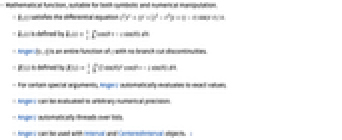
![TemplateBox[{nu, z}, AngerJ2]](Files/AngerJ.zh/3.png "TemplateBox[{nu, z}, AngerJ2]")

![TemplateBox[{nu, z}, AngerJ2]](Files/AngerJ.zh/5.png "TemplateBox[{nu, z}, AngerJ2]")
![TemplateBox[{nu, z}, AngerJ2]=1/piint_0^picos(theta nu-z sin(theta))dtheta](Files/AngerJ.zh/6.png "TemplateBox[{nu, z}, AngerJ2]=1/piint_0^picos(theta nu-z sin(theta))dtheta")
![TemplateBox[{nu, mu, z}, AngerJ]](Files/AngerJ.zh/7.png "TemplateBox[{nu, mu, z}, AngerJ]")
![TemplateBox[{nu, mu, z}, AngerJ]=1/piint_0^pi(2sin(theta))^mucos(theta nu-z sin(theta))dtheta](Files/AngerJ.zh/8.png "TemplateBox[{nu, mu, z}, AngerJ]=1/piint_0^pi(2sin(theta))^mucos(theta nu-z sin(theta))dtheta")
范例
打开所有单元 关闭所有单元![TemplateBox[{{1, /, 2}, x}, AngerJ2]](Files/AngerJ.zh/9.png "TemplateBox[{{1, /, 2}, x}, AngerJ2]")
范围 (39)
数值计算 (6)
使用 Interval 和 CenteredInterval 对象计算最坏情况下的保证间隔:
或用 Around 计算一般情况下的统计区间:
或用 MatrixFunction 计算矩阵形式的 AngerJ 函数:
特殊值 (7)
可视化 (3)


![TemplateBox[{0, z}, AngerJ2]](Files/AngerJ.zh/12.png "TemplateBox[{0, z}, AngerJ2]")
![TemplateBox[{0, z}, AngerJ2]](Files/AngerJ.zh/13.png "TemplateBox[{0, z}, AngerJ2]")
![TemplateBox[{{-, {1, /, 4}}, z}, AngerJ2]](Files/AngerJ.zh/14.png "TemplateBox[{{-, {1, /, 4}}, z}, AngerJ2]")
![TemplateBox[{{-, {1, /, 4}}, z}, AngerJ2]](Files/AngerJ.zh/15.png "TemplateBox[{{-, {1, /, 4}}, z}, AngerJ2]")
函数属性 (15)
![TemplateBox[{0, x}, AngerJ2]](Files/AngerJ.zh/16.png "TemplateBox[{0, x}, AngerJ2]")
![TemplateBox[{0, z}, AngerJ2]](Files/AngerJ.zh/17.png "TemplateBox[{0, z}, AngerJ2]")
![TemplateBox[{{-, {1, /, 2}}, x}, AngerJ2]](Files/AngerJ.zh/18.png "TemplateBox[{{-, {1, /, 2}}, x}, AngerJ2]")
![TemplateBox[{0, x}, AngerJ2]](Files/AngerJ.zh/19.png "TemplateBox[{0, x}, AngerJ2]")
![TemplateBox[{1, x}, AngerJ2]](Files/AngerJ.zh/20.png "TemplateBox[{1, x}, AngerJ2]")
![TemplateBox[{0, x}, AngerJ2]](Files/AngerJ.zh/21.png "TemplateBox[{0, x}, AngerJ2]")
![TemplateBox[{1, x}, AngerJ2]](Files/AngerJ.zh/22.png "TemplateBox[{1, x}, AngerJ2]")
使用 FullSimplify 简化 Anger 函数:
AngerJ 按元素线性作用于列表:
![TemplateBox[{2, x}, AngerJ2]](Files/AngerJ.zh/23.png "TemplateBox[{2, x}, AngerJ2]")

AngerJ 既不是非递增,也不是非递减:
![TemplateBox[{2, x}, AngerJ2]](Files/AngerJ.zh/25.png "TemplateBox[{2, x}, AngerJ2]")
![TemplateBox[{2, x}, AngerJ2]](Files/AngerJ.zh/26.png "TemplateBox[{2, x}, AngerJ2]")
AngerJ 既不是非负,也不是非正:
AngerJ 没有奇点或断点:
AngerJ 既不凸,也不凹:
TraditionalForm 格式:
微分和积分 (5)

 阶导数公式:
级数展开 (3)

属性和关系 (2)
Wolfram Research (2008),AngerJ,Wolfram 语言函数,https://reference.wolfram.com/language/ref/AngerJ.html.
文本
Wolfram Research (2008),AngerJ,Wolfram 语言函数,https://reference.wolfram.com/language/ref/AngerJ.html.
CMS
Wolfram 语言. 2008. "AngerJ." Wolfram 语言与系统参考资料中心. Wolfram Research. https://reference.wolfram.com/language/ref/AngerJ.html.
APA
Wolfram 语言. (2008). AngerJ. Wolfram 语言与系统参考资料中心. 追溯自 https://reference.wolfram.com/language/ref/AngerJ.html 年