
给出复数
的以度为单位的反余切.
ArcCotDegrees
给出复数
的以度为单位的反余切.
更多信息
- ArcCotDegrees,以及其他反三角函数和三角函数在高中几何课程中学习的内容,在许多科学学科中也有应用.
- 所有结果均以度为单位.
- 对于实数
值,结果总是在
到
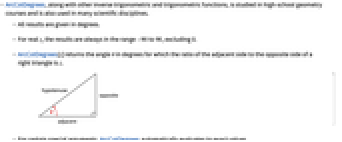
之间,不包括 0. - ArcCotDegrees[z] 返回直角三角形邻边与对边之比为
的角度
,单位为度. - 对于某些特殊参数,ArcCotDegrees 会自动求出精确值.
- ArcCotDegrees 可按任意数值精度求值.
- ArcCotDegrees 自动线性作用于列表.
- ArcCotDegrees[z] 在复平面
上有一个从
到
的分支切割不连续性. - ArcCotDegrees 可用于 Interval、CenteredInterval 和 Around 对象.
- 数学函数,适用于符号和数字运算.
范例
打开所有单元 关闭所有单元基本范例 (7)
ArcCotDegrees[1]
β = ArcCotDegrees[6 / 4]%//NSolve[ArcCotDegrees[x] == 60, x]Reduce[ArcCotDegrees[x] > 60, x]将 ArcCotDegrees 运用于下列列表:
ArcCotDegrees[{0, 2 - Sqrt[3], (1/Sqrt[3]), 1, Sqrt[3], 2 + Sqrt[3]}]Plot[ArcCot[x], {x, -5, 5}]Infinity 时的渐近展开:
Series[ArcCotDegrees[x], {x, ∞, 5}]范围 (39)
数值运算 (6)
ArcCotDegrees[2.5]N[ArcCotDegrees[2 / 3], 50]ArcCotDegrees[0.66666666666666666666666666666666666666666667]ArcCotDegrees[1.5 + 0.3I]高精度高效运算 ArcCotDegrees :
ArcCotDegrees[2.5`500]//TimingArcCotDegrees[2.5`100000];//Timing使用 Interval 和 CenteredInterval 对象计算最坏情况下的保证区间:
ArcCotDegrees[Interval[{1, Sqrt[3]}]]ArcCotDegrees[CenteredInterval[1, 1 / 100]]ArcCotDegrees[CenteredInterval[1 + 2I, (1 + I) / 100]]或者使用 Around 计算平均情况统计区间:
ArcCotDegrees[Around[.9, 0.01]]ArcCotDegrees[{{1, Sqrt[3]}, {0, Sqrt[3]}}]或者使用 MatrixFunction 计算矩阵 ArcCotDegrees 函数:
MatrixFunction[ArcCotDegrees[#]&, {{1, Sqrt[3]}, {0, Sqrt[3]}}]特殊值 (5)
固定点的 ArcCotDegrees 值:
Table[ArcCotDegrees[n ], {n, -1, 1}]ArcCotDegrees[(1/Sqrt[3])]ArcCotDegrees[Infinity]ArcCotDegrees[ComplexInfinity]ArcCotDegrees 的奇点:
{ArcCotDegrees[I], ArcCotDegrees[-I]}f[x_] := ArcCotDegrees[x] - 60;sol = Solve[f[x] == 0, x]xzero = x /. First[sol]Plot[f[x], {x, 0, 2}, Rule[...]]可视化 (4)
绘制 ArcCotDegrees 函数:
Plot[ArcCotDegrees[x], {x, -10, 10}]ComplexPlot3D[ArcCotDegrees[z], {z, -3 - 2I, 3 + 2I}, Rule[...]]绘制 ArcCotDegrees 的实部:
ComplexContourPlot[Re[ArcCotDegrees[z]], {z, -3 - 3I, 3 + 3I}, IconizedObject[«PlotOptions»]]绘制 ArcCotDegrees 的虚部:
ComplexContourPlot[Im[ArcCotDegrees[z]], {z, -3 - 3I, 3 + 3I}, IconizedObject[«PlotOptions»]]使用 ArcCotDegrees 绘制极坐标图:
Table[PolarPlot[ArcCotDegrees[k ϕ], {ϕ, -3π, 3π}, ...], {k, 1, 4}]函数属性 (12)
ArcCotDegrees 是对所有实数值有定义:
FunctionDomain[ArcCotDegrees[x], x]FunctionDomain[ArcCotDegrees[z], z, Complexes]ArcCotDegrees 可取区间
中除 0 以外的所有实数值:
FunctionRange[ArcCotDegrees[x], x, y]FunctionRange[ArcCotDegrees[x], x, y, Complexes]ArcCotDegrees 是奇函数:
ArcCotDegrees[-x]ArcCotDegrees 具有镜像属性
:
FullSimplify[ArcCotDegrees[Conjugate[x]] == Conjugate[ArcCotDegrees[x]]]ArcCotDegrees 不是解析函数:
FunctionAnalytic[ArcCotDegrees[x], x]FunctionMeromorphic[ArcCotDegrees[x], x]ArcCotDegrees 既不是非递减也不是非递增:
FunctionMonotonicity[ArcCotDegrees[x], x]ArcCotDegrees 是单射函数:
FunctionInjective[ArcCotDegrees[x], x]Plot[{ArcCotDegrees[x], 1 / 2}, {x, -360, 360}]ArcCotDegrees 不是满射函数:
FunctionSurjective[ArcCotDegrees[x], x]Plot[{ArcCotDegrees[x], 2, 0}, {x, -180, 180}]ArcCotDegrees 既不是非负,也不是非正:
FunctionSign[ArcCotDegrees[x], x]ArcCotDegrees 在零点处既有奇点又有不连续性:
FunctionSingularities[ArcCotDegrees[x], x]FunctionDiscontinuities[ArcCotDegrees[x], x]ArcCotDegrees 既不凸也不凹:
FunctionConvexity[ArcCotDegrees[x], x]ArcCotDegrees 对于 x 在 [0,100] 处为凸函数:
FunctionConvexity[{ArcCotDegrees[x], 0 <= x <= 100}, x]Plot[ArcCotDegrees[x], {x, 0, 100}]TraditionalForm 格式:
ArcCotDegrees[α]//TraditionalForm微分 (3)
积分 (2)
ArcCotDegrees 的不定积分:
Integrate[ArcCotDegrees[x], x]ArcCotDegrees 在以原点为中心的区间上的定积分为 0:
Integrate[ArcCotDegrees[x], {x, -1, 1}]级数展开 (4)
利用 Series 求泰勒展开式:
Series[ArcCotDegrees[x], {x, 1, 7}]在
周围绘制 ArcCotDegrees 的前三个近似值:
terms = Normal@Table[Series[ArcCotDegrees[x], {x, 1, m}], {m, 1, 5, 2}];
Plot[{ArcCotDegrees[x], terms}, {x, 0, 2}]Series[ArcCotDegrees[x], {x, I, 1}]Series[ArcCotDegrees[x], {x, I / 2, 1}]Series[ArcCotDegrees[x], {x, I, 3}, Assumptions -> x > 0]//FullSimplifyArcCotDegrees 可以应用于幂级数:
ArcCotDegrees[SeriesData[x, 0, {1, 0, -1/3, 0, -1/45, 0, -2/945, 0, -1/4725, 0, -2/93555}, -1, 10, 1]]函数恒等和化简 (2)
使用 FullSimplify 来使用 ArcCotDegrees 简化表达式:
FullSimplify[16 ArcCotDegrees[5] - 4 ArcCotDegrees[239]]使用 TrigToExp 以 Log 表示 ArcCotDegrees:
TrigToExp[ArcCotDegrees[z]]函数表示 (1)
使用 ArcTanDegrees 进行表示:
ArcTanDegrees[1 / x]//FullSimplify应用 (8)
Solve[ArcCotDegrees[α x + β] == 4, x]Solve[ArcCotDegrees[z]^2 + 3 ArcCotDegrees[z] == 2, z]Reduce[ArcCotDegrees[CotDegrees[z]] == w, z]使用 Reduce 求解关于 ArcCotDegrees 的不等式:
Reduce[ArcCotDegrees[x] > 60, x]FindRoot[ArcTanDegrees[z]^2 - 2 ArcTanDegrees[z + 1 / 3] == -3, {z, 0, 1 / 2}]Plot[ArcTanDegrees[z]^2 - 2 ArcTanDegrees[z + 1 / 3] + 3, {z, 0, 1 / 2}]绘制 ArcCotDegrees 的实部和虚部:
ReImPlot[ArcCotDegrees[x], {x, -3, 3}]ArcCotDegrees 与三角函数的不同组合:
{TanDegrees[ArcCotDegrees[z]], SecDegrees[ArcCotDegrees[1 / z]], SinDegrees[ArcCotDegrees[z ^ 2]], CosDegrees[ArcCotDegrees[z - 1]]}CotDegrees[ArcCotDegrees[x] + ArcCotDegrees[y]]//TrigExpand//SimplifyN[{ArcCotDegrees[4 / 3], ArcCotDegrees[3 / 4]}]Total[%]属性和关系 (5)
{CotDegrees[ArcCotDegrees[z]], ArcCotDegrees[CotDegrees[z]]}使用 PowerExpand 可忽略 ArcCotDegrees 的多值性:
PowerExpand[%]Refine[ArcCotDegrees[CotDegrees[z]], 0 < z < 90]ArcCotDegrees 的分支切割沿虚轴运行:
Plot3D[Re[ArcCotDegrees[x + I y]], {y, -2, 2}, {x, -2.5, 2.5}]ArcCotDegrees 给出的角度以度数为单位,而 ArcCot 给出的角度以弧度为单位:
ArcCotDegrees[1]ArcCot[1]将 FunctionExpand 应用于 ArcCotDegrees 可生成以弧度为单位的三角函数表达式:

FunctionExpand[ArcCotDegrees[x]]FunctionExpand[ArcCotDegrees[x ^ 2]ArcCotDegrees[120 - x / 2]]ExpToTrig 应用于 TrigToExp 的输出,将生成以弧度为单位的三角函数:
ArcCotDegrees[z]//TrigToExpExpToTrig[%]可能存在的问题 (1)
巧妙范例 (2)
求解关于 ArcCotDegrees 的三角方程:
Reduce[ArcCotDegrees[z] + ArcCotDegrees[z - 1] == 90, z]//Quiet%//N在整数点处绘制 ArcCotDegrees:
ArrayPlot[Table[FractionalPart[Abs[ArcCotDegrees[x y]]], {x, -40, 40}, {y, -40, 40}]]相关指南
-
▪
- 三角函数
文本
Wolfram Research (2024),ArcCotDegrees,Wolfram 语言函数,https://reference.wolfram.com/language/ref/ArcCotDegrees.html.
CMS
Wolfram 语言. 2024. "ArcCotDegrees." Wolfram 语言与系统参考资料中心. Wolfram Research. https://reference.wolfram.com/language/ref/ArcCotDegrees.html.
APA
Wolfram 语言. (2024). ArcCotDegrees. Wolfram 语言与系统参考资料中心. 追溯自 https://reference.wolfram.com/language/ref/ArcCotDegrees.html 年
BibTeX
@misc{reference.wolfram_2026_arccotdegrees, author="Wolfram Research", title="{ArcCotDegrees}", year="2024", howpublished="\url{https://reference.wolfram.com/language/ref/ArcCotDegrees.html}", note=[Accessed: 09-August-2026]}
BibLaTeX
@online{reference.wolfram_2026_arccotdegrees, organization={Wolfram Research}, title={ArcCotDegrees}, year={2024}, url={https://reference.wolfram.com/language/ref/ArcCotDegrees.html}, note=[Accessed: 09-August-2026]}