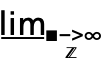
DiscreteMinLimit[f,k∞]
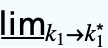
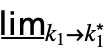
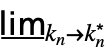
k が ∞ に近付くときの数列 f の最小極限k∞f(k)を整数上で与える.
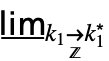
DiscreteMinLimit[f,{k1
,…,kn
}]
ネストした最小極限
⋯
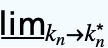
f(k1,…,kn)を整数上で与える.
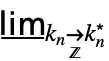
DiscreteMinLimit[f,{k1,…,kn}{
,…,
}]
多変量最小極限
f(k1,…,kn)を整数上で与える.
DiscreteMinLimit
DiscreteMinLimit[f,k∞]
k が ∞ に近付くときの数列 f の最小極限k∞f(k)を整数上で与える.
DiscreteMinLimit[f,{k1
,…,kn
}]
ネストした最小極限
⋯
f(k1,…,kn)を整数上で与える.
DiscreteMinLimit[f,{k1,…,kn}{
,…,
}]
多変量最小極限
f(k1,…,kn)を整数上で与える.
詳細とオプション
- DiscreteMinLimitは,下極限としても知られている.
- DiscreteMinLimitは極限の最大下界を計算し,常に実数値数列について定義される.収束条件や実際に極限が存在するかどうかに依存しないその他の漸近的特性を与えるためにしばしば使われる.
- DiscreteMinLimit[f,k∞]は
f として入力することができる.テンプレート
は
dmlim
で入力し,
を使ってカーソルを真下付き文字から本体に移動する. - DiscreteMinLimit[f,{k1,…,kn}{
,…,
}]は
…
f として入力できる. - 可能な極限点
は±∞である. - 最小極限は最小包絡線数列min[ω]の極限として定義される.
-
DiscreteMinLimit[f,k∞] DiscreteLimit[min[ω],ω∞] DiscreteMinLimit[f,{k1,…,kn}{∞,…,∞}] DiscreteLimit[min[ω],ω∞] - DiscreteMinLimit[f[k],k-∞]はDiscreteMinLimit[f[-l],l∞]等と等価である.
- この定義は,一変量の f[k]については最小包絡線 min[ω]MinValue[{f[k],k≥ω∧k∈
},k]を,多変量のf[k1,…,kn]についてはmin[ω]MinValue[{f[k1,…,kn],k1≥ω∧⋯∧kn≥ω∧ki∈
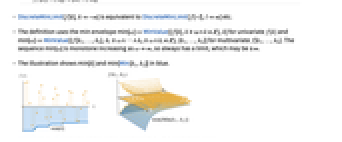
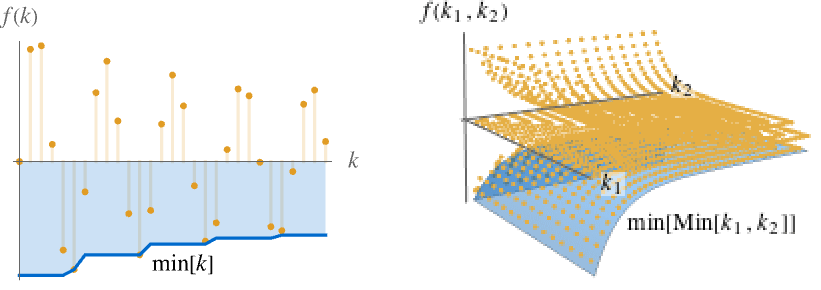
},{k1,…,kn}]を使う.数列min[ω]は ω∞のとき単調増加であるので,常に極限を持つ.それは±∞である可能性がある. - 次の図ではmin[k]とmin[Min[k1,k2]]が青で示されている.
- 最小極限が求まらなかったとき,DiscreteMinLimitは未評価で返される.
- 次は使用可能なオプションである.
-
Assumptions $Assumptions パラメータについての仮定 GenerateConditions Automatic パラメータについての条件を生成するかどうか Method Automatic 使用するメソッド PerformanceGoal "Quality" パフォーマンスのどの面について最適化するか - 次はGenerateConditionsの可能な設定である.
-
Automatic 一般的ではない条件のみ True すべての条件 False 条件なし None 条件が必要な場合は未評価で返す - PerformanceGoalの可能な設定には,$PerformanceGoal,"Quality","Speed"がある."Quality"設定のとき,DiscreteMinLimitは,一般に,より多くの問題を解いたりより簡単な結果を生成したりするが,より多くの時間とメモリが必要になる可能性がある.
例題
すべて開く すべて閉じる例 (4)
DiscreteMinLimit[(-1) ^ n, n -> ∞]DiscretePlot[{(3 + (24 / 25) ^ n) Sin[Pi(n / 20)]}, {n, 1, 200, 3}, PlotRange -> {-4, 4}]DiscreteMinLimit[(3 + (24 / 25) ^ n) * Sin[Pi(n / 20)], n -> ∞]
dmlim
を使ってテンプレート
を入力し,
を使って真下付き文字から本体に移動する:
Underscript[, nUnderscript[ -> , ℤ]∞]Sin[n]TraditionalFormによる表示:
DiscreteMinLimit[f[n], n -> Infinity]//TraditionalFormスコープ (22)
基本的な用法 (4)
n がInfinityに近付くときの数列の最小極限を計算する:
DiscreteMinLimit[(-1) ^ n 3n ^ 2 / (n ^ 2 + 5), n -> ∞]n が-Infinityに近付くときの数列の最小極限を計算する:
DiscreteMinLimit[Sin[n π / 2](5 + 3 ^ n), n -> -∞]DiscreteMinLimit[Cos[m + 1 / (n + 1)], {m -> ∞, n -> ∞}]DiscreteMinLimit[{(2) ^ (-n), Cos[n π]}, n -> ∞]初等関数数列 (6)
DiscreteMinLimit[(-1) ^ n(3n) / (1 + 6n), n -> ∞]DiscretePlot[{(-1) ^ n(3n) / (1 + 6n), -1 / 2}, {n, 0, 50}]DiscreteMinLimit[(-9 / 10) ^ n, n -> ∞]DiscretePlot[{(-9 / 10) ^ n}, {n, 10, 40}]DiscreteMinLimit[(-1) ^ n, n -> ∞]DiscretePlot[{(-1) ^ n}, {n, 10, 30}]DiscreteMinLimit[(-10 / 9) ^ n, n -> ∞]DiscretePlot[{(-10 / 9) ^ n}, {n, 10, 50}]DiscreteMinLimit[E ^ ((-1) ^ n(n) / (n + 2)), n -> ∞]DiscretePlot[{E ^ ((-1) ^ n(n) / (n + 2)), 1 / E}, {n, 1, 50}]DiscreteMinLimit[2 ^ Sin[n], n -> ∞]DiscreteMinLimit[Sin[n], n -> ∞]DiscretePlot[{Sin[n], -1}, {n, 1, 150}]DiscreteMinLimit[(3n / (n + 1) + (14 / 17) ^ n)Cos[Pi(n / 20)], n -> ∞]DiscretePlot[{(3 n / (n + 1) + (14 / 17) ^ n) * Cos[Pi(n / 20)], -3}, {n, 1, 200, 3}, PlotRange -> {-4, 4}]DiscreteMinLimit[(-1) ^ n ArcTan[n], n -> ∞]DiscretePlot[{(-1) ^ n ArcTan[n], -Pi / 2}, {n, 1, 30}]DiscreteMinLimit[Log[1 + n / (n + 1)] Sin[n Pi / 5], n -> ∞]DiscretePlot[{Log[1 + n / (n + 1)] Sin[n Pi / 5], %}, {n, 1, 50}]整数関数数列 (3)
Factorialを含む数列:
DiscreteMinLimit[(k!/(-1)^kk^9), k -> ∞]DiscretePlot[(k!/(-1)^kk^9), {k, 15}, PlotRange -> {-5, 5}, PlotStyle -> PointSize[Large]]FactorialPowerを含む数列:
DiscreteMinLimit[(-1) ^ n * (FactorialPower[n, 2] / (7n ^ 2 + 1)), n -> ∞]Fibonacciを含む数列の極限を計算する:
DiscreteMinLimit[Fibonacci[n]Sin[n Pi / 2] / GoldenRatio ^ n, n -> ∞]周期数列 (3)
DiscreteMinLimit[Mod[n, 5], n -> ∞]DiscretePlot[Mod[n, 5], {n, 1, 50}]DiscreteMinLimit[Sin[n Pi / 4], n -> ∞]DiscretePlot[Sin[n Pi / 4], {n, 1, 40}]DiscreteMinLimit[Cos[Pi n / 10], n -> Infinity]DiscretePlot[Cos[Pi n / 10], {n, 1, 20}]Table[Mod[Factorial[n] + (-1) ^ n, 5], {n, 12}]DiscreteMinLimit[Mod[Factorial[n] + (-1) ^ n, 5], n -> Infinity]DiscretePlot[Mod[Factorial[n] + (-1) ^ n, 5], {n, 1, 20}]DiscreteMinLimit[Sin[n], n -> Infinity]DiscretePlot[{Sin[n], -1}, {n, 1, 150}]DiscreteMinLimit[Exp[Sin[2n] ^ 2 / (2 + Cos[n])], n -> Infinity]DiscretePlot[Exp[Sin[2n] ^ 2 / (2 + Cos[n])], {n, 1, 150}]区分関数数列 (2)
DiscreteMinLimit[Piecewise[{{n, n ≤ 4}}, Sin[n]], n -> ∞]DiscretePlot[{Piecewise[{{n, n ≤ 4}}, Sin[n] ], -1}, {n, 0, 75}]DiscreteMinLimit[Piecewise[{{Sin[n], n ≤ 10}}, n(-1) ^ n], n -> ∞]DiscretePlot[Piecewise[{{Sin[n], n ≤ 20}}, n(-1) ^ n], {n, 0, 75}]DiscreteMinLimit[Piecewise[{{1 + 1 / n, Mod[n, 2] == 0}, {-1 - 1 / n, Mod[n, 2] == 1}}], n -> ∞]DiscretePlot[Piecewise[{{1 + 1 / n, Mod[n, 2] == 0}, {-1 - 1 / n, Mod[n, 2] == 1}}], {n, 1, 75}]整数論の数列 (2)
DiscreteMinLimit[LCM[Mod[n, 3], 20], n -> ∞]DiscreteMinLimit[GCD[Mod[n, 56], 33], n -> ∞]Primeを含む数列:
DiscreteMinLimit[(-1) ^ n Prime[n] / (n Log[n]), n -> ∞]DiscretePlot[(-1) ^ n Prime[n] / (n Log[n]), {n, 10, 100}]多変量数列 (2)
DiscreteMinLimit[(-1) ^ (m + n) (1000) ^ (1 / n) (m ^ 2 / (m ^ 2 + 1)), {m -> ∞, n -> ∞}]DiscretePlot3D[{(-1) ^ (m + n)(1000) ^ (1 / n)(m ^ 2 / (m ^ 2 + 1)), -1}, {n, 50, 60}, {m, 50, 60}, Filling -> None]DiscreteMinLimit[(m + n/m n), {m, n} -> {∞, ∞}]DiscreteMinLimit[Sin[(π n/3)]Cos[(π m/4)], {m, n} -> {∞, ∞}]オプション (6)
Assumptions (1)
GenerateConditions (3)
DiscreteMinLimit[(1/2 + ^ n), n -> ∞, GenerateConditions -> False]DiscreteMinLimit[(1/2 + ^ n), n -> ∞]DiscreteMinLimit[Exp[a n]Sin[n], n -> ∞, GenerateConditions -> None]デフォルトで,一意的な結果が返されるような条件が生成される:
DiscreteMinLimit[Exp[a n] Sin[n], n -> ∞]デフォルトで,特殊な値だけが結果を無効にする場合は条件が生成されない:
DiscreteMinLimit[(x y/x^2 + (-1 + a x)^2 y^2), {x, y} -> {∞, ∞}]GenerateConditions->Trueとすると,一般的ではない条件もレポートされる:
DiscreteMinLimit[(x y/x^2 + (-1 + a x)^2 y^2), {x, y} -> {∞, ∞}, GenerateConditions -> True]Method (1)
DiscreteMinLimit[Mod[n, 2], n -> ∞]DiscreteMinLimit[Mod[n, 2], n -> ∞, Method -> "Periodic"]DiscreteMinLimit[Mod[n, 2], n -> ∞, Method -> "DiscreteLimit"]PerformanceGoal (1)
DiscreteMinLimitは,任意に大きい周期の数列を含む極限を計算する:
expr = 1 / (Mod[n, 31] + 1 / (7 + Mod[n, 10 ^ 5]));DiscreteMinLimit[expr, n -> ∞]PerformanceGoalを使って,そのような場合に高くつくかもしれない計算を避ける:
DiscreteMinLimit[expr, n -> ∞, PerformanceGoal -> "Speed"]MethodオプションはPerformanceGoalをオーバーライドする:
DiscreteMinLimit[expr, n -> ∞, Method -> "Periodic", PerformanceGoal -> "Speed"]アプリケーション (3)
DiscreteMinLimit[(-1) ^ n E ^ (-10 / n), n -> ∞]DiscretePlot[{(-1) ^ n E ^ (-10 / n), -1}, {n, 1, 100}]a[n_] := n Cos[5n] / (2n + 1)DiscretePlot[a[n], {n, 1, 140}]DiscreteMaxLimitとDiscreteMinLimitは等しくないことを示す:
DiscreteMaxLimit[a[n], n -> ∞]DiscreteMinLimit[a[n], n -> ∞]DiscreteLimitを使って極限が存在しないことを確認する:
DiscreteLimit[a[n], n -> ∞]
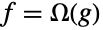
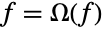
のとき,アルゴリズムのランタイム関数
は「big-omega of
」(
)であると言われる:
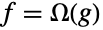
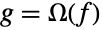
Ω[n_][f_, g_] := Underscript[, nUnderscript[ -> , ℤ]∞](f/g) > 0同様に,
および
のとき,
は「big-theta of
」(
)であると言われる:
Θ[n_][f_, g_] := Underscript[, nUnderscript[ -> , ℤ]∞](f/g) < ∞ && Underscript[, nUnderscript[ -> , ℤ]∞](f/g) > 0Ω[n][f[n], f[n]]f = n ^ 4 + 3n ^ 2 + 2;
g = 5 n ^ 3;
h = 10n ^ 2 + 2n + 1;
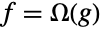
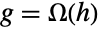
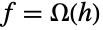
{Ω[n][f, g], Ω[n][g, h], Ω[n][f, h]}f = 1;
g = (1/n)Mod[-1 + n, 2] + n Mod[n, 2];
{Ω[n][f , g], Ω[n][g, f]}したがって,
は
と同様のアルゴリズムランタイムの空間における反射的半順序を定義する:
runtimes = {Exp[n], n Log[n], n, 1, n ^ 2};Sort[runtimes, Ω[n]]
で
なら
である.このことは
が同値関係であることを暗示している:
f = 10n ^ 2 + 2n + 1;
g = 5 n ^ 2 + 100;
{Ω[n][f, g], Ω[n][g, f], Θ[n][f, g], Θ[n][g, f]}特性と関係 (11)
f[n_] := (-1) ^ nDiscreteMinLimit[f[n], n -> ∞]DiscreteLimit[f[n], n -> ∞]f[n_] := Sin[n]g[n_] := Cos[n]DiscreteMinLimit[f[n] + g[n], n -> ∞] ≥ DiscreteMinLimit[f[n], n -> ∞] + DiscreteMinLimit[g[n], n -> ∞]DiscreteMinLimit[f[n] + g[n], n -> ∞] > DiscreteMinLimit[f[n], n -> ∞] + DiscreteMinLimit[g[n], n -> ∞]f[n_] := (-1) ^ nc = 6;DiscreteMinLimit[c f[n], n -> ∞] == c DiscreteMinLimit[f[n], n -> ∞]実数値数列について,DiscreteLimit が存在するならDiscreteMinLimitは同じ値を持つ:
f[n_] := (-1) ^ n n / (n ^ 2 + 1)DiscreteLimit[f[n], n -> ∞]DiscreteMinLimit[f[n], n -> ∞]f[n_] := n / (n + 1)g[n_] := Cos[n]DiscreteLimit[f[n], n -> ∞]DiscreteMinLimit[f[n] + g[n], n -> ∞] == DiscreteMinLimit[f[n], n -> ∞] + DiscreteMinLimit[g[n], n -> ∞]DiscreteMinLimitはDiscreteMaxLimit以下である:
a[n_] := Sin[n]DiscreteMinLimit[a[n], n -> ∞] < DiscreteMaxLimit[a[n], n -> ∞]DiscreteMinLimitとDiscreteMaxLimitが等しいなら,極限が存在し,その極限は両者の共通値に等しい:
f[n_] := (n Cos[n]/n^2 + 1){Underscript[, nUnderscript[ -> , ℤ]∞]f[n], Underscript[, nUnderscript[ -> , ℤ]∞]f[n], Underscript[, nUnderscript[ -> , ℤ]∞]f[n]}f[n_] := n^2{Underscript[, nUnderscript[ -> , ℤ]-∞]f[n], Underscript[, nUnderscript[ -> , ℤ]-∞]f[n], Underscript[, nUnderscript[ -> , ℤ]-∞]f[n]}DiscreteMinLimitは-DiscreteMaxLimit[-f,…]として計算することができる:
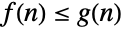
f[n_] := Piecewise[{{n, Mod[n, 2] == 0}, {-1, True}}]DiscreteMinLimit[f[x], x -> ∞] == -DiscreteMaxLimit[-f[x], x -> ∞]f[n_] := Sin[n / 20] / ng[n_] := (1/n)Reduce[f[n] ≤ g[n]n, Integers]//SimplifyUnderscript[, nUnderscript[ -> , ℤ]-∞]g[n] ≥ Underscript[, nUnderscript[ -> , ℤ]-∞]f[n] ≥ Underscript[, nUnderscript[ -> , ℤ]-∞]f[n]この例のように2つの最大極限が等しいなら,
には極限がある:
Underscript[, nUnderscript[ -> , ℤ]-∞]f[n] == Underscript[, nUnderscript[ -> , ℤ]-∞]g[n] == Underscript[, nUnderscript[ -> , ℤ]-∞]f[n]これは,はさみうちの定理 (またはサンドイッチ定理)の一般化である:
DiscretePlot[{f[n], g[n]}, {n, 500}, Filling -> {2 -> {1}}]MinLimitは常にDiscreteMinLimit以下である:
g[n_] := Sin[n π + Pi / 4]DiscreteMinLimit[g[n], n -> ∞]MinLimit[g[n], n -> ∞]Show[Plot[{g[n], -1, -1 / Sqrt[2]}, {n, 0, 10}, PlotTheme -> "DashedLines"], DiscretePlot[g[n], {n, 0, 10}, PlotMarkers -> {"Point", Large}]]考えられる問題 (1)
おもしろい例題 (1)
f[n_] := {{Sin[n], -1}, {(-1) ^ n 3n ^ 2 / (n ^ 2 + 5), -3}, {(-1) ^ n, -1}, {(-1) ^ n E ^ (-10 / n), -1}, {n Sin[5n] / (3n + 1), -1 / 3}, {(-1.2) ^ n, -10000}}range = {{-1.1, 1.1}, {-3.1, 3.1}, {-1.1, 1.1}, {-1, 1}, {-0.36, 0.36}, {-1600, 1600}};Grid[Partition[Table[With[{r1 = f[n][[m, 1]], r2 = f[n][[m, 2]], r3 = range[[m]]},
DiscretePlot[{r1, r2}, {n, 1, 40}, PlotRange -> r3, ImageSize -> 210, PlotLabel -> Style[HoldForm[DiscreteMinLimit[r1, n -> Infinity]] == DiscreteMinLimit[f[n][[m, 1]], n -> Infinity], 13]]], {m, 1, 6}], 2], Frame -> All]テキスト
Wolfram Research (2017), DiscreteMinLimit, Wolfram言語関数, https://reference.wolfram.com/language/ref/DiscreteMinLimit.html.
CMS
Wolfram Language. 2017. "DiscreteMinLimit." Wolfram Language & System Documentation Center. Wolfram Research. https://reference.wolfram.com/language/ref/DiscreteMinLimit.html.
APA
Wolfram Language. (2017). DiscreteMinLimit. Wolfram Language & System Documentation Center. Retrieved from https://reference.wolfram.com/language/ref/DiscreteMinLimit.html
BibTeX
@misc{reference.wolfram_2026_discreteminlimit, author="Wolfram Research", title="{DiscreteMinLimit}", year="2017", howpublished="\url{https://reference.wolfram.com/language/ref/DiscreteMinLimit.html}", note=[Accessed: 09-September-2026]}
BibLaTeX
@online{reference.wolfram_2026_discreteminlimit, organization={Wolfram Research}, title={DiscreteMinLimit}, year={2017}, url={https://reference.wolfram.com/language/ref/DiscreteMinLimit.html}, note=[Accessed: 09-September-2026]}