ElementData
 个化学元素的指定属性.
ElementData
如果想要访问 Wolfram 知识库,请使用 Element 类型的实体而不是 ElementData.
ElementData["name","property"]
给出化学元素 "name" 的指定属性的值.
ElementData[n,"property"]
给出第 n 个化学元素的指定属性.
更多信息
- 化学元素可以利用其全称、标准简称或原子序数指定.
- ElementData[] 给出由所有标准化学元素组成的列表.
- ElementData[n] 给出第 n
 个化学元素的全称.
 - ElementData["Properties"] 给出化学元素现有的全部属性的列表.
- 在一个特定情况中不适用或未知的属性由 Missing[…] 指明.
- 只具有特定精度的数值通常使用精度作为标签,并且以任意精度格式给出.
- 基本元素的属性包括:
-
"AtomicNumber" 原子序数 
"AtomicWeight" 以原子量单位表示的平均原子质量 - 如果未指定其它温度或压强,所有宏观性质均采用常温常压下的性质. 如果适用,均采用元素在常温常压下最稳定形式的性质.
- 材料性质包括:
-
"BrinellHardness" 布氏刻痕硬度 "BulkModulus" 体积弹性模量(非压缩性) 
"Density" 常温常压下的密度 "LiquidDensity" 熔点液体密度 "MohsHardness" 莫氏耐擦伤性 "MolarVolume" 摩尔体积 "PoissonRatio" 固体的泊松比 
"ShearModulus" 固体的切变模数 
"SoundSpeed" 声速 "ThermalConductivity" 热导率 
"ThermalExpansion" 线性热膨胀系数 
"VickersHardness" 维氏刻痕硬度 "YoungModulus" 固体的杨氏模量 
- 热力性质包括:
-
"AbsoluteBoilingPoint" 沸点温度(单位为开尔文) "AbsoluteMeltingPoint" 熔点温度(单位为开尔文) "AdiabaticIndex" 气体绝热指数 
"BoilingPoint" 摄氏沸点温度 "CriticalPressure" 液-气临界点压强 "CriticalTemperature" 液-气临界点温度 "CuriePoint" 铁磁-顺磁相变点的居里温度 "FusionHeat" 固-液相变潜热 "MeltingPoint" 摄氏熔点温度 "NeelPoint" 反铁磁-顺磁体相变点的奈耳温度 "Phase" 原生态 (例如 "Solid") "SpecificHeat" 比热容 
"SuperconductingPoint" 超导相变温度(单位为开尔文) "VaporizationHeat" 液-气相变潜热 - 电磁和光学性质包括:
-
"Color" 颜色 "ElectricalConductivity" 电导率 
"ElectricalType" 导电类型 (例如 "Insulator") "MagneticType" 磁性类型 (例如 "Paramagnetic") "MassMagneticSusceptibility" 质量磁化率 
"MolarMagneticSusceptibility" 摩尔磁化率 
"RefractiveIndex" 可见光折射率 "Resistivity" 固体电阻率 
"VolumeMagneticSusceptibility" 体磁化率 
- 丰度性质包括 (按质量分数):
-
"CrustAbundance" 地壳丰度 "HumanAbundance" 典型人体丰度 "MeteoriteAbundance" 碳质陨石丰度观测值 "OceanAbundance" 海洋丰度 "SolarAbundance" 太阳中丰度 "UniverseAbundance" 宇宙丰度观测值 - 周期表属性包括:
-
"Block" 填充的最外电子子壳层的标记 "Group" 周期表中的列 "Period" 周期表中的行 (电子壳层数) "Series" 命名的元素系列 (例如 "AlkaliMetals") - 基本化学性质包括:
-
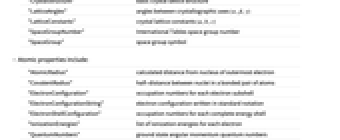
"AllotropicMultiplicities" 同素异型分子中的原子数量 "CommonCompoundNames" 常见化合物的名称 "ElectronAffinity" 电子亲和力 "Electronegativity" 泡令电负性 "GasAtomicMultiplicities" 气相分子中的原子数 "Valence" 通常形成的化学键数量 - 最稳定固相结晶属性包括:
-
"CrystalStructure" 基本晶格结构 "LatticeAngles" 晶轴之间的角度 
"LatticeConstants" 晶格常数 
"SpaceGroupNumber" 国际空间群数表 "SpaceGroup" 空间群符号 - 原子属性包括:
-
"AtomicRadius" 最外层电子到核的计算距离 "CovalentRadius" 一对键接的原子,核之间距离的一半 "ElectronConfiguration" 各电子子壳层的填充数 "ElectronConfigurationString" 以标准记法表示的电子排布 "ElectronShellConfiguration" 各完整能壳的填充数 "IonizationEnergies" 各电子的电离能的列表 "QuantumNumbers" 基态角动量量子数 "VanDerWaalsRadius" 球形原子间相互作用范围 - 核属性包括:
-
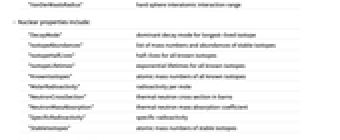
"DecayMode" 最长寿命同位素的主导衰变类型 "IsotopeAbundances" 稳定同位素的质量数和丰度列表 "IsotopeHalfLives" 所有已知同位素的半衰期 "IsotopeLifetimes" 所有已知同位素的指数形式寿命 "KnownIsotopes" 所有已知同位素的原子质量数 "MolarRadioactivity" 每摩尔放射性 "NeutronCrossSection" 以靶恩为单位的热中子截面 "NeutronMassAbsorption" 热中子质量吸收系数 "SpecificRadioactivity" 特定的放射性 "StableIsotopes" 稳定同位素的原子质量数 - 与名称相关的属性包括:
-
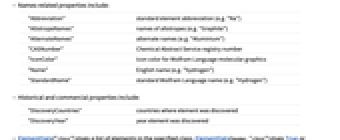
"Abbreviation" 标准元素缩写 (例如 "Na") "Allotropes" 同素异形体名称 (例如 "Graphite") "AlternateNames" 其它名称 (例如 "Aluminium") "CASNumber" 美国化学文摘社注册号 "IconColor" Wolfram 语言分子图形图谱色 "Name" 英语名称 (例如 "hydrogen") "StandardName" 标准 Wolfram 语言名称 (例如 "Hydrogen") - 历史和商业属性包括:
-
"DiscoveryCountries" 发现元素的国家 "DiscoveryYear" 元素被发现的年份 - ElementData["class"] 给出一个指定类别的元素列表. ElementData[name,"class"] 根据与 name 相应的元素是否在指定类别中给出 True 或 False.
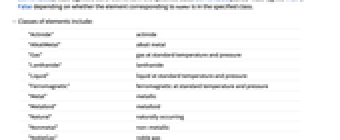
- 元素类别包括:
-
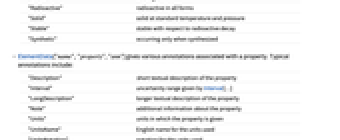
"Actinide" 锕系元素 "AlkaliMetal" 碱金属 "Gas" 常温常压下的气体 "Lanthanide" 镧系元素 "Liquid" 常温常压下的液体 "Ferromagnetic" 常温常压下的铁磁体 "Metal" 金属 "Metalloid" 类金属 "Natural" 原生态 "Nonmetal" 非金属 "NobleGas" 惰性气体 "Radioactive" 所有形式的放射性元素 "Solid" 常温常压下的固体 "Stable" 放射性衰变稳定元素 "Synthetic" 人工合成元素 - ElementData["name","property","ann"] 给出与属性相关的各种注释. 典型注释包括:
-
"Description" 属性的简短文字描述 "Interval" 由 Interval[…] 给出的不确定性范围 "LongDescription" 属性的较长文字描述 "Note" 属性的更多信息 "Units" 给出属性的所用的单位 "UnitsName" 所用单位的英语名称 "UnitsNotation" 所用单位的符号 "UnitsStandardName" 所用单位的 Wolfram 语言标准名称 "Value" 属性值 (没有指定注释时的默认值)
范例
打开所有单元 关闭所有单元范围 (17)
名称和类型 (7)
属性和注解 (5)
不确定性用 Interval 表示:
应用 (6)
属性和关系 (9)
用 Table 获得所有元素属性值的列表:
用 Map 做同样的事:
用 Grid 以格式化表格形式显示数据:
用 DeleteCases 过滤出没有缺失的元素:
用 ListPlot 绘出一个属性值列表的图:
在数据跨越几个数量级时使用 ListLogPlot:
用 LatticeData 获得固体结构详细信息:
利用 IsotopeData 获得同位素详细信息:
用 ChemicalData 获得元素化合物的属性:



 ElementData Source Information
Wolfram Research (2007),ElementData,Wolfram 语言函数,https://reference.wolfram.com/language/ref/ElementData.html (更新于 2014 年).
文本
Wolfram Research (2007),ElementData,Wolfram 语言函数,https://reference.wolfram.com/language/ref/ElementData.html (更新于 2014 年).
CMS
Wolfram 语言. 2007. "ElementData." Wolfram 语言与系统参考资料中心. Wolfram Research. 最新版本 2014. https://reference.wolfram.com/language/ref/ElementData.html.
APA
Wolfram 语言. (2007). ElementData. Wolfram 语言与系统参考资料中心. 追溯自 https://reference.wolfram.com/language/ref/ElementData.html 年