

Log2
Log2[x]
底を2とする x の対数を与える.
例題
すべて開く すべて閉じる例 (5)
Log2は底が2の対数を与える:
Log2[2 ^ 10]Log2[1.4142]Log2[x]Plot[Log2[x], {x, 0, 5}]ComplexPlot3D[Log2[z ^ 3], {z, -2 - 2I, 2 + 2I}, PlotLegends -> Automatic]Series[Log2[1 + x], {x, 0, 5}]Series[Log2[x], {x, -1, 3}, Assumptions -> Im[x] > 0]スコープ (43)
数値評価 (7)
Log2[9.]N[Log2[45], 100]Log2[5.211111111111111111]N[Log2[2 + I]]Log2[1600`100]//TimingLog2[456`100000];//TimingLog2は実数値区間を扱うことができる:
Log2[Interval[{1 / 3, 2}]]Aroundを使って平均的な場合の統計区間を計算する:
Log2[ Around[1 / 5, 0.01]]Log2[{{2, 1}, {0, 1 / 2}}]MatrixFunctionを使って行列のLog2関数を計算することもできる:
MatrixFunction[Log2, {{2, 1}, {0, 1 / 2}}]//FullSimplify特定の値 (6)
固定点におけるLog2の値:
Table[Log2[n ], {n, {1, 2, 4, 8}}]Table[Log2[1 / n], {n, {1, 2, 4, 8}}]Log2[0]Log2[ComplexInfinity]Log2[Infinity]Log2[0]Log2の零点:
Log2[1]Log2[x]=0.5となる x の値を求める:
xval = x /. FindRoot[Log2[x] == 0.5, {x, 0.1}]Plot[Log2[x], {x, 0, 2E}, Epilog -> Style[Point[{xval, Log2[xval]}], PointSize[Large], Red]]可視化 (3)
Log2関数をプロットする:
Plot[Log2[x], {x, 0, 4}]
ComplexContourPlot[Re[Log2[z]], {z, -2 - 2I, 2 + 2 I}, Contours -> 20]
ComplexContourPlot[Im[Log2[z]], {z, -2 - 2I, 2 + 2 I}, Contours -> 20]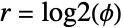
PolarPlot[Log2[ϕ], {ϕ, 0, 12π}, Frame -> True]関数の特性 (10)
Log2すべての正の値について定義される:
FunctionDomain[Log2[x], x]Log2は非零のすべての複素数値について定義される:
FunctionDomain[Log2[x], x, Complexes]Log2関数の値域:
FunctionRange[Log2[x], x, y]FunctionRange[Log2[x], x, y, Complexes]Log2は解析関数ではない:
FunctionAnalytic[Log2[x], x]FunctionMeromorphic[Log2[x], x]Log2は負の実軸に沿って分枝切断線を持つ:
Limit[Log2[-2 + ϵ I], ϵ -> 0, Direction -> "FromAbove"]Limit[Log2[-2 + ϵ I], ϵ -> 0, Direction -> "FromBelow"]Log2は正の実数上で単調である:
FunctionMonotonicity[Log2[x], x, PositiveReals]Log2は単射である:
FunctionInjective[Log2[x], x]Plot[{Log2[x], 1 / 2}, {x, 0, 5}]Log2は全射である:
FunctionSurjective[Log2[x], x]Plot[{Log2[x], 5}, {x, 0, 200}]Log2は非負でも非正でもない:
FunctionSign[Log2[x], x]Log2は x≤0について特異点と不連続点の両方を持つ:
FunctionSingularities[Log2[x], x]FunctionDiscontinuities[Log2[x], x]Log2は正の実数上で凹である:
FunctionConvexity[{Log2[x], x > 0}, x]TraditionalFormによる表示:
Log2[x]//HoldForm//TraditionalForm定義 (3)
D[Log2[x], x]Table[D[Log2[x], {x, k}], {k, 1, 5}]Plot[%, {x, -10, 10}, PlotLegends -> {"First Derivative", "Second Derivative", "Third Derivative", "Fourth Derivative", "Fifth Derivative"}]
 次導関数の式:
D[Log2[x], {x, k}]積分 (3)
Integrateを使って不定積分を計算する:
Integrate[Log2[x], x]Log2の定積分:
Integrate[Log2[x], {x, 0, 1}]Integrate[Log10[x]Log2[x], x]//FullSimplifyIntegrate[Log2[z] ^ a, z]Integrate[t ^ (α - 1)Log2[t], {t, 0, 1}, Assumptions -> Re[α] > 0]級数展開 (5)
Seriesを使ってテイラー(Taylor)展開を求める:
Series[Log2[x], {x, 2, 4}]
terms = Normal@Table[Series[Log2[x], {x, 1, m}], {m, 1, 5, 2}];
Plot[{Log2[x], terms}, {x, 0, 5}]SeriesCoefficientを使った級数展開の一般項:
SeriesCoefficient[Log2[x], {x, 1, n}]FourierSeries[Log2[x], x, 1]// FullSimplifySeries[Log2[x], {x, -2, 3}]Log2はベキ級数に適用できる:
Log2[x + (x^2/2) + (x^3/3) + O[x]^4]関数の恒等式と簡約 (6)
Log2の基本的な恒等式:
2 ^ Log2[x]FunctionExpand[Log2[x^a], x > 0 && a∈Reals]Log2[2 ^ n]Simplify[%, n > 0]FunctionExpand[Log2[x y], x > 0 && x + y ≥ 0]FullSimplify[Log2[x] == (Log[a, x]/Log[a, 2])]ComplexExpand[Log2[x + I y]]//FullSimplifyアプリケーション (5)
RSolve[w[n] == 2w[n / 2] + n - 1 && w[1] == 0, w[n], n]RSolve[b[2n] == 2 b[n] + n && b[1] == 0, b[n], n]mComparisons[n_] := n Log2[n / 2] + 1bComparisons[n_] := n(n - 1) / 2Limit[mComparisons[n] / bComparisons[n], n -> Infinity]y[17.] /. RSolve[{y[t + 1] == y[t] / 2, y[0] == 3.5}, y, t]Log2[3.5 / %]Log2[BarnesG[500]]//NCeiling[%]BitLength[BarnesG[500]]参加者(またはチーム)が2である単一のトーナメントで勝者を決定するのに必要なラウンド数を求める.そのためには,2を何乗すれば参加者(またはチーム)総数以上になるかを求める.
例えば,参加者が4人のトーナメントで勝者を決定するためには2ラウンド必要だが,32チームが参加するトーナメントで勝者を決定するためには5ラウンド必要になる.計算にLog2を使う:
rounds = Log2[4]round2 = Log2[32]関連リンク

 MathWorld
テキスト
Wolfram Research (2008), Log2, Wolfram言語関数, https://reference.wolfram.com/language/ref/Log2.html.
CMS
Wolfram Language. 2008. "Log2." Wolfram Language & System Documentation Center. Wolfram Research. https://reference.wolfram.com/language/ref/Log2.html.
APA
Wolfram Language. (2008). Log2. Wolfram Language & System Documentation Center. Retrieved from https://reference.wolfram.com/language/ref/Log2.html