FeatureExtract[examples]
与えられた例によって訓練された特徴抽出器を使って各 example から特徴を抽出する.
FeatureExtract[examples,spec]
指定された特徴抽出器法 spec を使って特徴を抽出する.
FeatureExtract
FeatureExtract[examples]
与えられた例によって訓練された特徴抽出器を使って各 example から特徴を抽出する.
FeatureExtract[examples,spec]
指定された特徴抽出器法 spec を使って特徴を抽出する.
詳細とオプション
- FeatureExtractは,通常,生のデータを処理して(例えば機械学習アルゴリズムの訓練に)使用可能な特徴にするために使われる.
- FeatureExtractは,数値,テキスト,サウンド,画像,グラフ,時系列,それらの組合せを含む,数多くのタイプのデータに使うことができる.
- 次は,examples の可能な値である.
-
example spec が定義された場合の,訓練なしの単一のユニタリ例 {example1,…} 訓練例のリスト Dataset[…] Datasetオブジェクト Tabular[…] Tabularオブジェクト - 各 exampleiは,単一のデータ要素,データ要素のリスト,データ要素の連想,あるいはDatasetオブジェクトでよい.
- 次は,spec の可能な値である.
-
extractor 指定された抽出器法を使う partextractor 例の特定の部分に抽出器を適用する {part1extractor1,…} 特定の部分についての抽出器を指定する - FeatureExtract[examples,{part1extractor1,…}]の extractoriは,すべて,別々に examples に適用される.
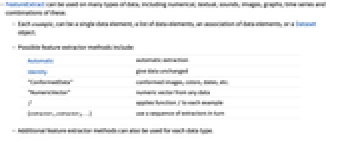
- 使用可能な特徴抽出器メソッドには以下がある.
-
Automatic 自動抽出 Identity データを変更せずに与える "ConformedData" 適合する画像,色,日付等 "NumericVector" 任意のデータからの数値ベクトル "name" 名前付きの抽出器法 f 関数 f を各例に適用する {extractor1,extractor2,…} 一連の抽出器を交互に使う - 次は,part の可能な形式である.
-
All 各例のすべての部分 i 各例の i
番目の部分{i1,i2,…} 各例の i1, i2, … 番目の部分 "key" 各例の指定されたキーを持つ部分 {"key1","key2",…} 各例の名前"keyi"がある部分 - 明示的に部分を指定する場合,言及されていない任意の部分は特徴抽出の際に除去される.
- FeatureExtract[examples]は,通常FeatureExtract[examples, "NumericVector"]と等価であるFeatureExtract[examples, Automatic]に等しい.
- "NumericVector"法は,通常,例を数値ベクトルに変換し,欠落データを補完して,DimensionReductionを使って次元を削減する.
- 単一のデータ型に特有の特徴抽出方は,そのデータ型と互換性のあるデータ要素にのみ適用される.その他のデータ要素は変更されずに返される.
- 1つの例のみが提供されている場合,すべての具体的な特徴抽出器が使用できるわけではない.例えば,ベクタープロセッサはスカラー特徴のリストのリストを想定する.
- 次は,具体的な抽出器である.
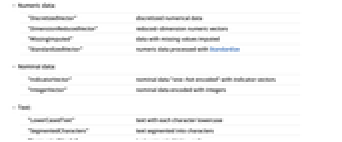
- 数値データ
-
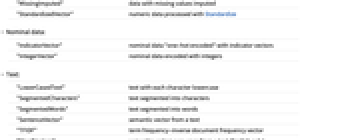
"DiscretizedVector" 離散化された数値データ "DimensionReducedVector" 次元を削減した数値ベクトル "MissingImputed" 欠落値が補完されたデータ "StandardizedVector" Standardizeで処理された数値データ - 名義データ
-
"IndicatorVector" インジケータベクトルで「ワンホットエンコード」された名義データ "IntegerVector" 整数で符号化された名義データ - テキスト:
-
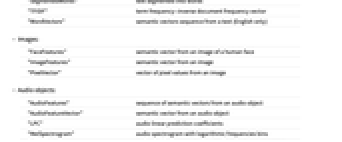
"LowerCasedText" 各文字が小文字のテキスト "SegmentedCharacters" 文字に分割されたテキスト "SegmentedWords" 単語に分割されたテキスト "SentenceVector" テキストからの意味ベクトル "TFIDF" 単語の出現頻度と逆文書頻度のベクトル "WordVectors" 英語テキストからの意味ベクトル列(英語のみ) - 画像
-
"FaceFeatures" ヒトの顔からの意味ベクトル "ImageFeatures" 画像からの意味ベクトル "PixelVector" 画像からの画素値のベクトル - 音声オブジェクト
-
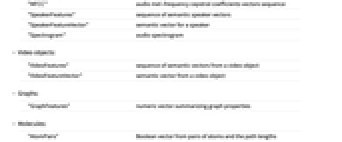
"AudioFeatures" 音声オブジェクトからの意味ベクトル列 "AudioFeatureVector" 音声オブジェクトからの意味ベクトル "LPC" 音声線形予測係数 "MelSpectrogram" 対数周波数ビンの音声スペクトログラム "MFCC" 音声メル周波数ケプストラム係数ベクトル列 "SpeakerFeatures" 意味話者ベクトルの列 "SpeakerFeatureVector" 話者の意味ベクトル "Spectrogram" 音声スペクトログラム - 動画オブジェクト
-
"VideoFeatures" 動画オブジェクトからの意味ベクトルの列 "VideoFeatureVector" 動画オブジェクトからの意味ベクトル - グラフ
-
"GraphFeatures" グラフ特性を要約する数値ベクトル - 分子
-
"AtomPairs" 原子対と両者の間の経路長からのブールベクトル "MoleculeExtendedConnectivity" 列挙された分子の部分グラフからのブールベクトル "MoleculeFeatures" 分子特性を要約する数値ベクトル "MoleculeTopologicalFeatures" 円形の原子近傍からのブールベクトル - 使用可能なオプション
-
FeatureNames Automatic exampleiの要素に割り当てる名前 FeatureTypes Automatic exampleiの要素に仮定する特徴タイプ RandomSeeding 1234 どのような擬似乱数生成器のシードを内部的に使うべきか - RandomSeedingの可能な設定
-
Automatic 関数が呼び出されるたびに自動的にシードを変える Inherited 外部シードの乱数を使う seed 明示的な整数または文字列をシードとして使う - FeatureExtract[…]はFeatureExtraction[…,"ExtractedFeatures"]に等しい.
抽出器
オプション
例題
すべて開く すべて閉じる例 (4)
FeatureExtract[{{1.4, "A"}, {1.5, "A"}, {2.3, "B"}, {5.4, "B"}}]FeatureExtract[{[image], [image], [image], [image], [image]}]"StandardizedVector"抽出器法を使って数値を標準化する:
FeatureExtract[{{1.4, 30.1}, {1.5, 46.3}, {2.3, 27.4}, {5.4, 51.2}}, "StandardizedVector"]抽出器法の"SegmentedCharacters"と"TFIDF"を繋ぎ合せて特徴についてのTFIDFベクトルを抽出する:
FeatureExtract[{"the cat is grey", "my cat is fast", "this dog is scary", "the big dog"}, {"SegmentedCharacters", "TFIDF"}] // MatrixFormスコープ (26)
入力形状 (9)
FeatureExtract[{"A rose by any other name", "It was the worst of times"}]FeatureExtract[{{"It was the best of times.", "Charles Dickens"}, {"A journey of a thousand miles begins with a single step.", "Laozi (attrib.)"}, {"To be or not to be, that is the question.", "William Shakespere"}}]FeatureExtract[{{"the cat is grey", [image]}, {"my cat is fast", [image]}, {"this dog is scary", [image]}, {"the big dog", [image]}}]連想のリストとしてフォーマットされたデータ集合から特徴を抽出する:
FeatureExtract[{<|"age" -> 32, "height" -> 160, "gender" -> "female"|>,
<|"height" -> 183, "age" -> 41, "gender" -> "female"|>,
<|"height" -> 123, "age" -> 30, "gender" -> "female"|>,
<|"height" -> 175, "age" -> 21, "gender" -> "male"|>,
<|"height" -> 150, "age" -> 11, "gender" -> "male"|>,
<|"age" -> 52, "height" -> 164, "gender" -> "female"|>}]FeatureExtract[<|"age" -> {32, 41, 30, 21, 11, 52}, "height" -> {160, 183, 123, 175, 150, 164}, "gender" -> {"female", "female", "female", "male", "male", "female"}|>]Tabularからの特徴抽出:
FeatureExtract[Tabular[Association["RawSchema" -> Association["ColumnProperties" ->
Association["age" -> Association["ElementType" -> "Integer64"],
"height" -> Association["ElementType" -> "Integer64"],
"gender" -> Association["ElementType" -> "String"]], "KeyColumns" -> None,
"Backend" -> "WolframKernel"], "Options" -> {},
"BackendData" -> Association["ColumnData" -> DataStructure["ColumnTable",
{{TabularColumn[Association["Data" -> {{32, 41, 30, 21, 11, 52}, {}, None},
"ElementType" -> "Integer64"]], TabularColumn[Association[
"Data" -> {{160, 183, 123, 175, 150, 164}, {}, None}, "ElementType" -> "Integer64"]],
TabularColumn[Association["Data" -> {{3, {0, 6, 12, 18, 22, 26, 32},
"femalefemalefemalemalemalefemale"}, {}, None}, "ElementType" -> "String"]]}}]]]]]Datasetからの特徴抽出:
FeatureExtract[Dataset[{Association["age" -> 32, "height" -> 160, "gender" -> "female"],
Association["age" -> 41, "height" -> 183, "gender" -> "female"],
Association["age" -> 30, "height" -> 123, "gender" -> "female"],
Association["age" -> 21, "height" -> 175, "gender" -> "male"],
Association["age" -> 11, "height" -> 150, "gender" -> "male"],
Association["age" -> 52, "height" -> 164, "gender" -> "female"]}]]FeatureExtract[{{1.4, Missing[], "A"}, {1.5, 50.2, "A"}, {Missing[], 42.3, "B"}, {5.4, 61.7, "B"}}]訓練を必要としない抽出器を使って単一の例題から特徴を抽出する:
FeatureExtract["Some text.", "WordVectors"]//Shallow抽出器指定 (8)
単一のテキストの特徴について,特徴抽出器"SentenceVector"を指定する:
FeatureExtract["the cat is cute", "SentenceVector"]//Short"SentenceVector"法を使って特徴を抽出し,続けて"DimensionReducedVector"法を使って次元削減を行なう:
FeatureExtract[{"the cat is grey", "my cat is fast", "this dog is scary", "the big dog"}, {"SentenceVector", "DimensionReducedVector"}]テキストと画像に対しテキストのみを扱う"TFIDF"法を使って特徴を抽出する:
FeatureExtract[{{"the cat is grey", [image]}, {"my cat is fast", [image]}, {"this dog is scary", [image]}, {"the big dog", [image]}}, "TFIDF"]"TFIDF"は画像には適用されないので,特徴はテキスト部分からしか抽出されなかった.
FeatureExtract[{{"Glucose", Molecule["Glucose"]}, {"Water", Molecule["Water"]}, {"Acetic Acid", Molecule["Acetic Acid"]}}, {1 -> { "SentenceVector", "DimensionReducedVector"}, 2 -> {"MoleculeFeatures", "DimensionReducedVector"}}]2番目の名義変数についてのみ,"IndicatorVector"法を使って特徴を抽出する:
FeatureExtract[{{"Yes", "A"}, {"No", "A"}, {"No", "B"}, {"Maybe", "B"}, {"No", "C"}}, 2 -> "IndicatorVector"] // MatrixFormIdentity抽出器法を使って最初の変数もコピーする:
FeatureExtract[{{"Yes", "A"}, {"No", "A"}, {"No", "B"}, {"Maybe", "B"}, {"No", "C"}}, {2 -> "IndicatorVector", 1 -> Identity}]FeatureExtract[{{"Yes", "A"}, {"No", "A"}, {"No", "B"}, {"Maybe", "B"}, {"No", "C"}}, {2 -> "IndicatorVector", 1 -> Identity, 1 -> Identity}]FeatureExtract[Tabular[Association["RawSchema" -> Association["ColumnProperties" ->
Association["Name" -> Association["ElementType" -> "String"],
"Molecule" -> Association["ElementType" -> "InertExpression"]], "KeyColumns" -> None,
"Backend" -> "WolframKernel"], "Options" -> {},
"BackendData" -> Association["ColumnData" -> DataStructure["ColumnTable",
{{TabularColumn[Association["Data" -> {{3, {0, 7, 12, 23}, "GlucoseWaterAcetic Acid"}, {},
None}, "ElementType" -> "String"]], TabularColumn[
Association["Data" -> {{Molecule[{"O", "C", "C", "O", "C", "O", "C", "O", "C", "O", "C",
"O", "H", "H", "H", "H", "H", "H", "H", "H", "H", "H", "H", "H"},
{Bond[{1, 2}, "Double"], Bond[{2, 3}, "Single"], Bond[{3, 4}, "Single"], Bond[{3, 5},
"Single"], Bond[{5, 6}, "Single"], Bond[{5, 7}, "Single"], Bond[{7, 8}, "Single"],
Bond[{7, 9}, "Single"], Bond[{9, 10}, "Single"], Bond[{9, 11}, "Single"], Bond[
{11, 12}, "Single"], Bond[{2, 13}, "Single"], Bond[{3, 14}, "Single"], Bond[
{4, 15}, "Single"], Bond[{5, 16}, "Single"], Bond[{6, 17}, "Single"], Bond[{7, 18},
"Single"], Bond[{8, 19}, "Single"], Bond[{9, 20}, "Single"], Bond[{10, 21},
"Single"], Bond[{11, 22}, "Single"], Bond[{11, 23}, "Single"], Bond[{12, 24},
"Single"]}, {StereochemistryElements -> {Association["StereoType" -> "Tetrahedral",
"ChiralCenter" -> 3, "Direction" -> "Counterclockwise"], Association[
"StereoType" -> "Tetrahedral", "ChiralCenter" -> 5, "Direction" -> "Clockwise"],
Association["StereoType" -> "Tetrahedral", "ChiralCenter" -> 7, "Direction" ->
"Counterclockwise"], Association["StereoType" -> "Tetrahedral",
"ChiralCenter" -> 9, "Direction" -> "Counterclockwise"]}}],
Molecule[{"O", "H", "H"}, {Bond[{1, 2}, "Single"], Bond[{1, 3}, "Single"]}, {}],
Molecule[{"C", "C", "O", "O", "H", "H", "H", "H"}, {Bond[{1, 2}, "Single"], Bond[
{2, 3}, "Double"], Bond[{2, 4}, "Single"], Bond[{1, 5}, "Single"], Bond[{1, 6},
"Single"], Bond[{1, 7}, "Single"], Bond[{4, 8}, "Single"]}, {}]}, {}, None},
"ElementType" -> "InertExpression", "CachedOriginalExpression" ->
{Molecule[{"O", "C", "C", "O", "C", "O", "C", "O", "C", "O", "C", "O", "H", "H", "H",
"H", "H", "H", "H", "H", "H", "H", "H", "H"}, {Bond[{1, 2}, "Double"],
Bond[{2, 3}, "Single"], Bond[{3, 4}, "Single"], Bond[{3, 5}, "Single"],
Bond[{5, 6}, "Single"], Bond[{5, 7}, "Single"], Bond[{7, 8}, "Single"],
Bond[{7, 9}, "Single"], Bond[{9, 10}, "Single"], Bond[{9, 11}, "Single"],
Bond[{11, 12}, "Single"], Bond[{2, 13}, "Single"], Bond[{3, 14}, "Single"],
Bond[{4, 15}, "Single"], Bond[{5, 16}, "Single"], Bond[{6, 17}, "Single"],
Bond[{7, 18}, "Single"], Bond[{8, 19}, "Single"], Bond[{9, 20}, "Single"],
Bond[{10, 21}, "Single"], Bond[{11, 22}, "Single"], Bond[{11, 23}, "Single"],
Bond[{12, 24}, "Single"]}, {StereochemistryElements -> {Association["StereoType" ->
"Tetrahedral", "ChiralCenter" -> 3, "Direction" -> "Counterclockwise"],
Association["StereoType" -> "Tetrahedral", "ChiralCenter" -> 5, "Direction" ->
"Clockwise"], Association["StereoType" -> "Tetrahedral", "ChiralCenter" -> 7,
"Direction" -> "Counterclockwise"], Association["StereoType" -> "Tetrahedral",
"ChiralCenter" -> 9, "Direction" -> "Counterclockwise"]}}],
Molecule[{"O", "H", "H"}, {Bond[{1, 2}, "Single"], Bond[{1, 3}, "Single"]}, {}],
Molecule[{"C", "C", "O", "O", "H", "H", "H", "H"}, {Bond[{1, 2}, "Single"],
Bond[{2, 3}, "Double"], Bond[{2, 4}, "Single"], Bond[{1, 5}, "Single"],
Bond[{1, 6}, "Single"], Bond[{1, 7}, "Single"], Bond[{4, 8}, "Single"]}, {}]}]]}}]]]], {"Name" -> { "SentenceVector", "DimensionReducedVector"}, "Molecule" -> { "MoleculeFeatures", "DimensionReducedVector"}}]data = {DateObject[{2014, 5, 5}, TimeObject[{9, 53, 6.30158}, TimeZone -> -5.], TimeZone -> -5.], DateObject[{2000, 1, 1}, TimeObject[{0, 0, 0.}, TimeZone -> -5.], TimeZone -> -5.], DateObject[{2006, 12}], DateObject[{2007, 8, 23}], DateObject[{2016, 4, 4}, TimeObject[{15, 59, 18.2738}, TimeZone -> -4.], TimeZone -> -4.]};FeatureExtract[data, {AbsoluteTime[#], #["Year"]}&]"StandardizedVector"法とカスタムの抽出器を連結する:
FeatureExtract[data, {{AbsoluteTime[#], #["Year"]}&, "StandardizedVector"}]FeatureExtract[{[image], [image], [image], [image]}, {"ConformedData", "ImageFeatures", "DimensionReducedVector"}]特徴型 (9)
FeatureExtract[{"the cat is grey", "my cat is fast", "this dog is scary", "the big dog"}]FeatureExtract[{"the cat is grey", "my cat is fast", "this dog is scary", "the big dog"}, "TFIDF"] // MatrixFormデフォルトで,テキストは単語に分割される.これでも同じ結果が与えられる:
FeatureExtract[{"the cat is grey", "my cat is fast", "this dog is scary", "the big dog"}, {"SegmentedWords", "TFIDF"}] // MatrixForm名義変数に"IndicatorVector"法を使って特徴を抽出する:
FeatureExtract[{{"Yes", "A"}, {"No", "A"}, {"No", "B"}, {"Maybe", "B"}, {"No", "C"}}, "IndicatorVector"] // MatrixFormDateObjectのインスタンスのリストから特徴を抽出する:
FeatureExtract[{DateObject[{2014, 5, 5, 9, 53, 6.30158}, "Instant", "Gregorian", -6.], DateObject[{2000, 1, 1, 0, 0, 0.}, "Instant", "Gregorian", -6.], DateObject[{2006, 12}, "Month", "Gregorian", -6.], DateObject[{2007, 8, 23}, "Day", "Gregorian", -6.], DateObject[{2016, 4, 4, 15, 59, 18.2738}, "Instant", "Gregorian", -4.]}]Graphのインスタンスのリストで特徴抽出器を訓練する:
FeatureExtract[{[image], [image], [image], [image]}]TimeSeriesインスタンスのリストで特徴抽出器を訓練する:
FeatureExtract[{TemporalData[TimeSeries, {{{0, 1, 0, 3, 0, 0, 0, 0, 2, 1, 0, 3, 0, 0, 0, 0, 0, 0, 0, 1, 0, 1, 0, 0,
0, 0, 0, 0, 0, 2, 0, 0, 36, 0, 6, 1, 2, 8, 6, 24, 20, 31, 68, 45, 140, 116, 65, 376, 322, 382,
516, 544, 767, 1133, 1788, 1360, 5886, 5412 ... tion[{2020, 1, 23, 0, 0, 0.}, {2020, 10, 5, 0, 0, 0.}, {1, "Day"}]},
1, {"Continuous", 1}, {"Discrete", 1}, 1, {DateFunction -> Automatic,
ResamplingMethod -> {"Interpolation", InterpolationOrder -> 1}, ValueDimensions -> 1}}, True,
12.2], TemporalData[TimeSeries, {{{0, 0, 0, 0, 0, 0, 0, 1, 0, 0, 1, 1, 0, 0, 0, 0, 0, 0, 0, 0, 0, 0, 0, 0,
0, 0, 0, 0, 0, 0, 0, 0, 0, 0, 0, 0, 0, 0, 0, 2, 0, 23, 2, 1, 3, 5, 4, 13, 6, 11, 9, 20, 11, 6,
23, 14, 38, 50, 86, 66, 103, 37, 121, 70, 1 ... {TemporalData`DateSpecification[{2020, 1, 23, 0, 0, 0.}, {2020, 10, 5, 0, 0, 0.}, {1, "Day"}]},
1, {"Continuous", 1}, {"Discrete", 1}, 1,
{ResamplingMethod -> {"Interpolation", InterpolationOrder -> 1}, ValueDimensions -> 1}}, True,
12.2], TemporalData[TimeSeries, {{{0, 0, 0, 0, 0, 0, 0, 0, 0, 0, 0, 0, 0, 0, 0, 0, 0, 0, 0, 0, 0, 0, 0, 0,
0, 0, 0, 0, 0, 0, 0, 0, 0, 0, 1, 0, 0, 1, 0, 0, 0, 2, 0, 9, 0, 7, 5, 6, 7, 14, 99, 0, 11, 38,
121, 51, 249, 172, 228, 572, 331, 323, 307, ... TemporalData`DateSpecification[{2020, 1, 23, 0, 0, 0.},
{2020, 10, 5, 0, 0, 0.}, {1, "Day"}]}, 1, {"Continuous", 1}, {"Discrete", 1}, 1,
{ResamplingMethod -> {"Interpolation", InterpolationOrder -> 1}, ValueDimensions -> 1}}, True,
12.2], TemporalData[TimeSeries, {{{0, 0, 0, 0, 0, 0, 0, 0, 2, 0, 0, 0, 0, 0, 0, 0, 0, 0, 0, 0, 0, 0, 0, 0,
0, 0, 0, 0, 0, 0, 0, 0, 0, 0, 0, 0, 0, 0, 0, 1, 0, 0, 1, 9, 0, 4, 0, 3, 0, 8, 17, 14, 4, 27,
24, 33, 52, 54, 53, 61, 71, 57, 163, 182, 196 ... {TemporalData`DateSpecification[{2020, 1, 23, 0, 0, 0.}, {2020, 10, 5, 0, 0, 0.}, {1, "Day"}]},
1, {"Continuous", 1}, {"Discrete", 1}, 1,
{ResamplingMethod -> {"Interpolation", InterpolationOrder -> 1}, ValueDimensions -> 1}}, True,
12.2], TemporalData[TimeSeries, {{{0, 0, 0, 0, 0, 0, 0, 0, 0, 0, 0, 0, 0, 0, 0, 0, 0, 0, 0, 0, 0, 0, 0, 0,
0, 0, 0, 0, 0, 0, 0, 0, 0, 0, 0, 0, 0, 0, 0, 0, 0, 0, 0, 1, 0, 0, 0, 2, 6, 0, 4, 9, 12, 20, 11,
28, 9, 26, 68, 35, 46, 101, 92, 21, 48, 69 ... {TemporalData`DateSpecification[{2020, 1, 23, 0, 0, 0.}, {2020, 10, 5, 0, 0, 0.}, {1, "Day"}]},
1, {"Continuous", 1}, {"Discrete", 1}, 1,
{ResamplingMethod -> {"Interpolation", InterpolationOrder -> 1}, ValueDimensions -> 1}}, True,
12.2]}]Moleculeデータから特徴を抽出する:
FeatureExtract[{Molecule["Sucrose"], Molecule["Butane"], Molecule["Pentane"]}]Audioインスタンスの集合から特徴を抽出する:
FeatureExtract[{Audio[Sound[Table[SoundNote[i, If[i == 12, 0.5, 0.1], "Violin"], {i, 0, 12}]]], Audio[Sound[Table[SoundNote[i, If[i == 12, 0.5, 0.1], "Cello"], {i, 0, 12}]]], Audio[Sound[Table[SoundNote[i, If[i == 12, 0.5, 0.1], "Trumpet"], {i, 0, 12}]]]}]FeatureExtract[{{1.4, Missing[], "A"}, {1.5, 50.2, "A"}, {Missing[], 42.3, "B"}, {5.4, 61.7, "B"}}]オプション (2)
FeatureNames (1)
FeatureNamesを使って特徴に名前を付け,部分指定にその名前を使う:
FeatureExtract[{{2.3, "male"}, {4.8, Missing[]}, {Missing[], "female"}, {5.2, "female"}}, {"age" -> Identity, "gender" -> "IndicatorVector"}, FeatureNames -> {"age", "gender"}] // MatrixFormFeatureTypes (1)
"IndicatorVector"法で単純なデータ集合から特徴を抽出する:
FeatureExtract[{{1, "A"}, {2, "A"}, {2, "B"}, {1, "B"}}, "IndicatorVector"]//MatrixForm"IndicatorVector"法は名義的特徴にしか作用しないので,最初の特徴は名義的であると想定された.
FeatureTypesを使って最初の特徴が数値であると強制的に解釈させ,特徴抽出器をバイパスする:
FeatureExtract[{{1, "A"}, {2, "A"}, {2, "B"}, {1, "B"}}, "IndicatorVector", FeatureTypes -> <|1 -> "Numerical"|>]// MatrixFormアプリケーション (1)
データ集合の可視化 (1)
dataset = {[image], [image], [image], [image], [image], [image], [image], [image], [image], [image], [image], [image], [image], [image], [image], [image], [image], [image], [image], [image], [image]};features = FeatureExtract[dataset];xy = DimensionReduce[features, 2, Method -> "TSNE"]ListPlot[List /@ xy, PlotMarkers -> (Image[#, ImageSize -> 40]& /@ dataset)]FeatureSpacePlotを使っても,同じような可視化を直接得ることができる:
FeatureSpacePlot[dataset]特性と関係 (2)
訓練例なしでの特徴抽出はFeatureExtraction[None,...]に等しい:
data = "This is a sentence"FeatureExtract[data, "SentenceVector"] == FeatureExtraction[None, "SentenceVector"][data]FeatureExtract[…]はFeatureExtraction[…,"ExtractedFeatures"]に等しい:
data = {"the cat is grey", "my cat is fast", "this dog is scary", "the big dog"};FeatureExtract[data, "TFIDF"] == FeatureExtraction[data, "TFIDF", "ExtractedFeatures"]関連するガイド
-
▪
- 顕微鏡検査のための画像計算 ▪
- 教師なし機械学習 ▪
- 動画処理 ▪
- 動画解析
テキスト
Wolfram Research (2016), FeatureExtract, Wolfram言語関数, https://reference.wolfram.com/language/ref/FeatureExtract.html (2025年に更新).
CMS
Wolfram Language. 2016. "FeatureExtract." Wolfram Language & System Documentation Center. Wolfram Research. Last Modified 2025. https://reference.wolfram.com/language/ref/FeatureExtract.html.
APA
Wolfram Language. (2016). FeatureExtract. Wolfram Language & System Documentation Center. Retrieved from https://reference.wolfram.com/language/ref/FeatureExtract.html
BibTeX
@misc{reference.wolfram_2026_featureextract, author="Wolfram Research", title="{FeatureExtract}", year="2025", howpublished="\url{https://reference.wolfram.com/language/ref/FeatureExtract.html}", note=[Accessed: 14-September-2026]}
BibLaTeX
@online{reference.wolfram_2026_featureextract, organization={Wolfram Research}, title={FeatureExtract}, year={2025}, url={https://reference.wolfram.com/language/ref/FeatureExtract.html}, note=[Accessed: 14-September-2026]}