

HermitianMatrix
HermitianMatrix[hmat]
エルミート(Hermite)行列 hmat を構造化配列に変換する.
詳細とオプション
- エルミート行列は,構造化配列として表されている場合は,便利な指定が利用できる.
- エルミート行列の場合,アプリケーションで発生する固有値問題を非常に低コストで解くことができる.
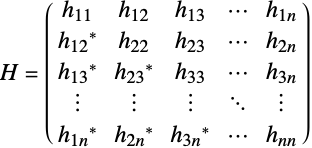
- エルミート行列
 は
 を満足する.
- 要素 hijは数値でなければならない.
- エルミート行列の逆行列および一般にエルミート行列の任意の行列関数はエルミート行列である.
- HermitianMatrix sa の次の特性"prop"には sa["prop"]でアクセスすることができる.
-
"Matrix" 完全配列として表されるエルミート行列 "Properties" サポートされる特性のリスト "Structure" 構造化配列の型 "StructuredData" 構造化配列によって保存されている内部データ "StructuredAlgorithms" 構造化配列についての特別なメソッドを持つ関数のリスト "Summary" Datasetとして表された情報の要約 - Normal[HermitianMatrix[…]]はエルミート行列を通常の行列として与える.
- HermitianMatrix[…,TargetStructure->struct]はエルミート行列を struct で指定された形式で与える.次は,使用可能な設定である.
-
Automatic 返す表現を自動的に選択する "Dense" 行列を密な行列として表す "Structured" 行列を構造化配列として表す - HermitianMatrix[…,TargetStructureAutomatic]はHermitianMatrix[…,TargetStructure"Structured"]に等しい.
例題
すべて開く すべて閉じる例 (1)
hm = HermitianMatrix[{{1, 1 + I, 2I}, {1 - I, 5, -3}, {-2I, -3, 0}}]MatrixForm[hm]NormalはHermitianMatrixを通常の表現に変換することができる:
Normal[hm]スコープ (4)
HermitianMatrix[{{1, 1 + I, 2I}, {5, -3}, {0}}]MatrixForm[%]HermitianMatrix[{{1}, {1 - I, 5}, {-2I, -3, 0}}]hm = HermitianMatrix[HilbertMatrix[4]]rm = ReflectionMatrix[{I, -1, -I}]{HermitianMatrix[rm], UnitaryMatrix[rm]}HermitianMatrixオブジェクトは行列についての情報を与える特性を含む:
hm = HermitianMatrix[(| | | | |
| ------- | ------- | ------- | ------- |
| 1 | 1 + 2 I | 1 + 3 I | 1 + 4 I |
| 1 - 2 I | 2 | 2 + 3 I | 2 + 4 I |
| 1 - 3 I | 2 - 3 I | 3 | 3 + 4 I |
| 1 - 4 I | 2 - 4 I | 3 - 4 I | 4 |)]hm["Properties"]
"Summary"特性は行列についての情報の簡単な要約を与える:
hm["Summary"]"StructuredAlgorithms"特性は構造化アルゴリズムを持つ関数をリストにする:
hm["StructuredAlgorithms"]オプション (1)
TargetStructure (1)
HermitianMatrix[(| | | |
| ----- | ----- | --- |
| 1 | 1 + I | 2 I |
| 1 - I | 5 | -3 |
| -2 I | -3 | 0 |), TargetStructure -> "Dense"]HermitianMatrix[(| | | |
| ----- | ----- | --- |
| 1 | 1 + I | 2 I |
| 1 - I | 5 | -3 |
| -2 I | -3 | 0 |), TargetStructure -> "Structured"]アプリケーション (3)
GaussianUnitaryMatrixDistributionから導かれた行列はエルミート行列である:
HermitianMatrix[RandomVariate[GaussianUnitaryMatrixDistribution[9]]]GaussianSymplecticMatrixDistributionから導かれた行列はエルミート行列である:
HermitianMatrix[RandomVariate[GaussianSymplecticMatrixDistribution[9]]]PauliMatrix[Range[3], TargetStructure -> "Hermitian"]

g = HermitianMatrix[{{7, 2 + I, 3I}, {2 - I, 6, -2}, {-3I, -2, 5}}]ip[u_, v_] := Conjugate[u].g.v
PositiveDefiniteMatrixQ[g]
{Subscript[e, 1], Subscript[e, 2], Subscript[e, 3]} = Orthogonalize[IdentityMatrix[3], ip]
Table[ip[Subscript[e, i], Subscript[e, j]], {i, 3}, {j, 3}]//Simplify特性と関係 (4)
hm = HermitianMatrix[(| | | |
| ---- | - | --- |
| 1 | 0 | 2 I |
| 0 | 2 | 0 |
| -2 I | 0 | -1 |)]ConjugateTranspose[hm] === hmhm = HermitianMatrix[(| | | |
| ----- | ----- | ----- |
| 1 | (1/2) | (1/3) |
| (1/2) | (1/3) | (1/4) |
| (1/3) | (1/4) | (1/5) |)]{HermitianMatrixQ[hm], SymmetricMatrixQ[hm] && MatrixQ[hm, RealValuedNumberQ]}エルミート行列は,SymmetrizedArrayあるいはHermitianMatrixを使って表すことができる:
array = SymmetrizedArray[{{1, 3} -> I, {2, 2} -> 2}, {3, 3}, Hermitian[All]]matrix = HermitianMatrix[{{0, 0, I}, {0, 2, 0}, {-I, 0, 0}}]2つの表現は等価であるが,異なるアルゴリズムをサポートする:
array == matrixSymmetrizedArrayは,D,Flatten,Inner,Outerのようなテンソル操作をサポートする:
array["StructuredAlgorithms"]HermitianMatrixは,KroneckerProductのような行列特有の操作をサポートする:
matrix["StructuredAlgorithms"]実際のエルミート行列はSymmetricMatrixを使って表すこともできる:
SymmetricMatrix[HermitianMatrix[(|   |   |
| - | - |
| 1 | 2 |
| 2 | 3 |)]]SymmetricMatrix[HermitianMatrix[(| | |
| ----- | ----- |
| 1 | 2 + I |
| 2 - I | 3 |)]]
テキスト
Wolfram Research (2024), HermitianMatrix, Wolfram言語関数, https://reference.wolfram.com/language/ref/HermitianMatrix.html.
CMS
Wolfram Language. 2024. "HermitianMatrix." Wolfram Language & System Documentation Center. Wolfram Research. https://reference.wolfram.com/language/ref/HermitianMatrix.html.
APA
Wolfram Language. (2024). HermitianMatrix. Wolfram Language & System Documentation Center. Retrieved from https://reference.wolfram.com/language/ref/HermitianMatrix.html