
AudioIdentify[audio]
audio が何の録音かの識別を試み,その結果を返す.
AudioIdentify[audio,category]
識別を指定された category に限定する.
AudioIdentify[audio,category,n]
n 個までの可能な識別のリストを与える.
AudioIdentify[audio,category,n,"prop"]
各識別について,指定された特性を与える.
AudioIdentify
AudioIdentify[audio]
audio が何の録音かの識別を試み,その結果を返す.
AudioIdentify[audio,category]
識別を指定された category に限定する.
AudioIdentify[audio,category,n]
n 個までの可能な識別のリストを与える.
AudioIdentify[audio,category,n,"prop"]
各識別について,指定された特性を与える.
詳細とオプション
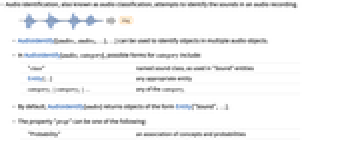
- 音声識別は,音声分類としても知られるもので,音声録音中の音の識別を試みる.
- AudioIdentify[{audio1,audio2,…},…]を使って複数の音声オブジェクト中のオブジェクトを識別することができる.
- AudioIdentify[audio,category]の category の可能な形には以下がある.
-
"class" "Sound" 実体で使われる,名前付きのサウンドクラス Entity[…] 適切な任意の実体 category1|category2|… categoryiのいずれか - デフォルトで,AudioIdentify[audio]はEntity["Sound",…]の形のオブジェクトを返す.
- 特性"prop"は以下の任意のものでよい.
-
"Probability" 概念と確率の連想 "Sound" サウンド実体オブジェクト "prop" "Sound"実体がサポートする特性 {prop1,…} 特性指定のリスト - 次は,使用可能なオプションである.
-
AcceptanceThreshold Automatic 許容可能とみなす最低確率 Masking All 関心区間 PerformanceGoal $PerformanceGoal 識別において何を最適化するか SpecificityGoal Automatic オブジェクトタイプのどの特異性を求めるか TargetDevice "CPU" 評価を行うターゲットデバイス - PerformanceGoalの可能な設定には"Speed"と"Quality"がある.
- SpecificityGoalの可能な設定には以下がある.
-
"Low" オブジェクトの一般的なカテゴリを優先する "High" 特定の種類のオブジェクトを優先する s 0(最低)から1(最高)までの特異性 - AudioIdentifyは,AcceptanceThresholdで指定された許容レベルで識別できないときにはMissing["Unidentified"]を返す.
- AudioIdentifyは機械学習を使う.含まれるメソッド,訓練集合,バイアスはWolfram言語のバージョンによって異なることがあり,与えられる結果も異なる可能性がある.
- AudioIdentifyはリソースをダウンロードすることがある.ダウンロードされたリソースは,$LocalBaseのローカルなオブジェクトストアに保存され,LocalObjects[]でリストしたりResourceRemoveで削除したりできる.

例題
すべて開く すべて閉じる例 (2)
スコープ (3)
a = ExampleData[{"Audio", "Bird"}];AudioIdentify[a]AudioIdentify[a, "Human sounds", AcceptanceThreshold -> 0]AudioIdentify[a, "Human sounds" | "musical instrument", 3, AcceptanceThreshold -> 0]a = Import["ExampleData/rule30.wav"];AudioIdentify[a, All, 3]返される識別は,明確な識別の数と要求された数のうち小さい方である:
AudioIdentify[a, All, 10]a = Import["ExampleData/rule30.wav"];AudioIdentify[a, All, 3, "Probability"]オプション (4)
AcceptanceThreshold (2)
AcceptanceThresholdを使って返される結果の信頼度を制御する:
a = \!\(\*AudioBox[""]\);AudioIdentify[a, AcceptanceThreshold -> .5]AudioIdentify[a, AcceptanceThreshold -> .9]AcceptanceThresholdは複数の識別を得る場合にも使われる:
a = \!\(\*AudioBox[""]\);AudioIdentify[a, All, 10]AudioIdentify[a, All, 10, AcceptanceThreshold -> 0]Masking (1)
SpecificityGoal (1)
SpecificityGoalオプションを使って結果の一般性を制御する:
{#, AudioIdentify[ExampleData[{"Audio", "SubwayTrain"}], SpecificityGoal -> #]}& /@ {"Low", "High"}アプリケーション (3)
ExampleDataの中のすべてのサウンドを識別する:
TextGrid[{#[[2]], Row@AudioIdentify[ExampleData[#], All, 2, SpecificityGoal -> "High"]}& /@ ExampleData["Audio"], Frame -> All]さまざまなサウンドを含む信号について,複数の識別と確率を得る:
a = \!\(\*AudioBox[""]\);AudioIdentify[a, All, 5, "Probability"]AudioBlockMapを使って1秒間の識別を行う:
identifications = AudioBlockMap[AudioIdentify[Audio[#], AcceptanceThreshold -> .4]&, a, {1, .5}]//Normalintervals = {{First[#][[1]] - .5, Last[#][[1]] + .5}, #[[1, 2]]}& /@ SplitBy[Normal[identifications], Last]colors = Hue[#1, .2]& /@ Most[Range[0, 1, 1. / Length[intervals]]];
Legended[AudioPlot[a, Prolog -> Flatten@MapThread[{#2, Rectangle[{#1[[1]], -1}, {#1[[2]], 1}]}&, {intervals[[All, 1]], colors}]], SwatchLegend[colors, Part[intervals, All, 2]]]WebAudioSearchを使って動物の音の小さなデータベースを構築する:
cows = WebAudioSearch["cow", "Samples", #Duration < 5&, MaxItems -> 10];
birds = WebAudioSearch["bird", "Samples", #Duration < 5&, MaxItems -> 10];
cats = WebAudioSearch["cat", "Samples", #Duration < 5&, MaxItems -> 10];
data = Join[Thread[cows -> [image]], Thread[birds -> [image]], Thread[cats -> [image]]]//Normal;RandomSample[data, 3]FeatureSpacePlotを使って意味論的に重要な2D空間に埋め込まれた信号を可視化する:
FeatureSpacePlot[data, LabelingFunction -> Callout]recognizeAnimal[audio_ -> label_] := label -> AudioIdentify[audio, "animal", AcceptanceThreshold -> .1]識別結果を使ってWordCloudを生成する:
WordCloud /@ GroupBy[recognizeAnimal /@ data, First][[All, All, 2]]//Normal//Column特性と関係 (1)
AudioIdentifyが使うニューラルネットには,NetModelを使ってアクセスできる:
net = NetModel["Wolfram AudioIdentify V1 Trained on AudioSet Data"]net[\!\(\*AudioBox[""]\), "TopProbabilities"]関連するガイド
-
▪
- 音声処理 ▪
- 音声解析 ▪
- 機械学習 ▪
- 信号処理 ▪
- 動画計算機能の更新履歴
テキスト
Wolfram Research (2019), AudioIdentify, Wolfram言語関数, https://reference.wolfram.com/language/ref/AudioIdentify.html.
CMS
Wolfram Language. 2019. "AudioIdentify." Wolfram Language & System Documentation Center. Wolfram Research. https://reference.wolfram.com/language/ref/AudioIdentify.html.
APA
Wolfram Language. (2019). AudioIdentify. Wolfram Language & System Documentation Center. Retrieved from https://reference.wolfram.com/language/ref/AudioIdentify.html
BibTeX
@misc{reference.wolfram_2026_audioidentify, author="Wolfram Research", title="{AudioIdentify}", year="2019", howpublished="\url{https://reference.wolfram.com/language/ref/AudioIdentify.html}", note=[Accessed: 17-August-2026]}
BibLaTeX
@online{reference.wolfram_2026_audioidentify, organization={Wolfram Research}, title={AudioIdentify}, year={2019}, url={https://reference.wolfram.com/language/ref/AudioIdentify.html}, note=[Accessed: 17-August-2026]}