Random Number Generation
| Introduction | Methods |
| Random Generation Functions | Statistical Distributions |
| Seeding and Localization | References |
 in order might be simulated.

Block[{trials = 10 ^ 5, count, rn},
	Table[
	count = 0;
	rn = Range[n];
	Do[If[RandomSample[rn] == rn, count++], {trials}];
	{n, N[count / trials]},
{n, 2, 8}]]Table[{i, N[1 / i!]}, {i, 2, 8}] can be obtained by generating values from the desired distribution and finding the mean of
  applied to those values.
Mean[RandomVariate[NormalDistribution[0, 2], 10 ^ 6] ^ 6]Expectation[x ^ 6, xNormalDistribution[0, 2]]ListLinePlot[Join[{0.}, Accumulate[RandomReal[{-1, 1}, {100}]]]]

Max[Abs[Sqrt[x ^ 2] - Abs[x] /. x -> RandomReal[{-10, 10}, 10000]]]

Max[Abs[Sqrt[x ^ 2] - Abs[x] /. x -> RandomComplex[{-10 + 10I, 10 + 10I}, 10000]]]ListPlot[Tally[RandomPrime[50, 10 ^ 5]], Filling -> Axis, PlotRange -> {0, Automatic}]Random Numbers
| RandomReal[] | give a pseudorandom real number in the range 0 to 1 |
| RandomReal[{xmin,xmax}] | give a pseudorandom real number in the range xmin to xmax |
| RandomReal[xmax] | give a pseudorandom real number in the range 0 to xmax |
| RandomReal[domain,n] | give a list of n pseudorandom reals |
| RandomReal[domain,{n1,n2,…}] | give an n1×n2×… array of pseudorandom reals |
| RandomInteger[{imin,imax}] | give a pseudorandom integer in the range {imin,…,imax} |
| RandomInteger[imax] | give a pseudorandom integer in the range {0,…,imax} |
| RandomInteger[] | pseudorandomly give 0 or 1 with probability  |
| RandomInteger[domain,n] | give a list of n pseudorandom integers |
| RandomInteger[domain,{n1,n2,…}] | give an n1×n2×… array of pseudorandom integers |
| RandomComplex[] | give a pseudorandom complex number in the unit square |
| RandomComplex[{zmin,zmax}] | give a pseudorandom complex number in the rectangle bounded by zmin and zmax |
| RandomComplex[zmax] | give a pseudorandom complex number in the rectangle bounded by 0 and zmax |
| RandomComplex[domain,n] | give a list of n pseudorandom complex numbers |
| RandomComplex[domain,{n1,n2,…}] | give an n1×n2×… array of pseudorandom complex numbers |
| RandomVariate[dist] | give a pseudorandom value from the distribution dist |
| RandomVariate[dist,n] | give a list of n pseudorandom values from dist |
| RandomVariate[dist,{n1,n2,…}] | give an n1×n2×… array of pseudorandom values from dist |
| RandomPrime[{imin,imax}] | give a pseudorandom prime in the range {imin,…,imax} |
| RandomPrime[imax] | give a pseudorandom prime in the range 2 to imax |
| RandomPrime[domain,n] | give a list of n pseudorandom primes |
| RandomPrime[domain,{n1,n2,…}] | give an n1×n2×… array of pseudorandom primes |
Timing[RandomReal[1, 10 ^ 7];]Timing[Table[RandomReal[1], {10 ^ 7}];] through
  , the total number of required pseudorandom numbers
 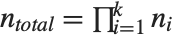 is generated and then partitioned. This makes the multidimensional array generation as efficient as possible because the total number of random values is generated as efficiently as possible and the time required for partitioning is negligible.
Timing[RandomInteger[100, {100, 100, 100, 10}];]Timing[RandomInteger[100, 10 ^ 7];]Timing[Table[RandomInteger[100, {10}], {100}, {100}, {100}];]Timing[RandomVariate[WeibullDistribution[2, 1], 10 ^ 5]//Length]Timing[Table[RandomVariate[WeibullDistribution[2, 1]], {10 ^ 5}]//Length]digits = Apply[StringJoin, Map[ToString, RandomInteger[9, 5]]]
pistring = StringJoin[Map[ToString, RealDigits[N[Pi, 10 ^ 6]][[1]]]];
StringPosition[pistring, digits]Block[{count = 0, ev},
Do[ev = Eigenvalues[RandomReal[{0, 1}, {5, 5}]];
If[Re[ev] == ev, count++], {10 ^ 5}];
N[count / 10 ^ 5]]Block[{count = 0, ev},
Do[ev = Eigenvalues[RandomVariate[NormalDistribution[0, 1], {5, 5}]];
If[Re[ev] == ev, count++], {10 ^ 5}];
N[count / 10 ^ 5]] given
given  is a binomial, and the conditional distribution of
  given
given  is a beta. As Casella and George mention, various strategies for detecting convergence and sampling using the Gibbs sampler have been suggested. For simplicity, assume that convergence will occur within 1000 iterations. A sample of size
  from the distribution will be taken as the
  values following the 1000 th iteration. It should be noted that these
  values will, however, be dependent.
sampler[len_] := Block[{y0, dist1, dist2, x0},
y0 = .5;
dist1[y_] := RandomVariate[BinomialDistribution[16, y]];dist2[x_] := RandomVariate[BetaDistribution[x + 2, 16 - x + 4]];
Do[{x0 = dist1[y0], y0 = dist2[x0]}, {1000}];
Table[{x0 = dist1[y0], y0 = dist2[x0]}, {len}]]data = sampler[10 ^ 4];frqs = Sort[Tally[data[[All, 1]]]];
BarChart[frqs[[All, 2]] / 10 ^ 4, ChartLabels -> frqs[[All, 1]]]Histogram[data[[All, -1]], Automatic, "ProbabilityDensity"]

Block[{y = .3, bcounts, probs, cdata},
	cdata = Select[data, y <= #[[2]] < y + .05&][[All, 1]];
	bcounts = BinCounts[cdata, {0, 17}] / Length[cdata];
	probs = Table[{x - .025, PDF[BinomialDistribution[16, y], x]}, {x, 0, 16}];
	ListPlot[{Transpose[{Range[0, 16], bcounts}], probs}, Filling -> Axis]]

Block[{x = 1, bcounts, probs, cdata},
	cdata = Select[data, #[[1]] == x&][[All, -1]];
	bcounts = BinCounts[cdata, {0, 1, .05}] / Length[cdata];
	probs = Table[{y - .025, CDF[BetaDistribution[x + 2, 16 - x + 4], y] - CDF[BetaDistribution[x + 2, 16 - x + 4], y - .05]}, {y, 0, 1, .05}];
	ListPlot[{Transpose[{Range[.025, .975, .05], bcounts}], probs}, Filling -> Axis, PlotRange -> All]]
Arbitrary-Precision Reals and Complexes
option name | default value | |
| WorkingPrecision | MachinePrecision | precision of the arithmetic to use in calculations |
RandomReal[{5, 50}, WorkingPrecision -> 25]
RandomVariate[StudentTDistribution[10], WorkingPrecision -> 50]
100 - Precision[BesselJ[1, RandomReal[{0, 1000}, 1000, WorkingPrecision -> 100]]]RandomComplex[7.5 + I, WorkingPrecision -> 50]
RandomInteger[10, WorkingPrecision -> 50]
Random Elements
| RandomChoice[{e1,e2,…}] | give a pseudorandom choice of one of the ei |
| RandomChoice[list,n] | give a list of n pseudorandom choices from list |
| RandomChoice[list,{n1,n2,…}] | give n1×n2×… pseudorandom choices from list |
| RandomChoice[{w1,w2,…}->{e1,e2,…}] | |
give a pseudorandom choice weighted by the wi | |
| RandomChoice[wlist->elist,n] | give a list of n weighted choices |
| RandomChoice[wlist->elist,{n1,n2,…}] | |
give an array of n1×n2×… array of weighted choices | |
| RandomSample[{e1,e2,…},n] | give a pseudorandom sample of n of the ei |
| RandomSample[{w1,w2,…}->{e1,e2,…},n] | |
give a pseudorandom sample of n of the ei chosen using weights wi | |
| RandomSample[{e1,e2,…}] | give a pseudorandom permutation of the ei |
| RandomSample[wlist->elist] | give a pseudorandom permutation of elist using initial weights wlist |
 . Since RandomSample samples without replacement, weights are updated internally based on the total remaining weight after each selection.
RandomChoice[{"heads", "tails"}, 15]RandomChoice[{.15, .1, .15, .15, .3, .15} -> Range[6], 20]RandomChoice[{1, 3, 5, 3, 1} -> Range[4, 8]]frqs = Tally[RandomChoice[{1, 3, 5, 3, 1} -> Range[4, 8], 1000]];
BarChart[frqs[[All, 2]] / 100, ChartLabels -> frqs[[All, 1]]]RandomSample[Join[Table["blue", {80}], Table["red", {45}]], 7]RandomSample[Range[10]]RandomSample[Range[10] ^ 2 -> Range[10]]data = Range[10];tallies = Tally[Table[RandomSample[data ^ 2 -> data, 1], {10 ^ 5}]]Sort[tallies][[All, 2]] / 10 ^ 5.Sort[Tally[RandomChoice[data ^ 2 -> data, 10 ^ 5]]][[All, 2]] / 10 ^ 5.N[data ^ 2 / Total[data ^ 2]]Partition[RandomSample[Range[20]], 5]| BlockRandom[expr] | evaluate expr with all pseudorandom generators localized |
| SeedRandom[n] | reset the pseudorandom generator using n as a seed |
| SeedRandom[] | reset the generator using as a seed the time of day and certain attributes of the current Wolfram Language session |
{SeedRandom[1];RandomReal[], SeedRandom[1];RandomReal[]}{BlockRandom[SeedRandom[1];RandomReal[]], BlockRandom[SeedRandom[1]];RandomReal[]}BlockRandom[SeedRandom[1];
SeedRandom[Method -> "Rule30CA"];
RandomReal[]]BlockRandom[SeedRandom[1, Method -> "Rule30CA"];
RandomReal[]]SeedRandom and BlockRandom in Parallel Computations
command | serial | parallel |
| SeedRandom[seed] | seed all current serial random generators with seed and the parallel generators with with seed + i, where i is the index for the parallel thread | seed only the random generator for the current thread with seed |
| SeedRandom[seed,Method->"ParallelGenerator"] | seed the parallel generators with seed + i, where i is the index for the parallel thread | no effect |
| SeedRandom[Method->method] | change the method for the serial random generator to method | change the method for only the random generator for the current thread to method |
| BlockRandom[expr] | evaluate expr with all pseudorandom generators localized | evaluate expr with only the pseudorandom generator for the current thread localized |
 samples that will run in parallel when given a list:
cf = Compile[{{n, _Integer}}, Total[Map[If[Norm[#] > 1., 0., 1.]&, RandomReal[1, {n, 2}]]] / n, RuntimeAttributes -> Listable, Parallelization -> True];SeedRandom[1234]; t1 = cf[ConstantArray[10 ^ 4, 20]]SeedRandom[1234]; t2 = BlockRandom[cf[ConstantArray[10 ^ 4, 20]]]Intersection[t1, t2]t3 = BlockRandom[cf[ConstantArray[10 ^ 4, 20]]];
Intersection[t1, t2, t3]cfws = Compile[{{n, _Integer}}, SeedRandom[1234];Total[Map[If[Norm[#] > 1., 0., 1.]&, RandomReal[1, {n, 2}]]] / n, RuntimeAttributes -> Listable, Parallelization -> True];t4 = cfws[ConstantArray[10 ^ 4, 20]]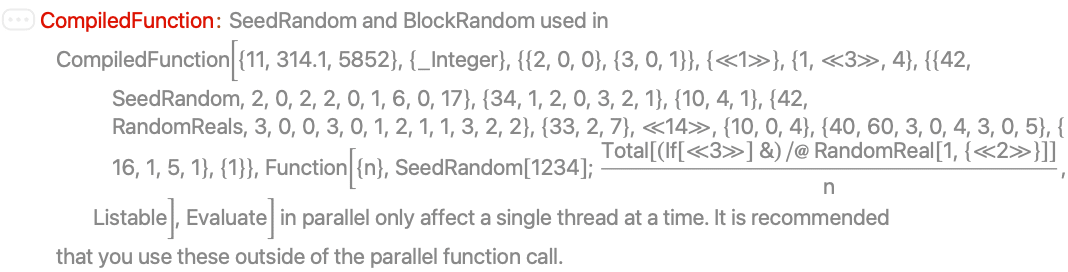
Union[t4]cfwb = Compile[{{n, _Integer}}, BlockRandom[Total[Map[If[Norm[#] > 1., 0., 1.]&, RandomReal[1, {n, 2}]]] / n], RuntimeAttributes -> Listable, Parallelization -> True];t5 = cfwb[ConstantArray[10 ^ 4, 20]]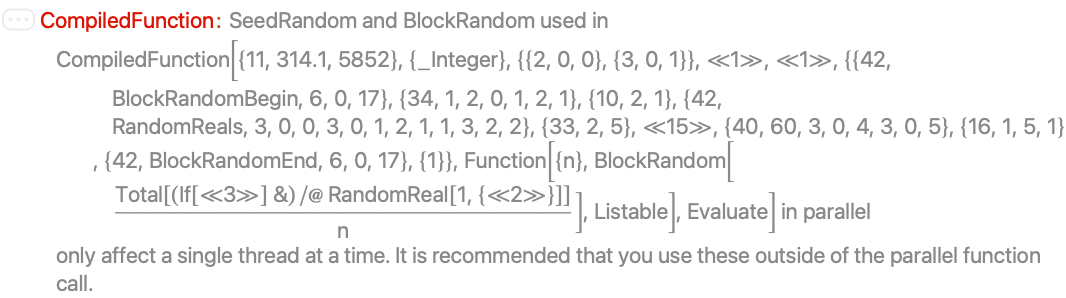
Union[t5]cfg = Compile[{{s, _Integer}}, SeedRandom[s, Method -> "ExtendedCA"], RuntimeAttributes -> Listable, Parallelization -> True];seeds = RandomInteger[{1, 2 ^ 16}, $ProcessorCount];cfg[seeds]
t6 = BlockRandom[cf[ConstantArray[10 ^ 4, $ProcessorCount]]]t7 = Map[BlockRandom[SeedRandom[#, Method -> "ExtendedCA"]; cf[10 ^ 4]]&, seeds]Sort[t6] === Sort[t7]| "Congruential" |
linear congruential generator (low
‐
quality randomness)
|
| "ExtendedCA" |
extended cellular automaton generator (default)
|
| "Legacy" | default generators prior to version 6.0 |
| "MersenneTwister" | Mersenne Twister shift register generator |
| "MKL" |
Intel MKL generator (Intel
‐
based systems)
|
| "ParallelGenerator" | used for initializing and seeding generators for parallel computations. |
| "ParallelMersenneTwister" | set of 1024 Mersenne Twister generators of period 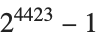 |
| "Rule30CA" | Wolfram rule 30 generator |
Map[BlockRandom[SeedRandom[2020, Method -> #];RandomInteger[10 ^ 20]]&, {"Congruential", "ExtendedCA", "Legacy", "MersenneTwister", "MKL", "Rule30CA"}]Map[BlockRandom[SeedRandom[2020, Method -> #];RandomReal[]]&, {"Congruential", "ExtendedCA", "Legacy", "MersenneTwister", "MKL", "Rule30CA"}]Congruential
 , where
  is given by the modular recurrence relation
 ,
,  , and
, and  called the multiplier, increment, and modulus, respectively. If the increment is 0, the generator is a multiplicative congruential generator. The values of
  ,
,  , and
, and  can be set via options to the "Congruential" method.
option name | default value | |
| "Bits" | Automatic | specify range of bits to use for numbers constructed from bits |
| "Multiplier" | 1283839219676404755 | multiplier value |
| "Increment" | 0 | increment value |
| "Modulus" | 2305843009213693951 | modulus value |
| "ConvertToRealsDirectly" | True | whether reals should be constructed directly from the congruence relation |
 .
.lcdata = BlockRandom[SeedRandom[1, Method -> {"Congruential", "Multiplier" -> 11, "Increment" -> 0, "Modulus" -> 63}];RandomReal[1, 40]];EulerPhi[63]


First[Select[Range[36], (Mod[11 ^ #, 63] === 1&)]]Partition[lcdata, 6]ListPlot[BlockRandom[SeedRandom[1, Method -> {"Congruential", "Multiplier" -> 11, "Increment" -> 0, "Modulus" -> 63}];RandomReal[1, 1000]]] used for constructing numbers from bits. Automatic uses {2,-1} unless
  is a power of 2, in which case {1,-1} is used.
ExtendedCA
option name | default value | |
| "Size" | 80 | state vector size as a multiplier of 64 |
| "Skip" | 4 | number of cells to skip |
| "Start" | 0 | which cell to start from |
 cells. The multiple of 64 can be controlled by the "Size" option. Once a state vector is computed by evolving the cellular automaton using the five-neighbor rule, bits are selected for random numbers from bits {start,start+skip,…}.
BlockRandom[SeedRandom[1];RandomReal[1, 5]]BlockRandom[SeedRandom[1, Method -> "ExtendedCA"];RandomReal[1, 5]]Legacy
BlockRandom[SeedRandom[31, Method -> "Legacy"];{RandomReal[], RandomInteger[50]}]BlockRandom[SeedRandom[31];{Random[], Random[Integer, {0, 50}]}]MersenneTwister
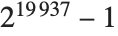 .
.BlockRandom[SeedRandom[1, Method -> "MersenneTwister"];RandomReal[1, 5]]Reference implementation
genrand64_int64 ()
#include <stdio.h>
#include "mt64.h"

int main(void) {
int i;
unsigned long long init[1], length=1;

init[0]=1ULL; /*SeedRandom[1, Method -> "MersenneTwister"];*/
init_by_array64(init, length);

for (i=0; i<5; i++) {
   printf("%20llu\n", genrand64_int64());
}

return 0;
}
/*Output*/
7259937129391483703
 7973299316636211948
16865006314979686608
 5442441613857606270
14480929463982189498
Wolfram Language
BlockRandom [
	SeedRandom[1, Method -> "MersenneTwister"];
	RandomInteger[2 ^ 64 - 1, 5]//Column
	]
Reals
genrand64_real1()
#include <stdio.h>
#include "mt64.h"

int main(void) {
int i;
unsigned long long init[1], length=1;

init[0]=1ULL; /*SeedRandom[1, Method -> "MersenneTwister"];*/
init_by_array64(init, length);

for (i=0; i<3; i++) {
        printf("%16.15f\n", genrand64_real1());
    }

return 0;
}
/*Output*/
0.393561980389721
0.432233422048709
0.914253824284137
Wolfram Language
BlockRandom [
	SeedRandom[1, Method -> "MersenneTwister"];
	RandomReal[1, 3]//Column
]SeedRandom[1, Method -> "MersenneTwister"];
Column[RandomInteger[{0, 2 ^ 64 - 1}, 3] * (1. / (2 ^ 53 - 1) / 2 ^ 11), 15]MKL
| "MCG31" | 31-bit multiplicative congruential generator |
| "MCG59" | 59-bit multiplicative congruential generator |
| "MRG32K3A" | combined multiple recursive generators with two components of order 3 |
| "MersenneTwister" | Mersenne Twister shift register generator |
| "R250" | generalized feedback shift register generator |
| "WichmannHill" | Wichmann–Hill combined multiplicative congruential generators |
| "Niederreiter" | Niederreiter low-discrepancy sequence |
| "Sobol" | Sobol low-discrepancy sequence |
ListPlot[BlockRandom[
	SeedRandom[Method -> {"MKL", Method -> {"Niederreiter", "Dimension" -> 2}}];RandomReal[1, {1000, 2}]],
AspectRatio -> 1, PlotStyle -> PointSize[Medium]]ListPlot[BlockRandom[
SeedRandom[Method -> {"MKL", Method -> {"Sobol", "Dimension" -> 2}}];RandomReal[1, {1000, 2}]],
AspectRatio -> 1, PlotStyle -> PointSize[Medium]]Rule30CA



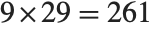 cells. The multiplier for 29 can be controlled by the "Size" option.
BlockRandom[SeedRandom[1, Method -> "Rule30CA"];RandomInteger[10 ^ 5, {2, 3, 4}]]ParallelMersenneTwister
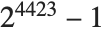 .
. data = Table[BlockRandom[SeedRandom[1, Method -> {"ParallelMersenneTwister", "Index" -> i}]; RandomReal[1, 2500]], {i, 0, 1}];
ListPlot[Transpose[data], AspectRatio -> 1, PlotStyle -> PointSize[Medium]]ParallelGenerator
| "ParallelMersenneTwister" | parallel Mersenne twister generators with period 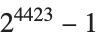 |
| "ExtendedCA" | extended CA generators with different starting positions |
| f | generator f[i] used for the i th thread |
| "Default" | restores the default method |
f = With[{n = $ProcessorCount}, Function[{"ExtendedCA", "Size" -> 80 n, "Skip" -> 4 n, "Start" -> 4 #}]]cf = Compile[{{n, _Integer}}, Total[RandomInteger[1, n]], RuntimeAttributes -> Listable, Parallelization -> True];SeedRandom[1234, Method -> "ParallelGenerator"]cf[ConstantArray[10 ^ 4, $ProcessorCount]]gfun = Function[{index}, Switch[Mod[index, 8],
0, "ExtendedCA",
1, "Rule50025CA",
2, "Rule30CA",
3, "MersenneTwister",
4, "Congruential",
5, {"MKL", Method -> "MCG31"},
6, {"MKL", Method -> "MCG59"},
7, {"MKL", Method -> "MRG32K3A"}]];SeedRandom[1234, Method -> {"ParallelGenerator", Method -> gfun}]t1 = cf[ConstantArray[10 ^ 4, $ProcessorCount]]t2 = Table[BlockRandom[SeedRandom[1234 + index, Method -> gfun[index]]; cf[10 ^ 4]], {index, 0, 7}]Intersection[t1, t2]SeedRandom[Method -> {"ParallelGenerator", Method -> "Default"}]Defining Your Own Generator
| GeneratesBitsQ | set to True if the method generates bits |
| GeneratesIntegersQ | set to True if the method generates integers for a given range |
| GeneratesRealsQ | set to True if the method generates reals for a given range and precision |
 . A warning message will be issued when results are out of range.
 . A warning message will be issued when results are out of range or of the wrong precision.
Example: Multiplicative Congruential Generator

Options[MultiplicativeCongruential] = {"Multiplier" -> 123456789, "Modulus" -> 2 ^ 35 - 1};MultiplicativeCongruential/:Random`InitializeGenerator[MultiplicativeCongruential, opts___] := Module[{mult, mod, flops = Flatten[{opts, Options[MultiplicativeCongruential]}]},
mult = "Multiplier" /. flops;
If[!(IntegerQ[mult] && Positive[mult]),
Throw[$Failed]
];
mod = "Modulus" /. flops;
If[!(IntegerQ[mod] && Positive[mult]),
Throw[$Failed]
];
MultiplicativeCongruential[mult, mod, 1]];MultiplicativeCongruential[___]["GeneratesRealsQ"] := True;MultiplicativeCongruential[mult_, mod_, ___]["SeedGenerator"[seed_]] :=
MultiplicativeCongruential[mult, mod, Mod[(mult * seed), mod]];MultiplicativeCongruential[mult_, mod_, s_]["GenerateReals"[n_, {a_, b_}, prec_]] :=
Module[{x = s},
{a + (b - a)Table[x = mult * x;Mod[x, mod], {n}] / mod, MultiplicativeCongruential[mult, mod, x]}
]BlockRandom[
SeedRandom[Method -> MultiplicativeCongruential];
RandomReal[{5, 50}, 10]]BlockRandom[
SeedRandom[Method -> MultiplicativeCongruential];
RandomInteger[{5, 50}]]
Example: Blum–Blum–Shub Generator
 ×
× for specified primes
  and
and  .
.Options[BlumBlumShub] = {"BlumPrimes" -> {1267650600228229401496703981519, 1267650600228229401496704318359}, "BitWidth" -> Automatic};SpecialBlumPrimeQ[x_] := (Positive[x] && (Mod[x, 4] == 3) && PrimeQ[x])BlumBlumShub::bprime = "`1` is not a list of two distinct special Blum primes.";BlumBlumShub::bw = "Warning: the value of the option BitWidth->`1` exceeds the number `2` that has been proved cyptographically secure.";BlumBlumShub::bw1 = "The value of the option BitWidth->`1` should be a positive machine sized integer or Automatic.";BlumBlumShub/:Random`InitializeGenerator[BlumBlumShub, opts___] := Module[{n, abw, bw, flops = Flatten[{opts, Options[BlumBlumShub]}]},
n = "BlumPrimes" /. flops;
If[!And[VectorQ[n, SpecialBlumPrimeQ], Length[n] == 2, Not[Apply[Equal, n]]],
Message[BlumBlumShub::"bprime", n];
Throw[$Failed]
];
n = Apply[Times, n];
abw = Max[1, Floor[Log[2., Log[2., n]]]];
bw = "BitWidth" /. flops;
If[bw === Automatic,
bw = abw,
If[!(IntegerQ[bw] && Positive[bw]),
Message[BlumBlumShub::bwi, bw];
Throw[$Failed]];
If[bw > abw,
Message[BlumBlumShub::bw, bw, abw]];
];
BlumBlumShub[n, bw, 2 ^ bw - 1, 2]];BlumBlumShub[___]["GeneratesBitsQ"] := True;BlumBlumShub[n_, bw_, __]["BitWidth"] := bw;BlumBlumShub[n_, bw_, mask_, ___]["SeedGenerator"[seed_]] :=
Module[{x, i = 0, state = {}},
While[Length[Union[state]] < 10,
x = seed + i;
state = NestList[PowerMod[#, 2, n]&, x, 9];
];
BlumBlumShub[n, bw, mask, Last[state]]]BlumBlumShub[n_, bw_, mask_, s_]["GenerateBits"[bits_]] :=
Module[{x = PowerMod[s, 2, n]},
{BitAnd[x, mask], BlumBlumShub[n, bw, mask, x]}]BlockRandom[
SeedRandom[Method -> BlumBlumShub];
{RandomInteger[{0, 10}, 5], RandomReal[4, 5]}]| RandomVariate[dist] | give a random number from the continuous distribution dist |
| RandomVariate[dist,n] | give a list of n pseudorandom reals from dist |
| RandomVariate[dist,{n1,n2,…}] | give an n1×n2×… array of pseudorandom reals from dist |
{RandomVariate[ChiSquareDistribution[8]], RandomVariate[PoissonDistribution[100]]}RandomVariate[BetaDistribution[3, 7], WorkingPrecision -> 30]RandomVariate[MultinormalDistribution[{1, 2}, {{2, .5}, {.5, 3}}]]RandomVariate[MultinomialDistribution[20, {1 / 3, 1 / 2, 1 / 6}]]dist = ProbabilityDistribution[E ^ -x ^ 3 / Gamma[4 / 3], {x, 0, Infinity}];
RandomVariate[dist]Continuous Distributions
 , variate generation uses additive properties of
  distributions to avoid expensive inverse CDF computations for nonintegral
  . The additive properties are given in, for instance, Johnson, Kotz, and Balakrishnan [7]. For
  a noncentral
  variate can be generated as the square of a normal variate with mean
  and variance 1. For
  noncentral
  variates are obtained as the sum of a central and a noncentral
  random variable. For
  ,
,  is distributed
  if
if 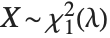 and
and  . This relationship cannot be used for
  . In that case the construction is
  with
with 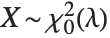 and
and  , where
  is the limiting noncentral
  distribution as
  goes to 0. The limiting distribution
  is a mixture of Poisson and
  variables, which has a nonzero probability mass at 0 and a continuous density for positive values. NoncentralFRatioDistribution variates are obtained from one central and one noncentral
  variate.
 . Otherwise, methods due to Cheng and Feast [9] and Ahrens and Dieter [10] are used.
 and
and  . If both parameters are 1, uniform random variates will be generated. If one of the beta parameters is 1, then a closed-form inverse CDF evaluation is used. Otherwise, RandomVariate switches between acceptance‐rejection methods due to Jöhnk [11], Cheng [12], and Atkinson [13]. An example of the advantage of using an acceptance‐rejection method over construction from two gammas can be seen in the following. The direct acceptance‐rejection method is nearly twice as fast as the gamma‐pair construction.
Timing[With[{x1 = RandomVariate[GammaDistribution[7, 1], 10 ^ 6]}, x1 / (x1 + RandomVariate[GammaDistribution[3, 1], 10 ^ 6])];]Timing[RandomVariate[BetaDistribution[7, 3], 10 ^ 6];] variates, as can be seen in the following. The direct construction takes roughly 1.5 times as long as the polar method for a million Student
  variates.
Timing[RandomVariate[NormalDistribution[0, 1], 10 ^ 6] / Sqrt[RandomVariate[ChiSquareDistribution[6], 10 ^ 6] / 6];]Timing[RandomVariate[StudentTDistribution[6], 10 ^ 6];]Discrete Distributions
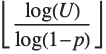 where
where  follows UniformDistribution[0,1]. BetaBinomialDistribution and BetaNegativeBinomialDistribution are constructed from BinomialDistribution and NegativeBinomialDistribution variates with probability parameters taken as random BetaDistribution variates.
 approaches 1 LogSeriesDistribution[p] switches to the direct construction
 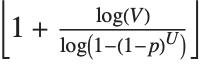 , where
  and
and  are uniformly distributed on the interval
  [15]. Depending on parameters and sample size, NegativeBinomialDistribution[n,p] may switch to construction as a Poisson-gamma mixture, which is a Poisson variable with mean following a gamma distribution [6].
 ]as μ increases.
Defining Distributional Generators
| Random`DistributionVector[expr,n,prec] | |
defines rules for generating n observations from expr with precision prec | |
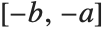 .
.NegativeOfUniform/:
Random`DistributionVector[NegativeOfUniform[a_, b_], n_Integer, prec_ ? Positive] := -RandomReal[{a, b}, n, WorkingPrecision -> prec] /;
VectorQ[{a, b}, NumericQ] && Element[{a, b}, Reals]{RandomReal[NegativeOfUniform[1, 3]], RandomReal[NegativeOfUniform[1, 3], WorkingPrecision -> 20]}RandomReal[NegativeOfUniform[7, 21], {3, 4}]NegativeOfDiscreteUniform/:
Random`DistributionVector[NegativeOfDiscreteUniform[a_Integer, b_Integer], n_Integer, Infinity] := -RandomInteger[{a, b}, n]RandomInteger[NegativeOfDiscreteUniform[1, 3], 10] instead of attaching definitions to a new symbol. The following examples will demonstrate slightly more complicated distributions, in which case attaching definitions to a symbol will be more useful.
Example: Normal Distribution by Inversion


 and replace
  with a random uniform between 0 and 1.

Quantile[NormalDistribution[μ, σ], q]NormalByInversion/:
Random`DistributionVector[
NormalByInversion[mu_ ? (NumericQ[#] && Im[#] === 0&), sigma_ ? Positive], n_Integer, prec_ ? Positive] := mu + Sqrt[2] sigma InverseErf[-1 + 2 RandomReal[1, n, WorkingPrecision -> prec]]RandomReal[NormalByInversion[1, 2], 10](ninv = RandomReal[NormalByInversion[1, 2], 10 ^ 4]);//Timing{Mean[ninv], StandardDeviation[ninv]}(ndist = RandomVariate[NormalDistribution[1, 2], 10 ^ 4]);//Timing{Mean[ndist], StandardDeviation[ndist]}Clear[ninv, ndist]Example: Uniform Distribution on a Disk
 with
with 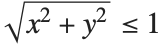 , is desired. Such a random point can be constructed as follows:



 to generate points uniformly distributed on a disk of radius
  .
. 
UniformDisk/:
	Random`DistributionVector[UniformDisk[r_ ? Positive], n_Integer, prec_ ? Positive] :=
	r * Sqrt[RandomReal[1, n, WorkingPrecision -> prec]] *
Transpose[{Cos[#], Sin[#]}&[RandomReal[2Pi, n, WorkingPrecision -> prec]]]RandomReal[UniformDisk[2]]ListPlot[RandomReal[UniformDisk[2], 1000], AspectRatio -> 1, PlotStyle -> PointSize[Medium]]Example: Gibbs Sampler
BinomialBetaSampler/:Random`DistributionVector[
	BinomialBetaSampler[m_Integer, α_ ? Positive], n_Integer, prec_ ? Positive] := Block[{y0, dist1, dist2, x0},
	y0 = .5;
	dist1[y_] := RandomVariate[BinomialDistribution[m, y]];dist2[x_] := RandomVariate[BetaDistribution[x + α, m - x + 4], WorkingPrecision -> prec];
	Do[{x0 = dist1[y0], y0 = dist2[x0]}, {1000}];
	Table[{x0 = dist1[y0], y0 = dist2[x0]}, {n}]]

RandomReal[BinomialBetaSampler[16, 2], 5][1] Geman, S. and D. Geman. "Stochastic Relaxation, Gibbs Distributions, and the Bayesian Restoration of Images." IEEE Transactions on Pattern Analysis and Machine Intelligence 6, no. 6 (1984): 721–741.
[2] Casella, G. and E. I. George. "Explaining the Gibbs Sampler." The American Statistician 46, no. 3 (1992): 167–174.
[3] Matsumoto, M. and T. Nishimura. "Mersenne Twister: A 623-Dimensionally Equidistributed Uniform Pseudorandom Number Generator." ACM Transactions on Modeling and Computer Simulation 8, no. 1 (1998): 3–30.
[4] Nishimura, T. "Tables of 64-Bit Mersenne Twisters." ACM Transactions on Modeling and Computer Simulation 10, no. 4 (2000): 348–357.
[5] Junod, P. "Cryptographic Secure Pseudo-Random Bits Generation: The Blum–Blum–Shub Generator." August 1999. http://crypto.junod.info/bbs.pdf
[6] Gentle, J. E. Random Number Generation and Monte Carlo Methods, 2nd ed. Springer-Verlag, 2003.
[7] Johnson, N. L., S. Kotz, and N. Balakrishnan. Continuous Univariate Distributions, Volume 2, 2nd ed. John Wiley & Sons, 1995.
[8] Smith, W. B. and R. R. Hocking. "Algorithm AS 53: Wishart Variate Generator." Applied Statistics 21, no. 3 (1972): 341–345.
[9] Cheng, R. C. H. and G. M. Feast. "Some Simple Gamma Variate Generators." Applied Statistics 28, no. 3 (1979): 290–295.
[10] Johnson, M. E. Multivariate Statistical Simulation. John Wiley & Sons, 1987.
[11] Jöhnk, M. D. "Erzeugung von Betaverteilten und Gammaverteilten Zufallszahlen." Metrika 8 (1964): 5–15.
[12] Cheng, R. C. H. "Generating Beta Variables with Nonintegral Shape Parameters." Communications of the ACM 21, no. 4 (1978): 317–322.
[13] Atkinson, A. C. "A Family of Switching Algorithms for the Computer Generation of Beta Random Variables." Biometrika 66, no. 1 (1979): 141–145.
[14] Bailey, R. W. "Polar Generation of Random Variates with the t-Distribution." Mathematics of Computation 62, no. 206 (1994): 779–781.
[15] Devroye, L. Non-Uniform Random Variate Generation. Springer-Verlag, 1986.
[16] Kachitvichyanukul, V. and B. W. Schmeiser. "Binomial Random Variate Generation." Communications of the ACM 31, no. 2 (1988): 216–223.
[17] Kachitvichyanukul, V. and B. W. Schmeiser. "Computer Generation of Hypergeometric Random Variates." Journal of Statistical Computation and Simulation 22, no. 2 (1985): 127–145.
[18] Ahrens, J. H. and U. Dieter. "Computer Generation of Poisson Deviates from Modified Normal Distributions." ACM Transactions on Mathematical Software 8, no. 2 (1982): 163–179.
[19] Matsumoto, M. and T. Nishimura. "Dynamic Creation of Pseudorandom Number Generators." In Proceedings of the Third International Conference on Monte Carlo and Quasi-Monte Carlo Methods in Scientific Computing: Monte Carlo and Quasi‐Monte Carlo Methods 1998, 56–69, 2000.

 Statistics: Modeling with Statistical Distributions
 Visualization: Histograms and Density Estimates
 Visualization: Quantile and Box-Whisker Plots