PairCorrelationG[pdata,r]
估计半径为 r 时点数据 pdata 的对相关函数  .
.
PairCorrelationG[pproc,r]
计算点过程 pproc 的  .
.
PairCorrelationG[bdata,r]
计算已分组数据 bdata 的  .
.
PairCorrelationG[pspec]
生成可重复应用于不同半径 r 的函数  .
.

PairCorrelationG
PairCorrelationG[pdata,r]
估计半径为 r 时点数据 pdata 的对相关函数  .
.
PairCorrelationG[pproc,r]
计算点过程 pproc 的  .
.
PairCorrelationG[bdata,r]
计算已分组数据 bdata 的  .
.
PairCorrelationG[pspec]
生成可重复应用于不同半径 r 的函数  .
.
更多信息和选项
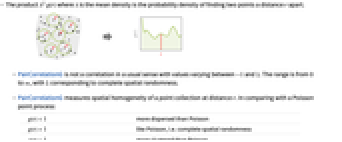

- 积
 是找到相距
是找到相距  的两个点的概率密度,其中
  是平均密度.
 -

- PairCorrelationG 不是通常意义上的值在
 和 1 之间变化的相关. 范围是从 0 到
  ,其中 1 对应于完全空间随机性.
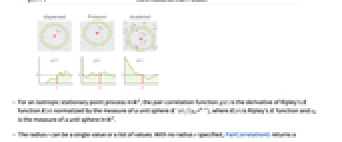
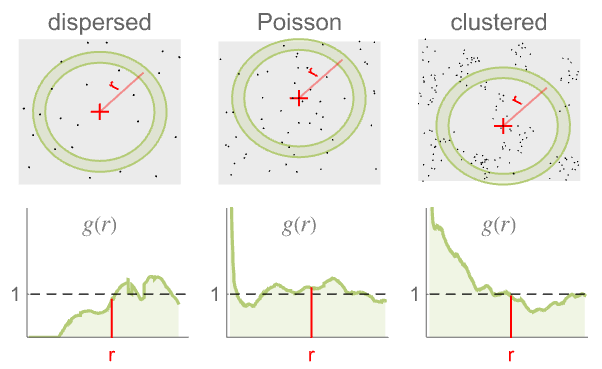
 - PairCorrelationG 测量距离
 处点集的空间均匀性. 与泊松点过程相比:
 -

比泊松点过程更分散 
与泊松点过程相似,即具有完全空间随机性 
比泊松点过程聚类性更强 -
- 对于
 中的各向同性平稳点过程,对相关函数
  是被单位球面的度量
  归一化的 Ripley's
  函数
函数  的导数,其中
  是 Ripley's
  函数,
函数, 是
是  中单位球面的度量.
 - 半径 r 可以是单个值或数值列表. 如果没有指定半径 r,PairCorrelationG 返回可用来重复计算
 函数的 PointStatisticFunction.
 - 可用以下形式给出点 pdata:
-
{p1,p2,…} 点 pi GeoPosition[…],GeoPositionXYZ[…],… 地理点 SpatialPointData[…] 空间点集 {pts,reg} 点集 pts 和观察区域 reg - 如果没有给出观察区域 reg,则用 RipleyRassonRegion 自动计算区域.
- 可用以下形式给出点过程 pproc:
-
proc 点过程 proc {proc,reg} 点过程 proc 和观察区域 reg - 观察区域 reg 不应含有参数且 SpatialObservationRegionQ 的结果为真.
- 已分组数据 bdata 来自 SpatialBinnedPointData,且被视为是具有分段恒定密度函数的 InhomogeneousPoissonPointProcess.
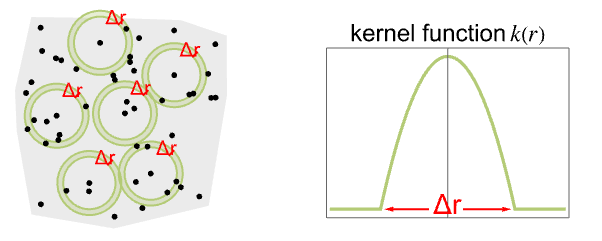
- 对于 pdata,
 是用核平滑
是用核平滑  计算出来的,其中应用了边缘校正. 这里
  是平滑内核,
 是点数.
是点数. -
- 对于 pproc,通过使用精确公式或通过仿真生成点数据来计算
 .
. - 可给出以下选项:
-
Method Automatic 使用什么方法 SpatialBoundaryCorrection Automatic 使用什么样的边界校正 - 对于 SpatialBoundaryCorrection,可使用以下设置:
-
Automatic 自动确定边界校正 "BorderMargin" 对于观察区域使用内边界 None 不进行边界校正 "Ripley" 根据到边界的距离进行加权 - 设置 Method{"Kernel"->kern,"Bandwidth"->bw} 允许选择估计时使用的平滑内核 kern 和带宽 bw. 此处 kern 可以是 KernelMixtureDistribution 支持的任何内置一维内核,带宽 bw 可以是 Automatic 或任意正数.
- 默认情况下,使用 "Epanechnikov" 内核,带宽被选定为
 .
. - PairCorrelationG 允许根据 RipleyK 或 BesagL 生成的 PointStatisticFunction 估计对相关函数. 通过平滑样条曲线进行估算. 这种情况下,参数 pdata 具有以下形式和解释:
-
{PointStatisticFunction[…],{r1,r2,dr}} 根据在距离 Range[r1,r2,dr] 处抽样的值估计对相关函数 {PointStatisticFunction[…],{{r1,r2,…}}} 根据在距离 {r1,r2,...} 处抽样的值估计对相关函数 {PointStatisticFunction[…],rspec,type} 与上述相同,但平滑类型为 type - 支持的平滑类型为:
-
1 对  应用平滑样条曲线,默认情况下使用此类型
2 对  应用平滑样条曲线,同时要求
3 - 对
 应用平滑样条曲线,同时要求
4 对  应用平滑样条曲线
 - 对
范例
打开所有单元 关闭所有单元基本范例 (3)
范围 (9)
点数据 (6)
将 PairCorrelationG 与 SpatialPointData 一起使用:
创建一个 PointStatisticFunction 以备后用:
将 PairCorrelationG 和 GeoPosition 一起使用:


点过程 (3)
选项 (2)
Method (1)
SpatialBoundaryCorrection (1)
不包含边界校正的 PairCorrelationG 估计器存在偏差,除非是处理较大的点集,否则不应使用:


文本
Wolfram Research (2020),PairCorrelationG,Wolfram 语言函数,https://reference.wolfram.com/language/ref/PairCorrelationG.html.
CMS
Wolfram 语言. 2020. "PairCorrelationG." Wolfram 语言与系统参考资料中心. Wolfram Research. https://reference.wolfram.com/language/ref/PairCorrelationG.html.
APA
Wolfram 语言. (2020). PairCorrelationG. Wolfram 语言与系统参考资料中心. 追溯自 https://reference.wolfram.com/language/ref/PairCorrelationG.html 年