
ContourIntegrate[f,z∈cont]
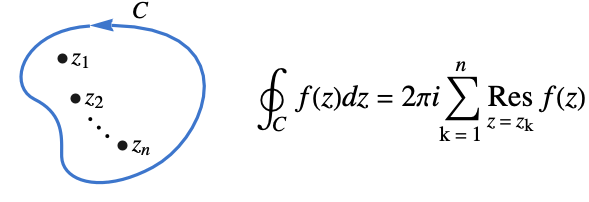
複素平面上で cont によって定義される曲線に沿った f の積分を与える.
ContourIntegrate
ContourIntegrate[f,z∈cont]
複素平面上で cont によって定義される曲線に沿った f の積分を与える.
詳細とオプション
- 周回積分は経路積分あるいは複素線積分としても知られている.
- 周回積分は複素解析における正則関数および有理型関数の研究で発現したものであるが,現在では逆ラプラス(Laplace)変換およびZ変換の計算,定積分と総和,偏微分方程式の解を含む幅広い分野で使われている.
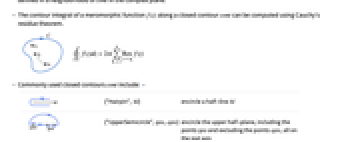
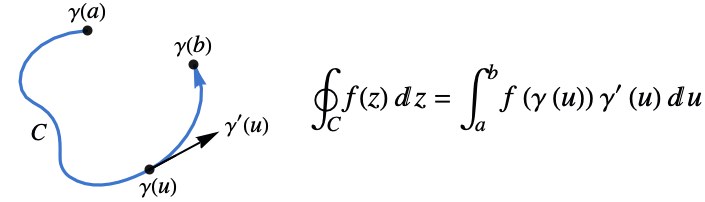
- 積分路 cont

に沿った関数
の周回積分は以下で与えられる. - 周回積分の値はパラメータ化には依存しないが,積分路 cont の向きには依存する.
- 関数 f は,通常は z の有理型関数であるが,複素平面内の cont の近傍で定義される任意の区分連続関数でよい.
- 有理型関数
の閉じた積分路 cont に沿った周回積分はコーシー(Cauchy)の留数定理を使って計算できる. - 次は,よく使われる閉じた積分路 cont である. »
-
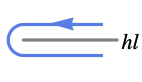
{"Hairpin", hl} 半直線 hl を囲む 

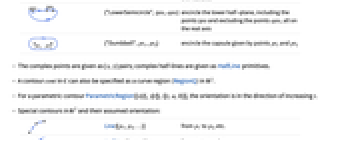
{"UpperSemicircle",ipts,epts} すべて実軸上の点 ipts を含み点 epts は含まない上半平面を囲む 

{"LowerSemicircle",ipts,epts} すべて実軸上の点 ipts を含み点 epts は含まない下半平面を囲む 

{"Dumbbell",pt1,pt2} 点 pt1と点 pt2で与えられるカプセルを囲む - 複素点は{x,y}のペアで与えられる.複素半直線はHalfLineプリミティブで与えられる.
における積分路 cont は
における曲線領域(RegionQ)としても指定できる.- パラメトリック積分路ParametricRegion[{x[t],y[t]},{{t,a,b}}]の向きは t が増加する方向である.
- 次は,
における特殊積分路とその推定される方向である. -

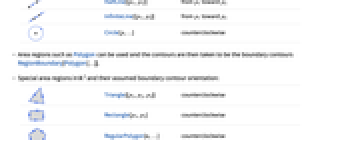
Line[{p1,p2,…}] p1から p2等まで 
HalfLine[{p1,p1}] p1から p2方向に 
InfiniteLine[{p1,p2}] p1から p2方向に 
Circle[p,…] 反時計回り - Polygonのような面領域を使うことができる.その場合の積分路は境界線RegionBoundary[Polygon[…]]である.
- 次は,
における特殊面領域とその推定境界線の向きである. -

Triangle[{p1,p2,p3}] 反時計回り 
Rectangle[p1,p2] 反時計回り 
RegularPolygon[n,…] 反時計回り 
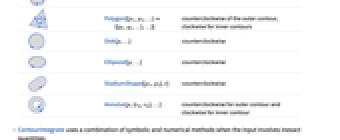
Polygon[{p1,p2,…}{{q1,q2,…},…}] 外側の積分路の反時計回り,内側の積分路の時計回り 
Disk[p,…] 反時計回り 
Ellipsoid[p,…] 反時計回り 
StadiumShape[{p1,p2},r] 反時計回り 
Annulus[p,{rm,rm},…] 外側の積分路の反時計回り,内側の積分路の時計回り - ContourIntegrateは,入力が厳密ではない数量を含む場合は記号メソッドを数値メソッドを組み合せて使う.
- cont 内の領域は自動評価を避けるためにInactiveでラップされることがある.
- 次は,使用可能なオプションである.
-
Assumptions $Assumptions パラメータについての仮定 GenerateConditions Automatic パラメータについての条件を含む答を生成するかどうか PrincipalValue False コーシー主値を求めるかどうか WorkingPrecision Automatic 内部計算の精度
例題
すべて開く すべて閉じる例 (3)
ContourIntegrate[1 / z, z∈Circle[]]ComplexPlot[(z^3 (1 - 3 z)/(3z + 2) (1 + 2 z^4)), {z, -3 - 3I, 3 + 3I}, ...]ContourIntegrate[(z ^ 3(1 - 3z)/(3z + 2) (1 + 2 z^4)), z∈Circle[{0, 0}, 2]]ContourIntegrate[E ^ (I z) / (z ^ 3 + 1 / 8), z∈RegularPolygon[6]]ComplexPlot[E ^ (I z) / (z ^ 3 + 1 / 8), {z, -2 - 2I, 2 + 2I}, ...]スコープ (53)
基本的な用法 (5)
f = (1/(z - 1)^2 (z - I));ComplexPlot[f, {z, -3 - 3I, 3 + 3I}, ...]ContourIntegrate[f, z∈Circle[{1, 0}, 1]]ContourIntegrate[f, z∈Circle[{1, 0}, 1], WorkingPrecision -> MachinePrecision]f = Exp[2z] / (z - 1);reg = Line[{{0, 0}, {1, 1}, {2, 0}}];ComplexPlot[f, {z, -1 - I, 3 + 3I}, ...]ContourIntegrate[f, z∈reg]f = 1 / (z - a);reg = Disk[{0, 0}, r, {0, Pi}];ContourIntegrate[f, z∈reg]f = Sin[z ^ 2 + 1 / z];reg = Circle[];ContourIntegrate[f, z∈reg, WorkingPrecision -> MachinePrecision]reg = ParametricRegion[{Cos[t], Sin[t]}, {{t, 0, 2Pi}}];ContourIntegrate[1 / z, z∈reg]特別テーマ:有理関数 (13)
ContourIntegrate[(3z ^ 3 + 2) / ((z - 1)(z ^ 2 + 9)), z∈Circle[{0, 0}, 4]]ContourIntegrate[z / (z - a) ^ 2, z∈Circle[{0, 0}, 1]]ComplexPlot[(z ^ 5 + 1/(z - I / 2)(z - 1 / 3) ^ 2), {z, -1 - I, 1 + I}, ...]ContourIntegrate[(z ^ 5 + 1/(2z - I)(3z - 1) ^ 3), z∈RegularPolygon[5]]f = (1/(z - 1)(z - 2)(z - 3));reg = Triangle[{{2, 1}, {-2, 0}, {3, -1}}];ComplexPlot[f, {z, -4 - 2I, 4 + 2I}, ...]ContourIntegrate[f, z∈reg]ContourIntegrate[f, z∈reg, WorkingPrecision -> MachinePrecision]f = (z^4 + 1/(z^2 - 1)^2 + 3);reg = Rectangle[{-2, 0}, {2, 1}];ComplexPlot[f, {z, -5 / 2 - 2I, 5 / 2 + 2I}, ...]ContourIntegrate[f, z∈reg]f = 1 / z;reg = Circle[];ComplexPlot[f, {z, -3 / 2 - 3I / 2, 3 / 2 + 3I / 2}, ...]ContourIntegrate[f, z∈reg]f = (1/z^2);reg = Line[{{1, 0}, {2, 1}, {3, 0}, {4, 1}}];ComplexPlot[f, {z, -1 - 2I, 9 / 2 + 2I}, ...]ContourIntegrate[f, z∈reg]f = (1/z - 2);reg = Circle[{0, 0}, {1 / 2, 1}, {0, (7Pi/4)}];ComplexPlot[f, {z, -2 - 2I, 2 + 2I}, ...]ContourIntegrate[f, z∈reg]f = (Cosh[z^2 - 1]/z^3 + I / 2);reg = Disk[{0, 0}, 1, {0, Pi}];ComplexPlot[f, {z, -2 - 2I, 2 + 2I}, ...]ContourIntegrate[f, z∈reg]f = (Cos[1 / z]/z);reg = Circle[];ComplexPlot[f, {z, -2 - 2I, 3 + 2I}, ...]ContourIntegrate[f, z∈reg]f = Exp[1 / Conjugate[z]];reg = Line[{{-1, -1}, {0, -1}, {1, -3 / 2}}];ComplexPlot[f, {z, -2 - 2I, 2 + 2I}, Epilog -> {RGBColor[0.33333333333333337, 0.33333333333333337, 0.33333333333333337], Arrow@reg}, ImageSize -> Small]ContourIntegrate[f, z∈reg]f = Sqrt[z + 1 / 2];reg = Circle[];ComplexPlot[f, {z, -1.5 - 1.5I, 1.5 + 1.5I}, ...]ContourIntegrate[f, z∈reg]f = (z - b) ^ 2 / (z - a);reg = Circle[];ContourIntegrate[f, z∈reg]特別テーマ:有理型関数 (5)
f = (z^2 + I/(z - I / 2)Cos[3z]);reg = RegularPolygon[5];ComplexPlot[f, {z, -2 - 2I, 2 + 2I}, ...]ContourIntegrate[f, z∈reg]N[%]ContourIntegrate[f, z∈reg, WorkingPrecision -> MachinePrecision]f = (Sin[z]/z(z^2 + 3)(z - 2));reg = Circle[{0, 0}, {1, 3}];ComplexPlot[f, {z, -4 - 4I, 4 + 4I}, ...]ContourIntegrate[f, z∈reg]f = (Cosh[z^2 - 1 / 4]/z^2 + 1 / 4);reg = Disk[{0, 0}, 1, {0, Pi}];ComplexPlot[f, {z, -2 - 2I, 2 + 2I}, ...]ContourIntegrate[f, z∈reg]f = Tan[z - I];reg = Annulus[{0, 0}, {1, 3}, {0, Pi}];ComplexPlot[f, {z, -7 / 2 - 7I / 2, 7 / 2 + 7I / 2}, ...]ContourIntegrate[f, z∈reg]ContourIntegrate[1 / Sin[z], z∈Circle[{0, 0}, r], Assumptions -> r > 0]特別テーマ:真性特異点がある関数 (4)
f = Exp[1 / z];reg = Circle[];ComplexPlot[f, {z, -2 - 2I, 2 + 2I}, ...]ContourIntegrate[f, z∈reg]輪郭線内に真性特異点があるSin関数:
f = (Sin[1 / z]/z^4 + I);reg = Rectangle[{-1 / 2, -1 / 2}, {1, 1}];ComplexPlot[f, {z, -2 - 2I, 2 + 2I}, ...]ContourIntegrate[f, z∈reg]f = (Tanh[1 / z]/(z - 1)(z + I / 2));reg = Disk[{-1 / 2, -1}, {1, 3 / 2}, {0, Pi / 2}];ComplexPlot[f, {z, -2 - 2I, 2 + 2I}, ...]ContourIntegrate[f, z∈reg]f = (Cos[2 - 1 / z]/z);reg = Annulus[{-1 / 2, -1}, {1 / 2, 3 / 2}, {0, Pi / 2}];ComplexPlot[f, {z, -2 - 2I, 3 + 2I}, ...]ContourIntegrate[f, z∈reg]特別テーマ:非解析的関数 (4)
f = Conjugate[z];reg = Circle[];ComplexPlot[f, {z, -2 - 2I, 2 + 2I}, ...]ContourIntegrate[f, z∈reg]Arg関数の周回積分:
f = Arg[z];reg = Circle[{0, 0}, 2];ComplexPlot[f, {z, -3 - 3I, 3 + 3I}, ...]ContourIntegrate[Arg[z], z∈reg]f = (1/z - Conjugate[z] + 1);reg = Disk[{0, 0}, {1, 2}, {-Pi / 8, 11Pi / 8}];ComplexPlot[f, {z, -2 - 2I, 2 + 2I}, ...]ContourIntegrate[f, z∈reg]//Simplifyf = (Exp[Conjugate[z]]/z + Conjugate[z]);reg = Rectangle[{-5 / 2, -5 / 2}, {-1, -1}];ComplexPlot[f, {z, -6 / 2 - 6 / 2I, 2 + 2I}, ...]ContourIntegrate[f, z∈reg]特別テーマ:分枝切断線がある関数 (2)
f = Sqrt[z];reg = Circle[];ComplexPlot[f, {z, -1.5 - 1.5I, 1.5 + 1.5I}, ...]ContourIntegrate[f, z∈reg]f = (z^2/Sqrt[z^2 + 1 / 2]);reg = Circle[];ComplexPlot[f, {z, -2 - 2I, 2 + 2I}, ...]ContourIntegrate[f, z∈reg]特別テーマ:記号パラメータ (5)
ContourIntegrate[(1/z - a), z∈Circle[{0, 0}, r]]GenerateConditions Falseを使って存在条件を抑制する:
ContourIntegrate[(1/z - a), z∈Circle[{0, 0}, r], GenerateConditions -> False]結果はPiecewise関数である:
ContourIntegrate[(1/(z - a)(z - b)), z∈Circle[{c1, c2}, r]]f = (1/z^2 + a);reg = Disk[{0, 0}, r, {0, Pi}];ContourIntegrate[f, z∈reg, GenerateConditions -> False]ContourIntegrate[(1/z - a), z∈Circle[{c1, c2}, {r1, r2}], GenerateConditions -> False]ContourIntegrate[1 / (z - a), z∈Annulus[{0, 0}, {r, R}, {0, Pi}]]特別テーマ:名前付きの積分路 (8)
複素平面の上半分を閉じる,実軸上の極を中心として正の方向の実軸に沿った周回積分:
ContourIntegrate[I E ^ (-I p) / (p ^ 2 - 4), p∈{"UpperSemicircle", 2, -2}]ComplexPlot[I E ^ (-I p) / (p ^ 2 - 4), {p, -4 - 4I, 4 + 4I}, ...]ContourIntegrate[I E ^ (-I p x) / (p ^ 2 - e ^ 2) / (p - a), p∈{"UpperSemicircle", Point[{e, 0}], Point[{-e, 0}]}]//Simplify複素平面の下半分を閉じる,実軸上の極を中心として正の方向の実軸に沿った周回積分:
ContourIntegrate[I E ^ (-I p) / (p ^ 2 - 4), p∈{"LowerSemicircle", -2, 2}]ComplexPlot[I E ^ (-I p) / (p ^ 2 - 4), {p, -4 - 4I, 4 + 4I}, ...]ContourIntegrate[I E ^ (-I p x) / (p ^ 2 - e ^ 2) / (p - a), p∈{"LowerSemicircle", Point[{-e, 0}], Point[{e, 0}]}]//Simplifyヘアピンつまりハンケル(Hankel)の積分路の周りの周回積分:
ContourIntegrate[(-z) ^ (1 / 2)E ^ (-z), z∈{"Hairpin", HalfLine[{0, 0}, {1, 0}]}, Assumptions -> Re[z] > 0]ComplexPlot[(-z) ^ (1 / 2)E ^ (-z), {z, -2 - 2I, 3 + 3I}, ...]ContourIntegrate[(-z) ^ (s - 1)E ^ (-z), z∈{"Hairpin", HalfLine[{0, 0}, {1, 0}]}, Assumptions -> Re[s] > 0]ContourIntegrate[(-z) ^ (1 / 3 - 1)E ^ (-z), z∈{"Hairpin", HalfLine[{0, 0}, {1, 0}]}]ComplexPlot[(-z) ^ (1 / 3 - 1)E ^ (-z), {z, -2 - 2I, 3 + 3I}, ...]評価するとZeta関数になる周回積分:
ContourIntegrate[(-z) ^ (s - 1)E ^ (-a z) / (1 - E ^ -z), z∈{"Hairpin", HalfLine[{0, 0}, {1, 0}]}, Assumptions -> Re[s] > 1]ContourIntegrate[(-z) ^ (14 / 9 - 1)E ^ (-3 z) / (1 - E ^ -z), z∈{"Hairpin", HalfLine[{0, 0}, {1, 0}]}]ComplexPlot[(-z) ^ (14 / 9 - 1)E ^ (-3 z) / (1 - E ^ -z), {z, -3 - 3I, 3 + 3I}, ...]ContourIntegrate[E ^ (-a z) / (1 - E ^ -z), z∈{"Hairpin", HalfLine[{0, 0}, {1, 0}]}]ContourIntegrate[E ^ (-2z) / (1 - E ^ -z), z∈{"Hairpin", HalfLine[{0, 0}, {1, 0}]}]ComplexPlot[E ^ (-2 z) / (1 - E ^ -z), {z, -3 - 3I, 3 + 3I}, ...]ContourIntegrate[E ^ (-z - 1 / 2z ^ 2)(-z) ^ (3 / 2 - 1), z∈{"Hairpin", HalfLine[{0, 0}, {1, 0}]}]ComplexPlot[E ^ (-z - 1 / 2z ^ 2)(-z) ^ (3 / 2 - 1), {z, -3 - 3I, 3 + 3I}, ...]ContourIntegrate[Log[z / (z - 1)], z∈{"Dumbbell", 0, 1}]ComplexPlot[Log[z / (z - 1)], {z, -1 - I, 2 + 2I}, ...]特別テーマ:領域輪郭 (7)
ContourIntegrate[1 / (s + 1)x ^ -s, s∈InfiniteLine[{1, 0}, {0, 1}]]ComplexPlot[1 / (s + 1) * (1 / 2) ^ -s, {s, -20 - 20I, 20 + 20I}, ...]ContourIntegrate[1 / (z - a), z∈Circle[]]ContourIntegrate[1 / (z - 1 / 2), z∈Circle[]]ContourIntegrate[z + 1, z∈Line[{{0, 0}, {1, 1}}]]ComplexPlot[z + 1, {z, -3 - 3I, 3 + 3I}, ...]reg = Triangle[{{0, 1}, {-1, 0}, {1, 0}}];ContourIntegrate[1 / (z - a), z∈reg]//SimplifyContourIntegrate[1 / (z - 1 / 2I), z∈reg]ComplexPlot[1 / (z - 1 / 2I), {z, -2 - I, 2 + 2I}, ...]reg = Rectangle[{-1, -1}, {1, 1}];ContourIntegrate[E ^ (I z) / (z ^ 2 + 1 / 4), z∈reg]ComplexPlot[E ^ (I z) / (z ^ 2 + 1 / 4), {z, -2 - 2I, 2 + 2I}, ...]reg = Disk[{0, 0}, {1, 2}, {0, Pi / 3}];ContourIntegrate[1 / (z - 1 / 2 - I), z∈reg]ComplexPlot[1 / (z - 1 / 2 - I), {z, -1 - I, 2 + 2I}, ...]reg = Annulus[{0, 0}, {1, 2}, {0, Pi}];ContourIntegrate[1 / (z ^ 2 + 3 / 2), z∈reg]ComplexPlot[1 / (z ^ 2 + 3 / 2), {z, -3 - I, 3 + 3I}, ...]オプション (6)
Assumptions (1)
オプションAssumptionsはパラメータに使うことができる:
ContourIntegrate[1 / (z - a), z∈Circle[]]ContourIntegrate[1 / (z - a), z∈Circle[], Assumptions -> Abs[a] < 1]GenerateConditions (2)
ContourIntegrateはGenerateConditionsAutomaticでパラメータについての条件を生成する:
ContourIntegrate[1 / (z - a), z∈Circle[]]オプションGenerateConditionsFalseを使って存在条件を抑制する:
ContourIntegrate[1 / (z - a), z∈Circle[], GenerateConditions -> False]ContourIntegrate[1 / (z - a), z∈Annulus[{0, 0}, {r, R}]]GenerateConditionsFalseを使って条件を抑制する:
ContourIntegrate[1 / (z - a), z∈Annulus[{0, 0}, {r, R}], GenerateConditions -> False]PrincipalValue (1)
オプションPrincipalValueを使ってコーシー主値が計算できる:
ContourIntegrate[1 / (z ^ 2 - I), z∈Line[{{0, 0}, {1, 1}}]]ContourIntegrate[1 / (z ^ 2 - I), z∈Line[{{0, 0}, {1, 1}}], PrincipalValue -> True]WorkingPrecision (2)
WorkingPrecisionが設定されていると,積分は数値的に評価される:
f = Exp[Tan[2 + 1 / z]];ContourIntegrate[f, z∈Circle[]]ContourIntegrate[f, z∈Circle[], WorkingPrecision -> MachinePrecision]f = 1 / (z - 0.5);ContourIntegrate[f, z∈Circle[]]アプリケーション (22)
有理関数 (2)
ContourIntegrate[(1/z^2 + 1), z∈Disk[{0, 0}, R, {0, Pi}]]Limit[%, R -> ∞]Integrateで得られた同じ結果:
Integrate[(1/x^2 + 1), {x, -∞, ∞}]Integrate[(x^2/(x^2 + 1)(x^2 + 4)), {x, 0, ∞}]ContourIntegrate[(z^2/(z^2 + 1)(z^2 + 4)), z∈Disk[{0, 0}, R, {0, Pi}], Assumptions -> R > 0]Limit[%, R -> ∞]三角関数と有理関数の積 (2)
Integrate[(Cos[2x]/(x^2 + a^2)^2), {x, -∞, ∞}]Integrate[(Sin[2x]/(x^2 + a^2)^2), {x, -∞, ∞}]res = Refine[ContourIntegrate[(Exp[2 I z]/(z^2 + a^2)^2), z∈Disk[{0, 0}, R, {0, Pi}]], Re[a] > 0]Limit[Simplify[Re[res], a > 0], R -> Infinity]Limit[Simplify[Im[res], a > 0], R -> Infinity]Integrate[(x Sin[2x]/x^2 + 3), {x, -∞, ∞}]Integrate[(x Cos[2x]/x^2 + 3), {x, -∞, ∞}]ContourIntegrate[(z Exp[I 2 z]/z^2 + 3), z∈Disk[{0, 0}, R, {0, Pi}]]Limit[%, R -> ∞]{Im[%], Re[%]}三角関数 (3)
f = (1/1 + a Sin[θ]);Integrate[f, {θ, 0, 2Pi}]% /. a -> 1 / 2g = f /. {Sin[θ] -> (z - z^-1/2I)}//FullSimplifyContourIntegrate[(g/I z), z∈Circle[], GenerateConditions -> True]% /. a -> 1 / 2f = (2Cos[2θ]/1 - 2a Cos[θ] + a^2);Integrate[f, {θ, 0, 2Pi}]//Simplifyg = (f//TrigExpand) /. {Sin[θ] -> (z - z^-1/2I), Cos[θ] -> (z + z^-1/2)}//FullSimplifyContourIntegrate[(g/I z), z∈Circle[], GenerateConditions -> True]f = (1/5 + 4Sin[θ]);Integrate[f, {θ, 0, 2Pi}]g = f /. {Sin[θ] -> (z - z^-1/2I)}//FullSimplifyContourIntegrate[(g/I z), z∈Circle[]]フーリエ変換 (2)
FourierTransform[(1/x^2 + 1), x, k](1/Sqrt[2Pi])ContourIntegrate[(Exp[I k z]/z^2 + 1), z∈Disk[{0, 0}, r, {0, Pi}]]Limit[%, r -> Infinity](-1/Sqrt[2Pi])ContourIntegrate[(Exp[I k z]/z^2 + 1), z∈Disk[{0, 0}, r, {-Pi, 0}]]Limit[%, r -> Infinity]FourierTransform[(1/-2 + 2x - x^2), x, k](1/Sqrt[2Pi])ContourIntegrate[(Exp[I k z]/-2 + 2z - z^2), z∈Disk[{0, 0}, r, {0, Pi}]]Limit[%, r -> Infinity](-1/Sqrt[2Pi])ContourIntegrate[(Exp[I k z]/-2 + 2z - z^2), z∈Disk[{0, 0}, r, {-Pi, 0}]]Limit[%, r -> Infinity]逆ラプラス変換 (4)
InverseLaplaceTransform[1 / (s + 1), s, t, GenerateConditions -> True]1 / (2Pi I)ContourIntegrate[1 / (s + 1) * E ^ (s t), s∈InfiniteLine[{1, 0}, {0, 1}]]f = Log[(s + 1) / (s + 2)];InverseLaplaceTransform[f, s, t, GenerateConditions -> True]1 / (2Pi I)ContourIntegrate[f * E ^ (s t), s∈InfiniteLine[{1, 0}, {0, 1}]]InverseLaplaceTransform[1 / Sqrt[s + 1], s, t, GenerateConditions -> True]1 / (2Pi I)ContourIntegrate[1 / Sqrt[s + 1] * E ^ (s t), s∈InfiniteLine[{1, 0}, {0, 1}]]Logを含む関数の逆ラプラス変換:
InverseLaplaceTransform[Log[s] / (s - 1), s, t, GenerateConditions -> True]1 / (2Pi I)ContourIntegrate[Log[s] / (s - 1) * E ^ (s t), s∈InfiniteLine[{1, 0}, {0, 1}]]逆メリン変換 (4)
InverseMellinTransform[(1/s^2 - 1), s, x, GenerateConditions -> True]1 / (2Pi I)ContourIntegrate[x ^ (-s) * (1/s^2 - 1), s∈InfiniteLine[{{2, 0}, {2, 1}}], GenerateConditions -> True]InverseMellinTransform[1 / (s - 1), s, x, GenerateConditions -> True]1 / (2Pi I)ContourIntegrate[1 / (s - 1) * x ^ -s, s∈InfiniteLine[{2, 0}, {0, 1}]]MellinTransform[(1/(1 + x)^3), x, s, GenerateConditions -> True]1 / (2Pi I)ContourIntegrate[Gamma[s]Gamma[3 - s] / 2 * x ^ -s, s∈InfiniteLine[{2, 0}, {0, 1}]]InverseMellinTransform[Gamma[s]Gamma[3 - s] / 2, s, x, GenerateConditions -> True]MellinTransform[(x ^ 2/(1 + x)^3), x, s, GenerateConditions -> True]1 / (2Pi I)ContourIntegrate[(1/2) π s (1 + s) Csc[π s] * x ^ -s, s∈InfiniteLine[{0, 0}, {0, 1}]]InverseMellinTransform[(1/2) π s (1 + s) Csc[π s], s, x]逆Z変換 (2)
InverseZTransform[z / (z - a), z, n](1/2Pi I)ContourIntegrate[(z^n/(z - a)), z∈Circle[{0, 0}, r]]Refine[%, r > Abs[a]]f = InverseZTransform[z / (z ^ 2 - 3 z + 1), z, n](1/2Pi I)ContourIntegrate[z^n / (z ^ 2 - 3 z + 1), z∈Circle[{0, 0}, r]]//FullSimplifyg = Limit[%, r -> ∞]//FullSimplifyf - g//FullSimplify古典的な定理 (3)
f = 3z ^ 2 / (z ^ 3 - 1 / 2);reg = Circle[];ComplexPlot[f, {z, -2 - 2I, 2 + 2I}, ...]ContourIntegrate[f, z∈reg](2Pi I) * ResidueSum[{f, Abs[z] < 1}, z]関数の特異点が交差されていなければ,積分の積分路は積分の値を変えずに変形できる:
f = 1 / (z - 2) + 1 / (z - 3);reg1 = Line[{{-1, 0}, {0, 1}, {1, 0}}];ContourIntegrate[f, z∈reg1]reg2 = Line[{{-1, 0}, {0, -1}, {1, 0}}];ContourIntegrate[f, z∈reg2]ContourIntegrate[1 / (z - 2), z∈Circle[]]ComplexPlot[1 / (z - 2), {z, -3 - 3I, 3 + 3I}, ...]特性と関係 (6)
記号計算がうまくいかないときはN[ContourIntegrate[...]]を適用して数値解を得る:
f = Exp[Tan[2 + 1 / z]];ContourIntegrate[f, z∈Circle[]]N[%]NIntegrateを使って計算することもできる:
NIntegrate[I * E ^ (I t) * (f /. z -> E ^ (I t)), {t, 0, 2Pi}]周回積分はIntegrateを使って得ることもできる:
ContourIntegrate[1 / (z - 1 / 2), z∈Circle[]]Integrate[I * E ^ (I t) / (E ^ (I t) - 1 / 2), {t, 0, 2Pi}]Integrateは複素平面で真っ直ぐな輪郭線に沿って積分できる:
Integrate[z ^ 2, {z, 0, 1 + I}]ContourIntegrate[z ^ 2, z∈Line[{{0, 0}, {1, 1}}]]閉じたパス上の周回積分はResidueSumを使っても得ることができる:
f = z ^ 2 / (2z ^ 3 - 1);ContourIntegrate[f, z∈Circle[{0, 0}, 2]]2πI * ResidueSum[{f, Abs[z] < 2}, z]//Simplify有理型関数の極はFunctionPolesを使って求めることができる:
f = Cos[z] / (z + a);FunctionPoles[f, z]ContourIntegrate[f, z∈Circle[{0, 0}, 1]]この積分はResidueを使って計算することもできる:
2π I * Residue[f, {z, -a}]閉じた経路上の周回積分はResidueを使って得ることもできる:
f = z ^ 2 / ((z - 1)(z - 2));ContourIntegrate[f, z∈Circle[{0, 0}, 3]]2π I * (Residue[f, {z, 1}] + Residue[f, {z, 2}])インタラクティブな例題 (2)
f = (1/z^2 + 1);Manipulate[
ComplexPlot[f, {z, -6 - 6I, 6 + 6I}, ...]
, {R, 0.1, 7}, SaveDefinitions -> True]Manipulate[ContourIntegrate[f, z∈Disk[{0, 0}, R, {0, Pi}], WorkingPrecision -> MachinePrecision], {R, 0.1, 7}, SaveDefinitions -> True]ContourIntegrate[f, z∈Disk[{0, 0}, R, {0, Pi}]]f = (1/z^6 + 1);Manipulate[
ComplexPlot[f, {z, -6 - 6I, 6 + 6I}, ...], {R, 0.1, 7}, SaveDefinitions -> True]Manipulate[ContourIntegrate[f, z∈Disk[{0, 0}, R, {0, Pi}], WorkingPrecision -> MachinePrecision], {R, 0.1, 7}, SaveDefinitions -> True]ContourIntegrate[f, z∈Disk[{0, 0}, R, {0, Pi}]]おもしろい例題 (2)
f = (z + 3 / 2/z^3 - 1 / 2);reg = Disk[{0, 0}, 1, {Pi / 6, 11Pi / 6}];ComplexPlot[f, {z, -2 - 2I, 2 + 2I}, ...]ContourIntegrate[f, z∈reg]reg = Line[{{0, 3}, {1, 1}, {3, 0}, {1, -1}, {0, -3}, {-1, -1}, {-3, 0}, {-1, 1}, {0, 3}}];ComplexPlot[(Exp[z]Cos[z]/(z^5 - 1)(z^3 - 8)), {z, -4 - 4I, 4 + 4I}, ...]ContourIntegrate[(Exp[z]Cos[z]/(z^5 - 1)(z^3 - 8)), z∈reg]関連するガイド
-
▪
- 複素変数関数
テキスト
Wolfram Research (2023), ContourIntegrate, Wolfram言語関数, https://reference.wolfram.com/language/ref/ContourIntegrate.html.
CMS
Wolfram Language. 2023. "ContourIntegrate." Wolfram Language & System Documentation Center. Wolfram Research. https://reference.wolfram.com/language/ref/ContourIntegrate.html.
APA
Wolfram Language. (2023). ContourIntegrate. Wolfram Language & System Documentation Center. Retrieved from https://reference.wolfram.com/language/ref/ContourIntegrate.html
BibTeX
@misc{reference.wolfram_2026_contourintegrate, author="Wolfram Research", title="{ContourIntegrate}", year="2023", howpublished="\url{https://reference.wolfram.com/language/ref/ContourIntegrate.html}", note=[Accessed: 08-September-2026]}
BibLaTeX
@online{reference.wolfram_2026_contourintegrate, organization={Wolfram Research}, title={ContourIntegrate}, year={2023}, url={https://reference.wolfram.com/language/ref/ContourIntegrate.html}, note=[Accessed: 08-September-2026]}