



SystemModelUncertaintyPlot
SystemModelUncertaintyPlot[sys,spec]
按照 spec 绘制系统模型 sys 中由于输入不确定性而导致的输出不确定性.
更多信息和选项
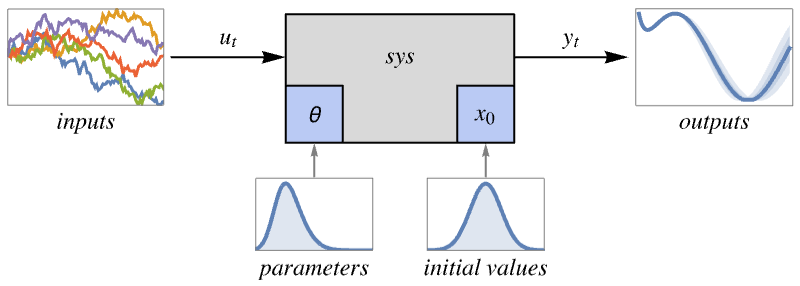
- SystemModelUncertaintyPlot 通常用于可视化系统模型中因参数、初始值或输入的不确定性而导致的关键信号的不确定性. 这允许通过图形方式对不确定性的影响进行验证.
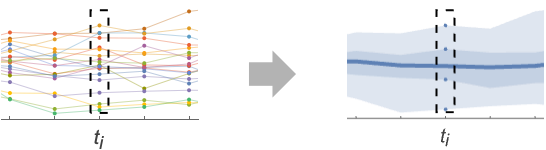
- 在给定不确定的参数、初始值和输入的情况下,系统被模拟了大量次数,并在每个时间点应用切片函数,以计算聚合统计信息. 默认情况下,分位数被用作切片函数.
- 系统模型 sys 可以具有以下形式:
-
SystemModel[…] 一般系统模型 StateSpaceModel[…] 状态空间模型 TransferFunctionModel[…] 传递函数模型 AffineStateSpaceModel[…] 仿射状态空间模型 NonlinearStateSpaceModel[…] 非线性状态空间模型 DiscreteInputOutputModel[…] 离散输入输出模型 - spec 是一个 Association,允许以下键值:
-
"InitialValues" {v1val1,…} 变量 vi 具有初始值 vali "Inputs" {in1fun1,…} 输入 ini 具有值 funi "Outputs" {v1,…} 要绘制的变量 "ParameterValues" {p1val1,…} 参数 pi 具有值 vali "SimulationCount" 200 目标模拟次数 "SimulationInterval" {tmin,tmax} 从时间 tmin 到 tmax 进行模拟并绘制 "SliceFunction" sfun 计算每个时间切片的函数 - 当提供有多个不确定性来源时,执行模拟以涵盖它们的组合,使用目标模拟次数作为上限.
- 在 "ParameterValues" 和 "InitialValues" 中的值 vali 可以采用以下形式:
-
pval 单一值 {pval1,…} 随机抽样的自定义值列表 int 均匀抽样的 Interval 或 CenteredInterval dist 要抽样的 Around 或分布 reg 均匀抽样的区域 - 对于包含 d 个变量的集合,可以使用 {v1,…,vd}vald 设置多维区域和分布 vald.
- "Inputs" 中的输入 funi 可以采用以下形式:
-
f 时刻 t 的单一函数 f[t] {f1,…} 随机抽样的自定义函数列表 rproc 抽样的随机过程 - 对于包含 d 个输入的集合,可以使用 {in1,…,ind}fund 设置矢量值函数和过程 fund.
- 切片函数 sfun 可以采用以下形式:
-
"MinMax" 最小值和最大值 "Quantiles" 百分位数 0%, 25%, 50%, 75%, 100% {"Quantiles",{q1,…}} 百分位数 {q1,…} "Confidence" 均值和 95% 置信区间 {"Confidence",{cl1,…}} 带有置信水平 {cl1,…}的置信区间 {sfun1,…} 自定义标量值函数列表 - SystemModelUncertaintyPlot 具有与 ListLinePlot 相同的选项,并有以下添加和更改: [所有选项的列表]
-
AxesLabel Automatic 在轴上标明单位 Filling Automatic 在每条曲线下插入填充 FrameLabel Automatic 边框标签 Method Automatic 使用哪些模拟和绘图方法 PlotLabel Automatic 图的总体标签 PlotLayout Automatic 如何定位数据 PlotLegends Automatic 曲线的图例 ProgressReporting $ProgressReporting 控制进度的显示 SamplingPeriod Automatic 随机过程的采样周期 TargetUnits Automatic - 在图中显示的单位
- 方法设置采用形式 Method <"sub1"val1,…>.
- 方法子选项 "subi" 包括:
-
"PlotMethod" Automatic 绘图方法 "SimulationMethod" Automatic 模拟方法 - "PlotMethod" 设置与 ListLinePlot 中的 Method 设置相同.
- "SimulationMethod" 设置与 SystemModelSimulate 中的 Method 设置相同.
- SystemModelUncertaintyPlot 在默认的 PlotLayout 中使用输出作为图表标签.
- 使用 PlotLayout "Association",SystemModelUncertaintyPlot 生成一个 Association,其中输出作为键,对应的图表作为每个请求变量的值.
- TargetUnits 的可能设置包括:
-
None 无单位 "Unit" 模型中定义的单位 "DisplayUnit" 显示模型中定义的单位(默认) unit 显式单位 {unitt,unit} 时间和数据的单位 - 仿真设置中含有 "Epoch" 的模型将触发使用 DateScale.
所有选项的列表
范例
打开所有单元 关闭所有单元基本范例 (1)
范围 (24)
模型 (4)
绘制 SystemModel 的两个变量的不确定性:
SystemModelUncertaintyPlot[[image], <|"Outputs" -> {"x", "y"}, "ParameterValues" -> {"theta" -> Interval[{0, π}]}|>, PlotRange -> All]绘制 AffineStateSpaceModel 输出的不确定性:
SystemModelUncertaintyPlot[AffineStateSpaceModel[{{Cos[x2], -1/10*x2 - Cos[x1^2]},
  {{0}, {1}}, {x2}, {{0}}}, {x1, x2}, Automatic,
 {Automatic}, Automatic, SamplingPeriod -> None], <|"InitialValues" -> {x1 -> Interval[{1, 2}]}, "SimulationInterval" -> 3|>]
绘制 NonlinearStateSpaceModel 输出的不确定性:
SystemModelUncertaintyPlot[NonlinearStateSpaceModel[{{Cos[x] + 4*a*Sin[x/2]},
  {x + Sin[x]}}, {x}, {}, {Automatic}, Automatic,
 SamplingPeriod -> None], <|"ParameterValues" -> {a -> Interval[{1, 10}]}|>]
绘制 DiscreteInputOutputModel 输出的不确定性:
diom = DiscreteInputOutputModel[Association["SampledSeries" -> TemporalData[TimeSeries,
    {{{{u[0] + y[-2] + a*y[-1]}, {u[-1] + u[0] + u[1]}}}, {{0, 1, 1}}, 1, {"Discrete", 1},
     {"Discrete", 1}, {1}, {MissingDataMethod -> None, ResamplingMethod -> ... ime", "LastValue", "OutputCount", "OutputVariables", "Path",
  "PathComponent", "PathComponents", "PathFunction", "PathLength", "SamplingPeriod", "StateCount",
  "TemporalData", "TimePath", "Times", "TimeSeries", "TimeValues", "Type", "Values"}];
使用 SquareWave 输入:
SystemModelUncertaintyPlot[diom, <|"ParameterValues" -> {a -> Interval[{0.1, 1}]}, "Inputs" -> {1 -> SquareWave}|>, PlotRange -> All]规范 (4)
SystemModelUncertaintyPlot[[image], <|"Outputs" -> {"x"}, "ParameterValues" -> {"theta" -> Interval[{0, π}]}|>, PlotRange -> All]SystemModelUncertaintyPlot[[image], <|"SimulationCount" -> 5, "Outputs" -> {"x", "y"}, "ParameterValues" -> {"theta" -> Interval[{0, π}]}|>, PlotRange -> All]SystemModelUncertaintyPlot[[image], <|"Outputs" -> {"x"}, "SimulationInterval" -> {0, 3}, "ParameterValues" -> {"theta" -> Interval[{0, π}]}|>, PlotRange -> All]在仿真设置中包含 "Epoch" 的模型,会在一系列日期上绘制其值:
model = SystemModel[[image], <|"ModelName" -> "MyModel", "SimulationSettings" -> {"Epoch" -> Now, "StopTime" -> Quantity[3, "Hours"]}|>]SystemModelUncertaintyPlot[model, <|"Outputs" -> {"room.temperature.T"}, "ParameterValues" -> {"room.roomInertia.C" -> Range[70000, 90000, 5000]}|>]值的不确定性 (5)
SystemModelUncertaintyPlot[[image], <|"Outputs" -> {"x"}, "ParameterValues" -> {"theta" -> Range[0, 1 / 2, 1 / 200]}|>, PlotRange -> All]SystemModelUncertaintyPlot[[image], <|"Outputs" -> {"x"}, "ParameterValues" -> {"theta" -> Interval[{0, 2π}]}|>, PlotRange -> All]SystemModelUncertaintyPlot[[image], <|"Outputs" -> {"x"}, "ParameterValues" -> {"theta" -> NormalDistribution[2, 0.1]}|>, PlotRange -> All]SystemModelUncertaintyPlot[[image], <|"Outputs" -> {"x"}, "ParameterValues" -> {"theta" -> MeshRegion[{{0}, {1}, {2}}, Line[{1, 2, 3}]]}|>, PlotRange -> All]绘制通过对两个初始值进行 Circle 抽样生成的不确定性:
SystemModelUncertaintyPlot[[image], <|"Outputs" -> {"x", "y"}, "InitialValues" -> {{"x", "y"} -> Circle[]}|>, PlotRange -> All]输入的不确定性 (3)
绘制使用 ARIMAProcess 作为输入时生成的不确定性:
SystemModelUncertaintyPlot[[image], <|"SimulationInterval" -> {0, 10}, "Outputs" -> {"syse.sys.rs"}, "Inputs" -> {"T" -> ARIMAProcess[{-.01}, 1, {.01}, 10^-6]}|>, PlotRange -> All, TargetUnits -> "Millimeters"]inputs = Table[With[{k = k}, Function[t, 0.1(k Tanh[t] + 0.1k Sin[0.15t])]], {k, 1, 10}];Plot[Through[inputs[x]], {x, 0, 60}]SystemModelUncertaintyPlot[[image], <|"Inputs" -> {"deltaFJ" -> inputs}|>, PlotRange -> All]SystemModelUncertaintyPlot[\!\(\*GraphicsBox[«8»]\), <|"Outputs" -> {"w"}, "Inputs" -> {{"V", "TL"} -> MAProcess[{{{.2, .1}, {-.1, .2}}}, {{0.001, 0}, {0, 0.001}}]}|>, PlotRange -> All]切片函数 (4)
SystemModelUncertaintyPlot[[image], <|"Outputs" -> {"x"}, "ParameterValues" -> {"theta" -> Interval[{0, 2π}]}, "SliceFunction" -> "MinMax"|>, PlotRange -> All]SystemModelUncertaintyPlot[[image], <|"Outputs" -> {"x"}, "ParameterValues" -> {"theta" -> Interval[{0, 2π}]}, "SliceFunction" -> {"Quantiles", {0, 0.45, 0.5, 0.55, 1}}|>, PlotRange -> All]SystemModelUncertaintyPlot[[image], <|"Outputs" -> {"x"}, "ParameterValues" -> {"theta" -> Interval[{0, 2π}]}, "SliceFunction" -> {"Confidence", {0.95, 0.98, 0.99}}|>, PlotRange -> All]SystemModelUncertaintyPlot[[image], <|"Outputs" -> {"x"}, "ParameterValues" -> {"theta" -> Interval[{0, 2π}]}, "SliceFunction" -> {Mean[#] - StandardDeviation[#]&, Mean, Mean[#] + StandardDeviation[#]&}|>, PlotRange -> All, PlotLegends -> {μ - σ, μ, μ + σ}]数据封装 (4)
SystemModelUncertaintyPlot[[image], <|"Outputs" -> Style["x", StandardRed], "ParameterValues" -> {"theta" -> Interval[{0, 2π}]}|>]对 "Shared" PlotLayout 中的几个变量使用封装:
SystemModelUncertaintyPlot[[image], <|"Outputs" -> {Style["vx", StandardRed], Style["y", StandardOrange]}, "ParameterValues" -> {"theta" -> Interval[{0, 2π}]}|>, PlotLayout -> "Shared"]SystemModelUncertaintyPlot[[image], <|"Outputs" -> Labeled[Style["x", StandardRed], "position", Below], "ParameterValues" -> {"theta" -> Interval[{0, 2π}]}|>]对 "Shared" PlotLayout 中的几个变量使用封装:
SystemModelUncertaintyPlot[[image], <|"Outputs" -> {Callout[Style["vx", StandardRed], "velocity", Above], Callout[Style["y", StandardOrange], "position", Below]}, "ParameterValues" -> {"theta" -> Interval[{0, 2π}]}|>, PlotLayout -> "Shared"]添加 Tooltip:
SystemModelUncertaintyPlot[[image], <|"Outputs" -> Tooltip["x", "position"], "ParameterValues" -> {"theta" -> Interval[{0, 2π}]}|>]SystemModelUncertaintyPlot[[image], <|"Outputs" -> Legended["x", "position"], "ParameterValues" -> {"theta" -> Interval[{0, 2π}]}|>]自定义 "Shared" PlotLayout 中几个变量的图例:
SystemModelUncertaintyPlot[[image], <|"Outputs" -> {Legended["vx", "velocity"], Legended["y", "position"]}, "ParameterValues" -> {"theta" -> Interval[{0, 2π}]}|>, PlotLayout -> "Shared"]选项 (17)
AxesLabel (2)
在默认的 PlotLayout 中,AxesLabel 默认设置为 None:
SystemModelUncertaintyPlot[[image], <|"Outputs" -> {"x"}, "ParameterValues" -> {"theta" -> Interval[{0, 2π}]}|>, PlotRange -> All, Frame -> False, Axes -> True]SystemModelUncertaintyPlot[[image], <|"Outputs" -> {"x"}, "ParameterValues" -> {"theta" -> Interval[{0, 2π}]}|>, PlotRange -> All, AxesLabel -> {"time", "position"}, Frame -> False, Axes -> True]Filling (2)
已知的切片函数默认使用自定义 Filling:
SystemModelUncertaintyPlot[[image], <|"Outputs" -> {"x"}, "ParameterValues" -> {"theta" -> Interval[{0, 2π}]}|>, PlotRange -> All]SystemModelUncertaintyPlot[[image], <|"Outputs" -> {"x"}, "ParameterValues" -> {"theta" -> Interval[{0, 2π}]}|>, PlotRange -> All, Filling -> {1 -> {5}}]FrameLabel (2)
默认情况下,绘制变量的单位被用作 FrameLabel:
SystemModelUncertaintyPlot[[image], <|"Outputs" -> {"x"}, "ParameterValues" -> {"theta" -> Interval[{0, 2π}]}|>, PlotRange -> All]SystemModelUncertaintyPlot[[image], <|"Outputs" -> {"x"}, "ParameterValues" -> {"theta" -> Interval[{0, 2π}]}|>, FrameLabel -> {"time", "position"}, PlotRange -> All]Method (1)
使用 Method 设置自定义的模拟方法:
SystemModelUncertaintyPlot[[image], <|"Outputs" -> {"x"}, "ParameterValues" -> {"theta" -> Interval[{0, 2π}]}|>, Method -> <|"SimulationMethod" -> {"InterpolationPoints" -> 10}|>, PlotRange -> All]PlotLabel (1)
PlotLayout (2)
获取与每个输出的单独图的 Association:
SystemModelUncertaintyPlot[[image], <|"Outputs" -> {"x", "vy"}, "ParameterValues" -> {"theta" -> Interval[{0, 2π}]}|>, PlotRange -> All, PlotLayout -> "Association"]SystemModelUncertaintyPlot[[image], <|"Outputs" -> {"x", "vy"}, "ParameterValues" -> {"theta" -> Interval[{0, 2π}]}|>, PlotRange -> All, PlotLayout -> "Shared"]PlotLegends (2)
已知的切片函数默认使用自定义的 PlotLegends:
SystemModelUncertaintyPlot[[image], <|"Outputs" -> {"x"}, "ParameterValues" -> {"theta" -> Interval[{0, 2π}]}, "SliceFunction" -> {"Quantiles", {0, 0.45, 0.5, 0.55, 1}}|>, PlotRange -> All]SystemModelUncertaintyPlot[[image], <|"Outputs" -> {"x"}, "ParameterValues" -> {"theta" -> Interval[{0, 2π}]}, "SliceFunction" -> {"Quantiles", {0, 0.45, 0.5, 0.55, 1}}|>, PlotLegends -> {None, None, "Median", None, None}]ProgressReporting (1)
使用 ProgressReporting 控制进度报告:
SystemModelUncertaintyPlot[[image], <|"Outputs" -> {"x"}, "ParameterValues" -> {"theta" -> Interval[{0, 2π}]}|>, PlotRange -> All, ProgressReporting -> False]SamplingPeriod (1)
ScalingFunctions (2)
用 ScalingFunctions 绘制对数刻度的模型:
SystemModelUncertaintyPlot[AffineStateSpaceModel[{{x1, 2*x1}, {{}}},
 {{x1, 1}, {x2, 1}}], <|"Outputs" -> {x1, x2}, "InitialValues" -> {x1 -> {1, 10, 100, 1000}}|>, ScalingFunctions -> "Log"]
在仿真设置中包含 "Epoch" 的模型将按日期序列上的值进行绘制:
model = SystemModel[[image], <|"ModelName" -> "MyModel", "SimulationSettings" -> {"Epoch" -> Now}|>]SystemModelUncertaintyPlot[model, <|"Outputs" -> {"H"}, "ParameterValues" -> {"k" -> Range[100, 130, 5]}|>]用 ScalingFunctions{None,Automatic} 生成仿真时间图:
SystemModelUncertaintyPlot[model, <|"Outputs" -> {"H"}, "ParameterValues" -> {"k" -> Range[100, 130, 5]}|>, ScalingFunctions -> {None, Automatic}, TargetUnits -> {"Years", Automatic}]用 DateTicksFormat 格式化日期刻度标签:
SystemModelUncertaintyPlot[model, <|"Outputs" -> {"H"}, "ParameterValues" -> {"k" -> Range[100, 130, 5]}|>, ScalingFunctions -> {DateScale[DateTicksFormat -> "YearShort"], Automatic}]TargetUnits (1)
使用 TargetUnits 设置自定义单位:
SystemModelUncertaintyPlot[[image], <|"Outputs" -> {"x"}, "ParameterValues" -> {"theta" -> Interval[{0, 2π}]}|>, PlotRange -> All, TargetUnits -> {"Seconds", "Decimeters"}]应用 (6)
平衡附近的轨迹 (1)
绘制简单阻尼摆在初始条件接近平衡点时角度和角速度的不确定性:
model = CreateSystemModel["DampedPendulum", {ω'[t] == -g Sin[θ[t]] / l - b ω[t], θ'[t] == ω[t]}, t, {θ∈"Units.SI.Angle"}, <|"ParameterValues" -> {g -> 10, l -> 1 / 2, b -> 2}|>]SystemModelUncertaintyPlot[model, <|"SimulationInterval" -> 5, "Outputs" -> θ, "InitialValues" -> {θ -> CenteredInterval[0, π / 4]}|>, ...]当系统在接近不稳定的完全倒立位置启动时,它同样会向地面位置演化:
SystemModelUncertaintyPlot[model, <|"SimulationInterval" -> 5, "Outputs" -> θ, "InitialValues" -> {θ -> Interval[{3π / 4, π - π / 100}]}|>, ...]SystemModelUncertaintyPlot[model, <|"SimulationInterval" -> 5, "Outputs" -> θ, "InitialValues" -> {θ -> Interval[{3π / 4, π - π / 100}]}, "SliceFunction" -> Table[With[{k = k}, Part[#, k]&], {k, RandomSample[Range[200], 20]}]|>, ...]系统容差 (1)
电路性能在很大程度上取决于其组件和参数的容差. 当该扬声器模型中一个组件的电阻遵循截断正态分布时,通过扬声器的电流变化是可以测量的:
SystemModelUncertaintyPlot[[image], <|"Outputs" -> "speaker.l.i", "SimulationInterval" -> Quantity[40, "Milliseconds"], "ParameterValues" -> {"r1.R" -> TruncatedDistribution[{0, ∞}, NormalDistribution[6, 5]]}|>]外部干扰也会影响电路的性能. 例如,扬声器的输入电压可能受到高频信号的影响:
inputs = Table[With[{k = k}, Function[{t}, 2.5Sin[2 π t 50] + k Sin[2 π t 2000]]], {k, 0, 0.6, 0.05}];Plot[Through[inputs[t]], {t, 0, 0.01}]SystemModelUncertaintyPlot[[image], <|"Outputs" -> "speaker.l.i", "SimulationInterval" -> Quantity[10, "Milliseconds"], "Inputs" -> {"vi" -> inputs}|>, TargetUnits -> {"Milliseconds", "Milliamperes"}]受控系统的验证 (1)
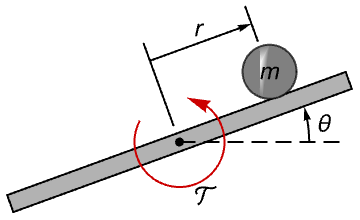
model = [image];spec = <|"SimulationInterval" -> {0, 1.2}, "InitialValues" -> {"syse.sys.ballAndBeamDynamics.rs" -> Interval[{0, 0.15}]}|>;SystemModelUncertaintyPlot[model, Append[spec, "Outputs" -> {"syse.sys.ballAndBeamDynamics.rs"}], PlotRange -> All, PlotLabel -> "r"]控制力在开始时达到峰值,然后又有几次峰值,以阻止球超过稳定位置:
SystemModelUncertaintyPlot[model, Append[spec, "Outputs" -> {"syse.sys.T"}], PlotRange -> All, PlotLabel -> "Control effort"]受控系统还应该针对外部干扰进行验证. 用白噪声扭矩扰动对受控球杆系统施加应力,并绘制系统在不同噪声采样周期下的控制力度:
SystemModelUncertaintyPlot[model, <|"SimulationInterval" -> {0, 1.2}, "Outputs" -> {"syse.sys.T"}, "Inputs" -> {"T" -> WhiteNoiseProcess[0.1]}|>, SamplingPeriod -> 0.3, PlotRange -> All, PlotLabel -> "Control effort"]轨道调整 (1)
model = ConnectSystemModelComponents["BoostModel", {"orbit"∈"Control.CircularOrbit", "zero"∈"Blocks.Sources.Constant", "boost"∈"Blocks.Sources.Pulse"}, {"orbit.fr""zero.y", "orbit.fphi""boost.y"}, IconizedObject[«model settings»]]sim = SystemModelSimulate[model, {"orbit.x", "orbit.y"}, Quantity[8, "Hours"], <|"ParameterValues" -> {"boost.amplitude" -> {0, 600, 700, 800, 900, 1000}}|>];SystemModelPlot[sim, PlotLegends -> None, Axes -> False, Frame -> True]如果助推幅度遵循正态分布,则可以展开有界或无界轨迹. 绘制到力心距离的不确定性:
SystemModelUncertaintyPlot[model, <|"Outputs" -> {"orbit.r"}, "ParameterValues" -> {"boost.amplitude" -> NormalDistribution[600, 100]}|>]供暖系统中的过冲 (1)
从一个加热系统模型开始,该模型中的热流会在仿真中途切换方向:
model = \!\(\*GraphicsBox[«8»]\);pipe9T = <|"Outputs" -> "pipe9.mediums[1].T", "SimulationInterval" -> 100|>;uncertainty = <|"ParameterValues" -> {"pipe8.diameter" -> Interval[{0.012, 0.055}]}|>;绘制管道温度相对于管道直径的不确定性,并观察其对过冲的影响:
SystemModelUncertaintyPlot[model, Join[pipe9T, uncertainty], PlotRange -> {Automatic, {18, 50}}, PlotLabel -> "Temperature overshoot"]pipes89T = <|"Outputs" -> {"pipe9.mediums[1].T", "pipe8.mediums[1].T"}, "SimulationInterval" -> 100|>;SystemModelUncertaintyPlot[model, Join[pipes89T, uncertainty], PlotRange -> All, PlotLayout -> "Shared", PlotLabel -> "Temperature overshoots"]机器人的控制设计 (1)
从一个机器人模型开始,该机器人执行一个时间受限的运动,承载 300 公斤的载荷,目标旋转角度为 60°:
model = SystemModel[\!\(\*GraphicsBox[«8»]\), <|"ParameterValues" -> {"mLoad" -> 300}, "ModelName" -> "IndustrialRobot"|>];angle = <|"Outputs" -> "mechanics.r1.angle", "SimulationInterval" -> 1.856, "InterpolationPoints" -> 500|>;uncertainty = <|"ParameterValues" -> {"kp1" -> Interval[{1, 30}]}|>;绘制旋转角度相对于控制器增益的不确定性,并查看仿真结束时对目标角度的影响:
SystemModelUncertaintyPlot[model, Join[angle, uncertainty], PlotRange -> {{1.2, 1.85}, {50, 65}}, PlotLabel -> "Rotation angle", GridLines -> {{}, {60}}]属性和关系 (2)
使用 SystemModelPlot 绘制各个曲线:
model = \!\(\*GraphicsBox[«8»]\);SystemModelPlot[model, {"Inertia2.w"}, <|"ParameterValues" -> {"Inertia2.J" -> 2}|>]使用 SystemModelPlot 在进行参数扫描时绘制各个曲线:
SystemModelPlot[model, {"Inertia2.w"}, <|"ParameterValues" -> {"Inertia2.J" -> {1, 2, 3}}|>]使用 SystemModelPlot 绘制由 SystemModelSimulateSensitivity 计算得到的灵敏度带:
sim = SystemModelSimulateSensitivity[model, 10, {"Inertia2.J"}, <|"ParameterValues" -> {"Inertia2.J" -> 2}|>]SystemModelPlot[sim, {{"Inertia2.w", "Inertia2.J", 0.5}}]使用 SystemModelUncertaintyPlot 绘制不确定性:
SystemModelUncertaintyPlot[model, <|"Outputs" -> "Inertia2.w", "ParameterValues" -> {"Inertia2.J" -> CenteredInterval[{{1, 1, 536870912, -29}, 63}]}|>]Interval 和 CenteredInterval 作为区域被抽样:
model = \!\(\*GraphicsBox[«8»]\);SystemModelUncertaintyPlot[model, <|"Outputs" -> "Inertia2.w", "ParameterValues" -> {"Inertia2.J" -> CenteredInterval[{{1, 1, 858993460, -33}, 66}]}|>]Around 和 VectorAround 作为其对应的分布被抽样:
SystemModelUncertaintyPlot[model, <|"Outputs" -> "Inertia2.w", "ParameterValues" -> {"Inertia2.J" -> Around[2., 0.1]}|>]相关链接

 Wolfram System Modeler 相关文档
文本
Wolfram Research (2024),SystemModelUncertaintyPlot,Wolfram 语言函数,https://reference.wolfram.com/language/ref/SystemModelUncertaintyPlot.html.
CMS
Wolfram 语言. 2024. "SystemModelUncertaintyPlot." Wolfram 语言与系统参考资料中心. Wolfram Research. https://reference.wolfram.com/language/ref/SystemModelUncertaintyPlot.html.
APA
Wolfram 语言. (2024). SystemModelUncertaintyPlot. Wolfram 语言与系统参考资料中心. 追溯自 https://reference.wolfram.com/language/ref/SystemModelUncertaintyPlot.html 年